

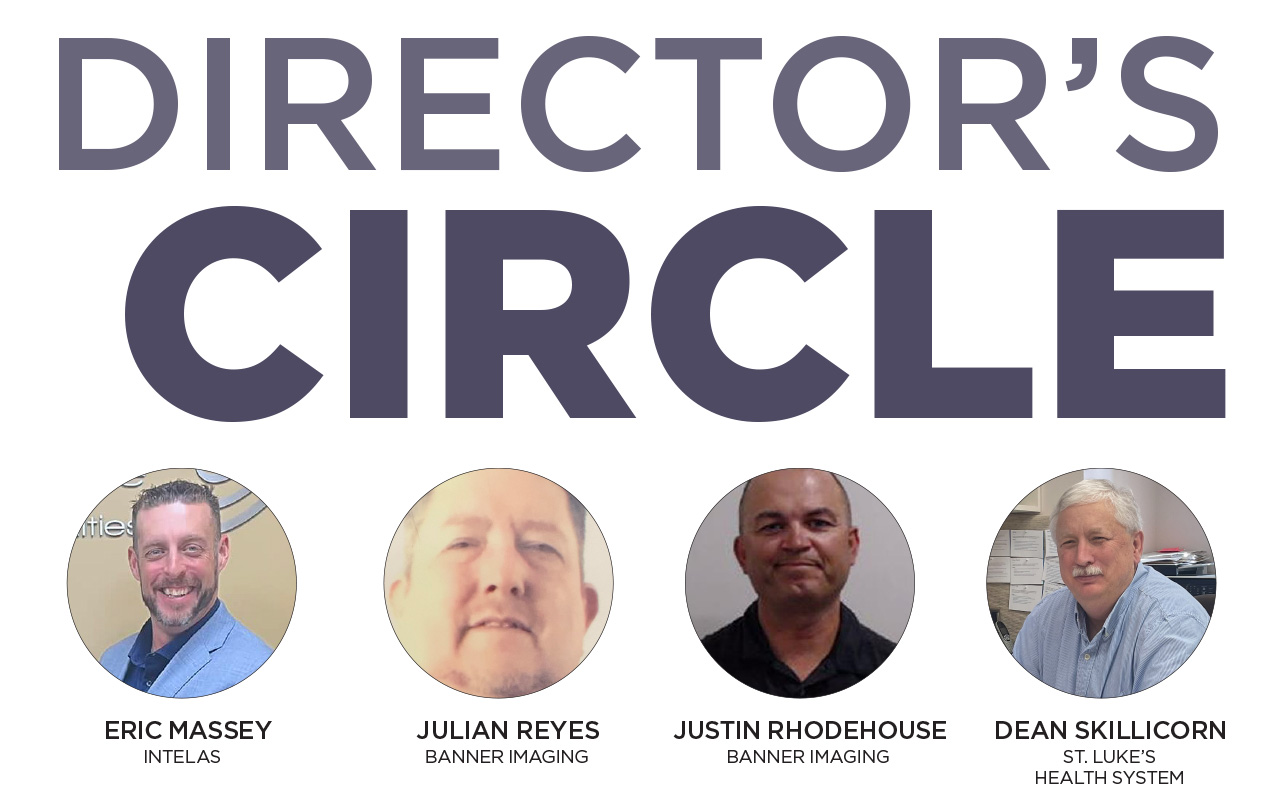
In this issue of ICE Magazine, experts share insights and tips regarding imaging parts. ICE Magazine invited several imaging service directors to participate and share their imaging parts knowledge with readers. Participants in this month’s director’s circle article are:
- Intelas Regional Director of Operations Eric Massey;
- Banner Imaging Director of Imaging Service Julian Reyes teamed up with Banner/Entech Associate Director Diagnostic Imaging Justin Rhodehouse; and
- St. Luke’s Health System Manager, HTM, Medical Imaging Services Dean Skillicorn.
Q: What are the most pressing concerns regarding parts for the service of imaging devices?
MASSEY: Parts arriving dead on arrival (DOA) remains one of our top concerns. A DOA part means extended system downtime, delayed patient care and significant financial impact for the hospital.
REYES/RHODEHOUSE: The most pressing concerns regarding parts is availability and reliability. With capital constraints in today’s healthcare environment, we have to keep our equipment in top shape as long as it is reasonable. Once a unit becomes end of service life, parts become increasingly harder to come by. The concern over reliability has always been an issue. Parts get refurbished which in turn degrades the parts reliability over time.
SKILLICORN: Availability of parts for EOS devices in the after-market setting. Hospital systems are now making choices about extending life to defer capital costs where needed. This is a difficult process for most as most institutions do not project capital budgets past 2-3 years. This trend is changing as large institutions are finding value in planning replacement of systems 5-10 years in advance and trying to understand where systems will be placed in future plans for their organizations.
Q: How does your facility obtain parts for imaging devices?
MASSEY: We source parts through both OEM and third-party providers. For newer systems where third-party inventory is limited, we rely more heavily on OEMs. Older systems are more flexible with third-party options.
REYES/RHODEHOUSE: Our facility obtains parts using multiple providers. We use OEM and third-party companies to source our parts. Where we get them from could be determined by contracts, price and availability. We also use companies that can repair the part for you. There is a lead time to complete repair since you have to the ship part to them, but they offer very competitive pricing compared to purchasing outright.
SKILLICORN: We utilize the OEM in several cases for shared services type agreements. In cases where we are not contractually obligated to do so or in the case of EOS systems, we use a multitude of third-party vendors to purchase parts as necessary.
Q: What should a facility look for in a parts provider?
MASSEY: Prioritize quality and process integrity. Visit the provider’s facility, observe their harvesting and shipping processes, and confirm that they use proper electrostatic discharge (ESD) protection from start to finish. Poor ESD protocols are a leading cause of DOA parts. Also train your own staff – if technicians don’t use ESD straps properly, even a single touch can destroy a board.
REYES/RHODEHOUSE: The main things our facility looks for in a part provider are price, can they delivery on time, and do they offer any warranty on their parts. We have found that third parties are obtaining more stock on older parts to stay competitive while offering warranties on their parts.
SKILLICORN: Great question. Outside of our shared services agreements, we look for pricing, discounting and availability. Quick ordering processes are very attractive to us.
Q: What tips and advice can you share for others to implement regarding parts for imaging devices?
MASSEY: Partner with vendors who have proven ESD and testing procedures. Implement strong ESD protocols internally as well. Also consider forward stocking high-failure parts to minimize downtime.
REYES/RHODEHOUSE: One tip of advice I could offer regarding parts for imaging devices is there is always a thought that when a part gets replaced it will be brand new. In most cases the parts being installed will be refurbished and tested before sent out to an imaging location. Price on a new part versus a refurbished part can be drastically different. Sometimes your only option is the part in stock which may be new or may be refurbished.
SKILLICORN: Research, research and research. Have these organizations present to you what they can do. Many have additional services that can be very helpful.
Q: What else would you like to share with ICE Magazine readers regarding parts for imaging devices?
MASSEY: In imaging, quality should always outweigh price. Choosing the cheapest part provider often leads to repeat failures and higher total costs. Do your research, verify their processes and stay loyal to those who deliver consistently.
REYES/RHODEHOUSE: The last thing I could share regarding parts for imaging devices is parts come in many different varieties depending on the modality and age of equipment. You will find parts involving electronics, mechanical devices, hydraulics and pneumatics. They can range in all different sizes and weights. Some parts after being installed will require calibrations to complete repair. My advice would to be keep your options open when searching for parts depending on your patient needs.
SKILLICORN: When comparing parts purchases, be sure that you are providing the correct version level of the parts. This is critical as most parts have multiple version levels. Getting the correct part quickly is key in servicing imaging equipment in a safe manner and being effective.