

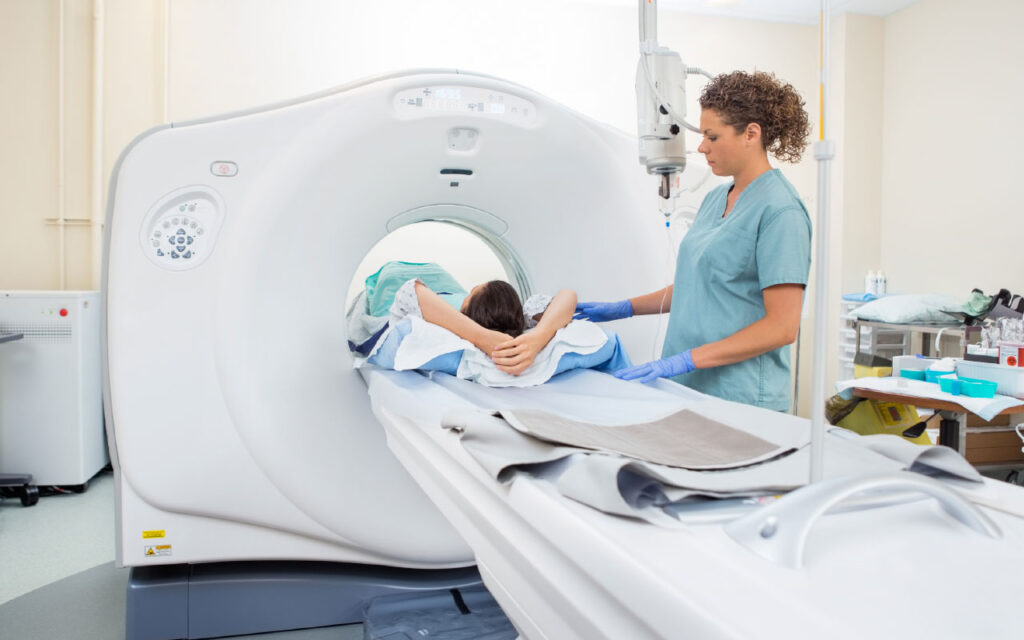
 ICE Magazine gathered insights from radiology directors and imaging leaders for a roundtable article focused on the patient experience in imaging. Insiders were able to share their thoughts regarding patient experience to highlight strategies, successes and challenges across the industry.
Participants include:
- AdventHealth Executive Director of Retail Services Health Parks Joel George, MBA, MSN, RN;
- Children’s Hospital Los Angeles Executive Director of Imaging Mario Pistilli, DBA, FACHE, FAHRA, CRA, CNMT.
- Emory Healthcare Radiology Program Director, Patient Experience Jamie Dennis, MHA, CRA, RT. (R)(CT);
- Lexington Medical Center Director of Imaging Services Wesley Harden, CRA, FAHRA

Q: How does your department currently approach improving the patient experience? Do you have specific programs, initiatives or best practices in place?
Dennis: Yes, we have a dedicated committee that focuses on radiology patient experience and service training for the staff. We started the committee last year and have seen improvements with our patient experience scores over the last year. The committee has team members from each of our hospitals and every modality is represented. We provide “passport THANK YOU cards” to our patients after their visit. The cards serve as a good reminder for who took care of them during their visit along with other information, such as how to obtain their images. My role has recently changed into a radiology program director focusing on patient experience, as this is such a large focus within our organization.
George: In our AdventHealth Health Parks, patient experience is embedded into the strategy and daily operations of care delivery. Rather than viewing it as a standalone initiative, we draw on proven practices from consumer-obsessed and hospitality-driven brands to shape the way patients access and engage with care. Our Health Parks model integrates multiple services under one roof primary care, imaging, labs, sports medicine rehab, and specialty care creating a seamless “one-stop” patient journey. We utilize consumer journey mapping to identify friction points and design purposeful moments of ease and delight, ensuring patient flow and team connectivity are both optimized. We have also implemented hospitality training for frontline teams, emphasizing anticipatory service, personalized welcomes and thoughtful farewells. These practices are operationalized through centralized check-in systems, coordinated workflows and consistent measurement of patient satisfaction. The result has been stronger loyalty, high team engagement and growth fueled by organic reviews and referrals to prove that patient experience, when embedded into operations, becomes a sustainable advantage.
Harden: We focus on communication, compassion and care. We want to make sure we are letting the patient know what is going on, how long it will take and then give them the chance to ask questions and be engaged in their care. Our teams really do a great job of providing that compassionate care and making sure we are doing all we can to make the experience a positive one.
Pistilli: We use Press Ganey to administer a patient satisfaction survey and track and trend results. Based on the results, we choose one question to focus on improving for the year based on its score and correlation to overall satisfaction. Once chosen, the leadership team and staff brainstorm ideas on action that might improve that particular aspect of patient experience. So, the initiatives in place change yearly in terms of focus but the action items, if they work, we keep.
Q: How do you measure patient experience in your department? What metrics or stories have been most impactful in showing improvement?
Dennis: We use Press Ganey, a national survey group. We have held classes over the last year focusing on training radiology leadership on how to interrupt the scores, and how to interrupt comments and best practices to share with team members. We have also held dedicated meetings with modality teams providing feedback based on patients’ comments and partnering with the modality to see how we can best solve some of the recurring issues. We report out scores weekly for what has been accumulated during the month to-date and if the score has gone up or down from the prior month.
George: We take a dual-lens approach to measuring patient experience combining traditional industry benchmarks with real-time consumer feedback.
Surveys: We utilize validated tools such as Press Ganey and Forsta surveys to track likelihood-to-recommend, provider communication, care coordination and overall satisfaction. These standardized measures allow us to benchmark against national performance and ensure we are meeting clinical and service quality expectations.
Likelihood to Recommend: Among these metrics, likelihood to recommend (LTR) has been especially impactful. It not only reflects satisfaction with a single encounter but also signals the patient’s confidence in making us their long-term healthcare partner.
Google Reviews: Equally important, we place a strong emphasis on organic Google reviews. In today’s consumer-driven healthcare environment, these reviews serve as a public trust score and the most visible reflection of the patient experience. We actively monitor and respond to reviews, learning from both praise and constructive feedback. The consistency of our 4.8+ star ratings across multiple Health Park locations with over 5,000 organic reviews is a direct validation that hospitality-driven practices resonate with patients and their families.
Harden: We use Press Ganey surveys to measure how we are doing and focus on the voice of the customer. Whether positive or negative, we want to hear how we are doing so we can be sure our efforts are focused in the right place. It is always nice to hear positive comments as it lets us know what we are doing well. The negative comments we view as opportunities to make adjustments to improve.
Pistilli: By survey and data tracking.
Q: How does improving patient experience benefit staff, the department and the larger health system?
Dennis: Improving the overall patient experience has a direct impact on the overall employee experience, in a positive way. Typically, the patients help us to identify problems or gaps based on their comments. By fixing some of those issues, it usually helps resolve an issue the staff might have been experiencing as well. Sometimes I think the patients’ voice is louder than the staff’s voice for bringing up concerns. We don’t know what to fix unless the concern is raised.
George: Improving patient experience is not just about the patient, it transforms the entire care environment. For staff, a well-designed experience reduces friction, improves workflows and fosters pride in their work. When teams see patients leaving happier, more at ease and more connected, it directly fuels engagement, lowers burnout and reinforces the “why” behind their calling in healthcare. A culture of hospitality-driven service gives staff the tools and permission to go beyond tasks and focus on meaningful human connection. For the larger healthcare system, improved patient experience has strategic impact. Positive encounters build loyalty, increase likelihood-to-recommend and strengthen brand reputation. Seamless care journeys keep referrals in-network, improve retention and support financial stewardship by maximizing utilization of services within the system.
Harden: Let me just state the obvious first. People want to go back to places where they had a good experience. They also want to tell their friends about the good experience they had but will also tell about the bad ones too. Probably more so. So yes, improving the patient experience does have an element of that to it. However, the real benefit in finding ways to improve the patient experience is in knowing you are doing the best you can to ensure that patient has the best outcome. There is a sense of pride in knowing the efforts you are putting in make a difference in not just the patient but their family’s lives as well.
Pistilli: It benefits staff as our staff is very mission driven and they truly want our patients to have the best experience possible. When we get validation of that from our patients through the satisfaction survey then the team feels good that our patients are well cared for. The department benefits as we can put our whole focus on the patient care that needs to happen and not into service recovery. The institution benefits through driving trust, customer loyalty and good word of mouth.
Q: What are the biggest challenges your department faces in improving patient experience? How are you working to overcome these challenges?
Dennis: We have some locations in our healthcare system that are hospital based and those locations see a mixture of patients: inpatients, emergency room and outpatients. These areas tend to see more challenges with improving patient experience for outpatients. There might be a patient scheduled but if an emergent patient comes through the emergency department, they could get delayed, causing dissatisfaction with the patient experience. This certainly limits our ability to stay on a specific schedule depending on the location. The staff do a great job of communicating with the patients if there is a delay and outpatient appointments are limited at some location schedules based on ED trends for volume. To mitigate the limited schedule at some of our hospital settings, we have extended our evening hours and are offering weekend hours at most of our outpatient locations. This increases our appointment availability and allows more convenient times for our patients to receive their imaging.
George: Integrating imaging into a one-stop shop care model creates tremendous value for patients, but it also comes with unique challenges:
Capacity & Scheduling Balance: Imaging demand is highly variable. Managing capacity to serve same-day walk-ins, urgent add-ons from primary care, and scheduled specialty orders all under one roof requires sophisticated scheduling systems and flexible staffing models.
Technology & Space Optimization: Imaging equipment requires significant square footage, shielding and infrastructure. In a multi-specialty setting, the challenge is balancing high-tech imaging suites with the need for exam rooms, rehab space, and other services, while still creating a seamless flow for patients.
Workforce & Training: Recruiting and retaining technologists who are not only clinically excellent but also hospitality-trained is essential. Ensuring consistent service standards across modalities (MRI, CT, ultrasound, X-ray) can be complex.
Consumer Expectations: Patients increasingly expect quick access, comfortable environments and transparent communication of results. Meeting those expectations while balancing safety, quality and throughput is an ongoing challenge.
Harden: I think one of the biggest challenges we face is the ever-increasing volumes combined with the staffing shortages that make it really challenging for frontline staff to maintain the personal experience sometimes. No matter how much we talk about taking time to ensure the patient in front of you feels like they are the only one, it is really tough to put aside the thought of those you know are waiting. We are trying to be creative in finding ways to address the staffing shortage and are making progress, but these can take time to realize. Working with schools to accept more students and creating pathways for progression to advanced modalities quicker are a couple of initiatives we have started. There are others, but the real focus has to be on the staff we have now and how we can help them get through those busy times. Our staff are phenomenal and have done an excellent job, but we try to make sure they know how much they are appreciated. Food is always a good pick me up!
Pistilli: I think many places are challenged as we are with time, staffing and complexity. There is lots of communication that needs to happen from scheduling an appointment to finally walking that patient out the door and a break in communication anywhere in that chain can sour the patient experience. We are working to overcome this through including the entire team in the patient experience process. We also reinforce that every team member is responsible for that patient’s experience regardless of their role so trying to minimize the “that’s not my patient” attitude or “that’s not my job.” We also reinforce to focus on the patient in front of you not how many more there are – you can only image one patient at a time so be present in the moment and focus on doing your best in that moment – easy to say and hard to do.
Q: What role does equipment, scheduling software, AI or the physical environment of your department play in shaping patient experience?
Dennis: The physical environment plays a big role in our patient experience for a lot of our locations and based on what the patient’s expectations might be. Our locations for imaging are throughout all of the Atlanta area, known for heavy traffic all the time. Each location is different and has a different layout, thus it can be a little difficult finding the radiology department. This is a constant struggle for all our locations. We have been working with the operating units based on the patient’s comments on ways to improve the wayfinding capabilities for our patients. The system did launch a new wayfinding app that provides a “yellow brick road” to exactly where one wants to go, it is now a matter of making sure everyone knows about it.
George: Technology and design are as critical to patient experience as the care itself. In imaging and one-stop shop models, they play distinct but interconnected roles. Intelligent scheduling platforms help balance demand between walk-ins, urgent add-ons and pre-booked appointments. AI-powered tools can predict peak times, optimize equipment utilization and minimize downtime – all of which translate into reduced wait times and greater convenience for patients. The built environment is a silent driver of experience. In my prior role as regional director of imaging, I was blessed to be able to integrate calming themes and tools like MRI video goggles to reduce anxiety and improve patient comfort. At the same time, thoughtful placement of equipment within a Health Park supports efficient patient flow, minimizes bottlenecks, and keeps the experience intuitive and stress-free.
Harden: I think the physical environment can play a role in the patient experience. We get many comments about how clean the facility looks and the grounds. We also see lots of comments about the comfort of the waiting room. These are always challenging as what is just fine for one person may not meet the standards of another. So, we try to focus on cleanliness and making sure the patient is not spending too much time there. Also, making sure they are kept informed of delays does help when they do have to wait. Scheduling can also impact the patient experience. If they have to hold for long periods of time or no one answers the phone this can frustrate patients. We have put efforts into allowing electronic communications about scheduling and I see a real opportunity to use AI and other scheduling tools to make improvements on this process.
Pistilli: All of those play huge roles in the patient experience. The easier we make every step of the process then the more satisfied our patients will be. AI and software will increasingly allow us the ability to communicate better and in real time and allow processes to be streamlined.
Q: What else should ICE Magazine readers know regarding this topic?
George: The vision for hospitality embedding in healthcare is that it should be as intuitive and seamless as the best consumer experiences we see in consumer-obsessed hospitality brands even outside of healthcare such as high-end hotels or restaurants. AdventHealth is an incredible organization that makes consumers feel whole and welcome through our service standards that drive patient experience. A one-stop shop model is not simply about convenience it is about reimagining care delivery so that patients feel known, supported and cared for across their entire journey.
Harden: I think it is important for imaging leaders to share their experiences and ideas around this topic as the more information that is out there the better we all can become. By sharing what you have done may help another leader find an answer to a problem they were struggling with. Together we are stronger.
Pistilli: I think ICE readers should know that giving a great patient experience is still possible even in staff constrained, stressful, busy environments. It takes the entire team coming together and being willing to support each other to make it happen.