

By Matt Skoufalos
 As a biomed specializing in medical imaging equipment for Intelas Healthcare of San Antonio, Texas, Richard Adrian Rodriquez travels across the country, performing on-site preventive maintenance, corrective maintenance and administrative work as part of a national field service team.
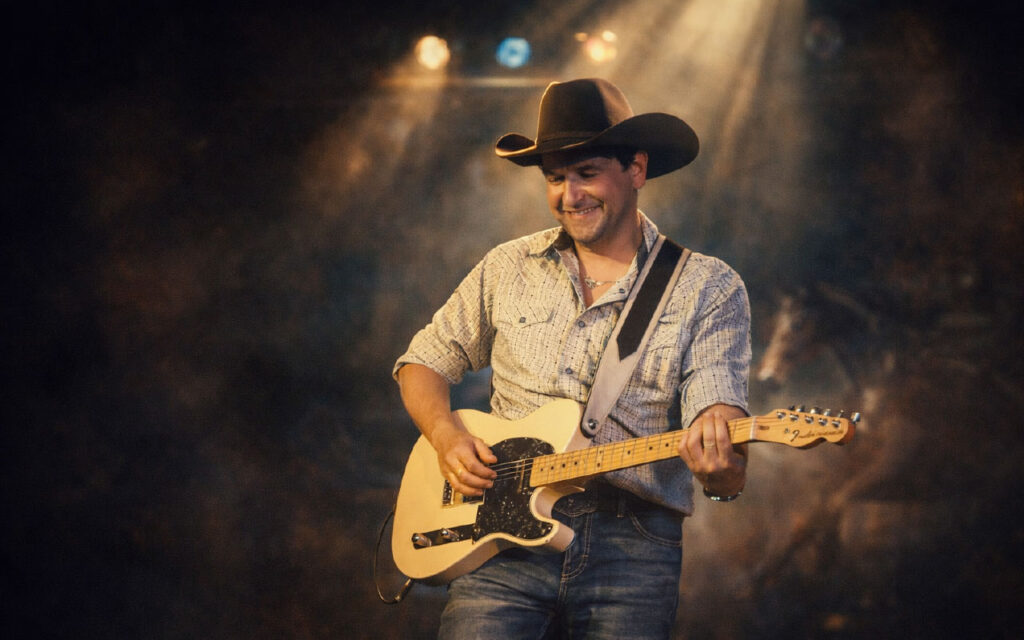
But for the better part of three decades, Adrian traveled across the world, performing Tejano and country music for fans in far-flung regions of the globe, recording Grammy-nominated albums, and rubbing elbows with some of the best players in the industry.
His interest in biomedical work developed partly from a love of tearing down electronic devices and repairing them, a skill he developed early in high school. He also remembers visiting his mother at the hospital where she worked, and her pointing out the professional who came in to repair the equipment. “‘Isn’t that interesting?’ she said, and it was,” Adrian recalled. “I always wanted to be a musician, and they supported me in that, but they told me to have a backup skill.”
A childhood of tearing apart and reassembling electronics led Adrian to earn an associate’s degree in electronics after high school. But a childhood of absorbing and replaying guitar-driven rock from bands like AC/DC, Van Halen, Rush and Journey led to a career as a hired-gun guitarist.
Despite having an arena-rock soul, “there weren’t any cover bands making money in the clubs” with that repertoire by the time Adrian started playing gigs. However, in the late 1980s and early 1990s, the mainstream explosion of country music brought artists like Garth Brooks, Alan Jackson, Travis Tritt, and Brooks and Dunn into the popular consciousness. As radio stations and clubs adapted their formats to accommodate that interest, he learned new tunes to pick up work.

“More country bands started calling me,” Adrian said. “They were paying, and they were busy, so I started playing more, and traveling regionally.”
By 1995, he was playing five nights a week in the house band at a nightclub in Lubbock, Texas, where Tejano singer Shelly Lares regularly toured with her band. After a few times through, they became friendly enough with Rodriquez that when Lares began to lean more into country music, “they needed a picker and thought of me,” he said.
“I came to San Antonio for an audition and I was in,” Adrian said.
A radio rocker turned country, Adrian slid into the Tejano sound with some slight adjustments. He’d grown up listening to his father playing guitar in conjunto bands, “doing the things that were hot in his generation,” and so was prepared to leverage his Fender telecaster for some arpeggiated “chicken pickin’” just as easily as for rock ’n’ roll distortion. If the songs needed a different voicing, he picked up the 12-string bajo sexto and acoustic guitar.
“Tejano music is mostly ranchero type songs that come from German accordion and polka and cumbia rhythm,” Adrian said. “Spanish people grabbed onto the accordion and the polkas; that evolved into Tejano (Tex-Mex), which incorporated more keyboards and brass and more orchestral instruments and sounds.”
The queen of Tejano music was Selena Quintanilla-Perez, known better by her stage name, Selena. Lares was a top performer in the genre, having grown up with Quintanilla-Perez. Tragically, Quintanilla-Perez was murdered by the president of her fan club at the age of 23, cutting short a career that was poised for mainstream crossover. Her albums have continued to sell long after her death in 1995, but a broader embrace of Tejano music never followed.
“Selena’s death was hard on everybody,” Adrian said. “She was on the verge of crossing over into pop; Shelly was crossing over into country.”
Adrian began working with Lares in October 1996, a professional touring and recording relationship that has extended across three decades. They still get together occasionally for projects, but today, Lares runs her own record label as an artist-in-resident at the University of Texas-San Antonio. There, she established the first Tejano music course to mentor young Latin artists to preserve the genre and culture.
While working with Lares, however, Adrian played in Japan, Korea, Guam, China, and most of the United States. He played on two Grammy Award-nominated recordings. He’s met musicians from some of his favorite bands, including Los Lobos, members of George Strait’s Ace in the Hole Band, and singer-songwriters like Dean Dillon, Randy Rogers and many others.
“I’ve done so much more in this business than I thought I would ever do,” he said. “I was just lucky and blessed to be out there.”
In the midst of his music career, Adrian met his wife Kara, in 2009. They were married in 2013, but Kara fell ill in 2016, and sadly passed away in 2019. Her diagnosis compelled Rodriquez to pursue a mid-life career change, and so he returned to school to earn a degree in biomedical engineering.
“Being a musician is feast or famine,” Adrian said. “My wife had always picked up the slack and floated us; when she got sick, I knew I had to get a job. I graduated around the time she passed away, and that threw me into the workforce.”
“Usually a musician might have a day job to support their creative pursuits; in my case, playing music supports the day job,” he said.
If the Tejano music scene lost its mainstream momentum with Selena’s passing, the emergence of the digital music business upended the recording industry altogether. Today, most of Adrian’s gigging is to feed his passion and pick up lucrative side work when it’s available. Music has become “a nice little side hustle” that he enjoys on weekends and the occasional evening, playing out with several San-Antonio-area acts like Jerry DeLeon and Jake Botello, and producing an album for singer Mario Flores.
“It’s very hard to make any money at it other than publishing, touring and playing live,” he said. “There’s no such thing as CD sales anymore. You just put your stuff up there, drive people to it, and hope people come out and support live music.”
Despite those factors, the human connection in live performance still resonates. A kind word from an audience member, or a moment of recognition in passing reminds Adrian about the fundamental power of reaching people through music.
“I thank God that what talent I had was able to reach somebody,” he said. “It’s really rewarding when somebody comes up to you and says, ‘Thanks for being here.’ If it makes people happy, great, if it helps someone, great.”
“It’s about helping people, and that’s why I got into healthcare as well,” he said. “That’s my way of helping mankind: keeping the equipment up and running. It takes a special kind of heart to be a nurse or a teacher; I grew up with my mom setting that example for me.”
Adrian views his career in healthcare as keeping his mother’s legacy alive; “contributing what you can to humanity.”
He’s also found salvation from the tragedy of losing Kara. In the wake of her passing, Adrian began to evaluate his own life’s path, and made what he said are changes for the better. Along the way, he also met Shari, a speech therapist to whom he’s now engaged to be married. The family includes their adult children, his daughter Brooklyn and her son Austen; a Chihuahua, a Yorki and three Chinese Crested dogs.
“Shari’s changed my outlook on life,” Adrian said. “She’s a beautiful, amazing woman, inside and out, and I’ve learned so much from her.”
“Every day I thank God for her” he said. “She’s my purpose. With God on our side, and her by mine, there’s nothing we can’t do together.”