

Each month, ICE Magazine connects with imaging leaders to explore key trends shaping the industry. This month, experts weigh in on the evolving landscape of contrast imaging, including supply chain challenges, patient safety and emerging technologies.
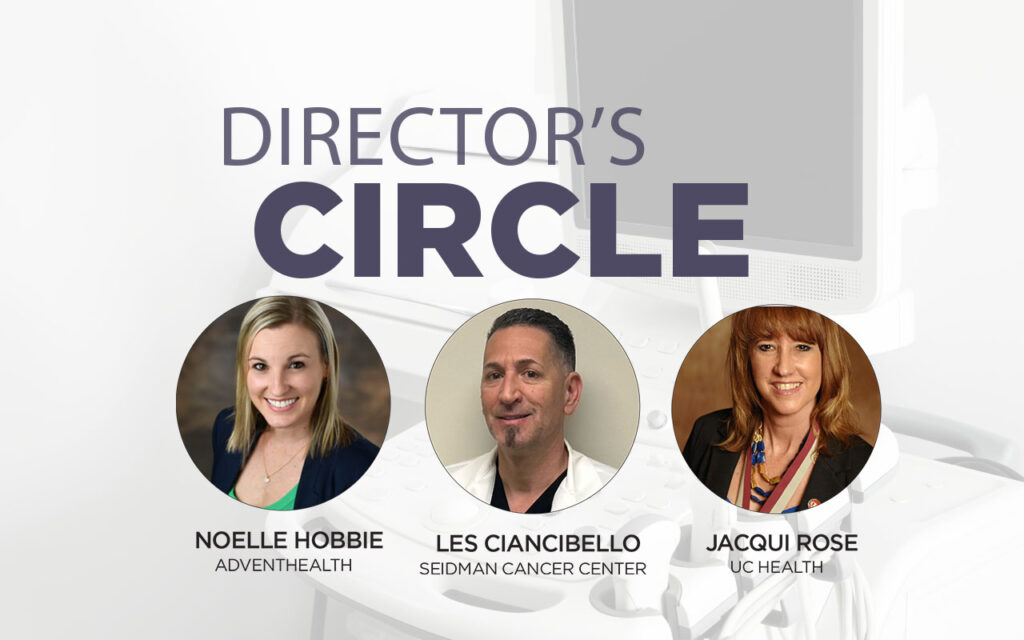
This month, the panelists are:
- Noelle Hobbie, executive director of imaging, Central Florida Division, AdventHealth;
- Les Ciancibello, RT(R)(CT), radiology supervisor, Seidman Cancer Center; and
- Jacqui Rose, system director of radiology, UC Health.
Q: What operational or clinical factors are currently driving the greatest changes in contrast imaging practices within your department or health system?
Hobbie: Several factors are driving change, including the continued growth of cardiac imaging in both CT and MR, emergency department throughput demands, and evolving approaches to renal function screening. Supply chain reliability also plays a major role. We prioritize partnerships with suppliers that can confidently meet the demand of a large, growing organization while controlling cost through economies of scale and enterprise-wide agreements. In addition, we continue to streamline premedication pathways for patients with contrast allergies. Most recently, we are exploring options to electronically send premedication prescriptions to the patient’s pharmacy of choice rather than requiring the patient to pick them up at an imaging center. We also maintain a strong focus on preventing and managing contrast extravasations.
Ciancibello: I think the biggest change in contrast practice has been the reduction in dose as a result of the global contrast shortage. What we learned from this shortage was that we can produce high-quality diagnostic scans with lower volumes in several routine imaging protocols. I feel it is important to have contrast dosing guidelines; however, they need to be coupled with clinical and patient-based scenarios, allowing for deviation when necessary.
Rose: Contrast utilization and practice changes are primarily driven by cost and supply availability. To ensure uninterrupted, high-quality patient care, the organization remains flexible and works closely with suppliers to maintain adequate inventory and manage supply chain challenges.
Q: How are you balancing patient safety with the need for efficiency and throughput in today’s high-volume imaging environments?
Hobbie: We navigate this balance daily – especially in the emergency setting, where CT utilization is highest. Following ACR guidance, we screen appropriately for contrast-induced nephropathy (CIN) risk while avoiding unnecessary renal function testing to support throughput. Where appropriate, we use point-of-care (POC) testing when needed. eGFR results are incorporated directly into the technologists’ EMR worklist for rapid review. In select high-volume locations, we have dedicated resources focused on readiness for contrast CT (IV placement, CIN screening and POC testing). We also maintain POC testing competency across staff in outpatient settings so patients can complete required testing during the same visit, rather than obtaining lab work before their scheduled appointment.
Ciancibello: Patient safety is always priority number one in my imaging suites. The development and follow-through of solid workflows naturally keep your department running efficiently, and by default, throughput is increased. As an example in my suite, we have a lead technologist who acts as an “air traffic controller” in the space. She has taken the time to assure that all orders are clear, that those outside normal protocols are discussed with a radiologist or attending physician, and that everything is in order for the patient the day they arrive. After that, it is as simple as guiding the patients onto the correct scanner, similar to the way an air traffic controller guides planes onto and off runways. With skilled technologists at the scanners ready for each patient, the scanner — or “runway” — is always clear and ready for the case.
Rose: To balance patient safety with efficiency and throughput, we consistently review current practices and processes to ensure our efficiency is optimized. We develop future optimization plans via new products or services as those become available and with funding opportunities.
Q: What role do new technologies play in diagnostic imaging?
Hobbie: New technologies are supporting both safety and efficiency. We are actively evaluating enhancements to power injector technology, particularly safety features that help prevent never-events such as air emboli. We also value time-saving features like automatic priming that create incremental throughput gains. We are also leveraging automated post-processing and image reconstruction, and many of these applications support contrast-enhanced studies, including angiography cases like cardiac CTA. Additionally, we are using technology and decision support to reduce redundant contrast imaging. For example, providers caring for stroke patients may order both CTA head/neck and MRA when typically only one is needed. We leverage EMR reporting to educate providers and encourage ordering the most appropriate single study.
Ciancibello: I think this is a difficult question to answer. The radiology world is constantly evolving, almost to a point faster than we can absorb what is being offered. Dual-energy CT has been available for 15 or more years, quickly followed by spectral CT and now photon-counting CT. These technologies offer options, opportunities and challenges yet to be understood. Most of us only use these tools and what they have to offer in very limited or niche capacities. It takes time for technologists to adapt to these new technologies. As I often say regarding our new photon-counting scanner, “this isn’t your grandma’s CT of the old days.” With 0.25-second rotation time, infinite rows of detectors, multitudes of scan modes, reconstruction and filtration options, the combinations are endless. Added to that, the adoption of these technologies by the readers is slow. Like all fields, the radiologist pool is also short-staffed, and they are always being asked to read more data faster. Finding that balance between the two is going to be the challenge.
Rose: New technologies drive our future planning, whether it’s related to safety, efficiency or throughput. These technologies are critical to enhancing our processes, which will ultimately improve overall care and patient experience.
Q: How are you ensuring technologists and clinicians remain competent and confident amid staffing challenges?
Hobbie: We rely on a well-structured onboarding plan and ongoing competency validation. Our annual skills fairs include training and competency checks for IV starts, infiltration/extravasation recognition and response, and proper power injector use. We ensure hands-on education is a part of all clinical competency checkoffs.
Ciancibello: Our health system is and has been making a concerted effort to optimize and standardize protocols and technologies systemwide. With 34 scanners, consisting of four different vendors at multiple locations across our region, this takes time. Holding monthly or bimonthly meetings with CT supervisors and leads gives us an opportunity to share what’s new and coming, what’s changing and what’s not working. Keeping an open line of communication between the academic and community departments across our system has been extremely helpful in getting us to a place of consistent practice. Once you’re consistent in what you do, you can more easily share staff from location to location.
Rose: Maintaining competencies is challenging in today’s environment when we have multiple teammates at many locations using a variety of technologies. Currently, most of our team members rotate between locations, so it is imperative that they remain competent on all equipment and processes to provide the safest possible environment for our patients and themselves. We achieve this by partnering with our vendors to provide top-quality education and training to each member of the team, as well as our clinicians who guide our protocols. This is refreshed and validated annually to ensure nothing falls through the cracks.
Q: What trends or advancements in contrast imaging do you believe will have the most significant impact over the next three to five years?
Hobbie: One significant initiative will be expanding contrast-enhanced imaging into our mammography services. CEM is a cost-effective, supplemental screening option for women with high risk and/or dense breast tissue. This will provide an additional option for patients who are unable to complete a breast MRI. It will require thoughtful change management for women’s center teams who have not previously supported contrast workflows.
The increasing availability of advanced CT technology, such as dual-source and dual-energy scanners, will continue to improve vascular visualization, even when injection timing or quality is suboptimal. Using these capabilities to compensate for patient-centered challenges can help avoid repeat scans or re-injections. Finally, we expect continued emphasis on routine protocol review to identify opportunities to minimize contrast dose while preserving image quality and diagnostic performance.
Ciancibello: I think for high-volume sites, bulk contrast delivery will continue to be the trend. I feel the focus on contrast reduction will continue to be important from both a cost and patient care perspective. I’d really like to see some advanced connectivity between injectors and RIS, as today this is still a manual process requiring many steps for both technologists and readers alike. Ideally, the injector should know what contrast agent was loaded, capture the lot number, volume and flow, and send this directly to the patient’s chart as well as the dictation system for documentation and billing purposes.
Rose: New technologies will likely have the greatest impact over the next few years. We are focused heavily on patient safety and will be working closely with our vendor partners to enhance technological advancements that will ensure that patient safety is improved. One key area is improving our extravasation rates. While we are well within the ACR recommendations, our goals are to reduce rates overall and improve patient experience at all locations.