

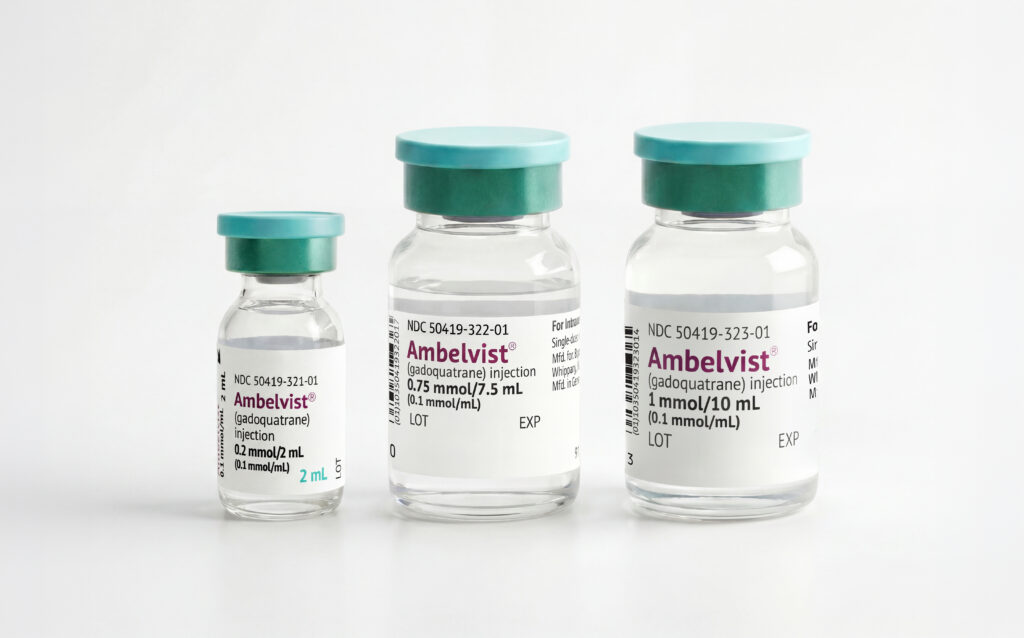
Bayer has announced that the U.S. Food and Drug Administration (FDA) approved Ambelvist (gadoquatrane), a new, intravenous macrocyclic gadolinium (Gd)-based contrast agent (mGBCA) indicated for contrast-enhanced magnetic resonance imaging (MRI) to detect and visualize lesions with abnormal vascularity in the central nervous system (CNS) and non-CNS body regions in adult and pediatric patients, including term neonates.1 Ambelvist is a next-generation mGBCA with a novel tetrameric structure and high relaxivity (a measure of signal enhancement).1
With this approval, Ambelvist becomes the lowest-dose mGBCA in the U.S. AMBELVIST has a recommended dose of 0.01 mmol/kg actual body weight (which delivers 0.04 mmol Gd/kg body weight), representing 60% less Gd compared to mGBCAs with a Gd content of 0.1 mmol Gd/kg body weight and 20% less Gd compared to gadopiclenol with a Gd content of 0.05 mmol Gd/kg body weight.1,2
Contrast-enhanced MRI is a medical imaging examination often used by clinicians to gain insight into what’s happening in the human body. This type of study can play an important role in detecting abnormalities, monitoring disease progression and informing treatment decisions.3 For some adults and children with chronic diseases or conditions that require close, long-term monitoring – such as multiple sclerosis, other neurological or spinal conditions as well as different types of cancer – regular, serial images may be required.
1 Bayer Pharmaceuticals. AMBELVIST (gadoquatrane) [package insert]. U.S. Food and Drug Administration. Available at: https://labeling.bayerhealthcare.com/html/products/pi/ambelvist_PI.pdf.
2 Bracco. Vueway (gadopiclenol) package insert. U.S. Food and Drug Administration. Available at: http://www.bracco.com/sites/default/files/2022-11/us-en-spc-vueway.pdf.
3 National Institute of Biomedical Imaging and Bioengineering (NIBIB), National Institutes of Health. Magnetic Resonance Imaging (MRI). Available at: https://www.nibib.nih.gov/science-education/science-topics/magnetic-resonance-imaging-mri. Accessed: 15 April 2026.