
MED Institute evaluation under ASTM F2503-26 gives MRI technologists documentation for patients who want to wear the metal-free respirator during exams
Patients who want to keep a respirator on during an MRI exam now have independent documentation to show their technologist – at least for one product.
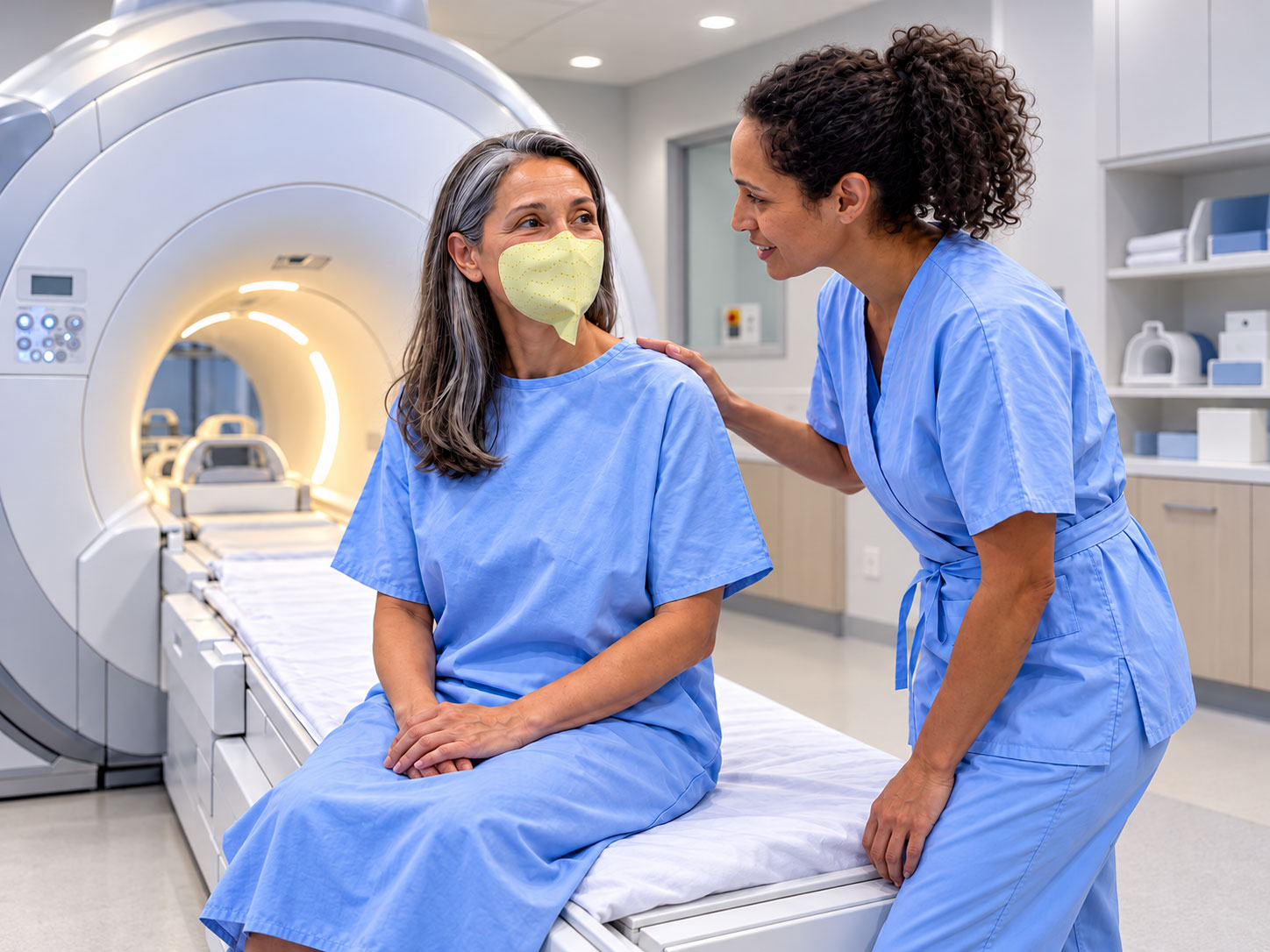
Global Safety First, the Sea Girt, New Jersey-based maker of the ReadiMask strapless respirator, announced Oct. 7 that MED Institute has completed an independent technical evaluation of the respirator under the ASTM F2503-26 framework for magnetic resonance (MR) safety labeling. The evaluation supports the company’s labeling of ReadiMask as MR Safe, meaning it may be worn during MRI exams without restrictions based on MRI system type or magnetic field strength.
ReadiMask contains no metallic structural components, including metal nose wires, staples, clips or fasteners. Instead of straps or ear loops, the respirator seals directly to the wearer’s face with a medical-grade adhesive around its perimeter.
Why the documentation matters
According to the company, customers have worn ReadiMask during hundreds of MRI exams. But some patients met questions or resistance from MRI facilities that were unfamiliar with the product or lacked independent documentation confirming its MRI safety labeling.
To close that gap, Global Safety First commissioned MED Institute to evaluate the respirator and provide patients, MRI technologists, imaging centers and hospitals with clear technical documentation supporting the MR Safe label.
“People who choose to wear a respirator shouldn’t have to give it up simply because they need an MRI,” said John Schwind, inventor and CEO of Global Safety First. “Our customers had already been successfully using ReadiMask during MRI exams, but some were being asked to prove that it was safe to bring into the MRI room. We wanted to eliminate that uncertainty with an independent technical evaluation by an organization that understands MRI safety at the highest technical level.”
“Clear, standardized documentation helps MRI professionals make informed decisions about products entering the MR environment,” said David Gross, PhD, PE, vice president of MED Institute. “We were pleased to evaluate ReadiMask under ASTM F2503-26 and provide objective technical support for its MR Safe labeling, helping provide patients with access to this innovative respiratory protection during MRI.”
What MR Safe means
ASTM F2503 sets the terminology and labeling framework for items entering the MR environment, including the categories MR Safe, MR Conditional and MR Unsafe. Under FDA guidance, an MR Safe item poses no known hazards from exposure to any MR environment and carries no MRI-related conditions or restrictions on its presence or use there.
That designation is different from describing a product as “metal-free,” “MRI-friendly” or “safe for MRI rooms,” labels that some masks and respirators already use. MR Safe surgical and procedure masks are also available. The company says ReadiMask stands apart as a filtering facepiece respirator that seals to the face with an adhesive perimeter and has no straps or metallic structural components.
MED Institute is a contract research organization that provides medical device testing, engineering, regulatory and clinical services, including MRI safety evaluation and testing. Its scientists participate in ASTM working groups on MRI safety standards, and the organization is accredited to ISO/IEC 17025:2017 and certified to ISO 13485:2016.
“Rather than relying solely on our own assessment that ReadiMask was appropriate for use in the MR environment, we wanted an independent technical evaluation under the recognized ASTM framework,” Schwind said.
Resources for patients and MRI facilities
Patients can download a one-page summary of the MRI safety evaluation to give to their MRI technologist, imaging center or hospital before an appointment. MRI information is available at ReadiMask.com/MRI, and the technical documentation is at ReadiMask.com/MRI-Report.
ReadiMask is made in the United States and comes in multiple sizes for consumer and voluntary use, including medical appointments, MRI exams and travel. The company’s ReadiMask 365 was named one of two Phase 2 winners of the U.S. government’s Mask Innovation Challenge, which drew nearly 1,500 submissions. The challenge was sponsored by the Biomedical Advanced Research and Development Authority in partnership with the National Institute for Occupational Safety and Health and the National Institute of Standards and Technology.