

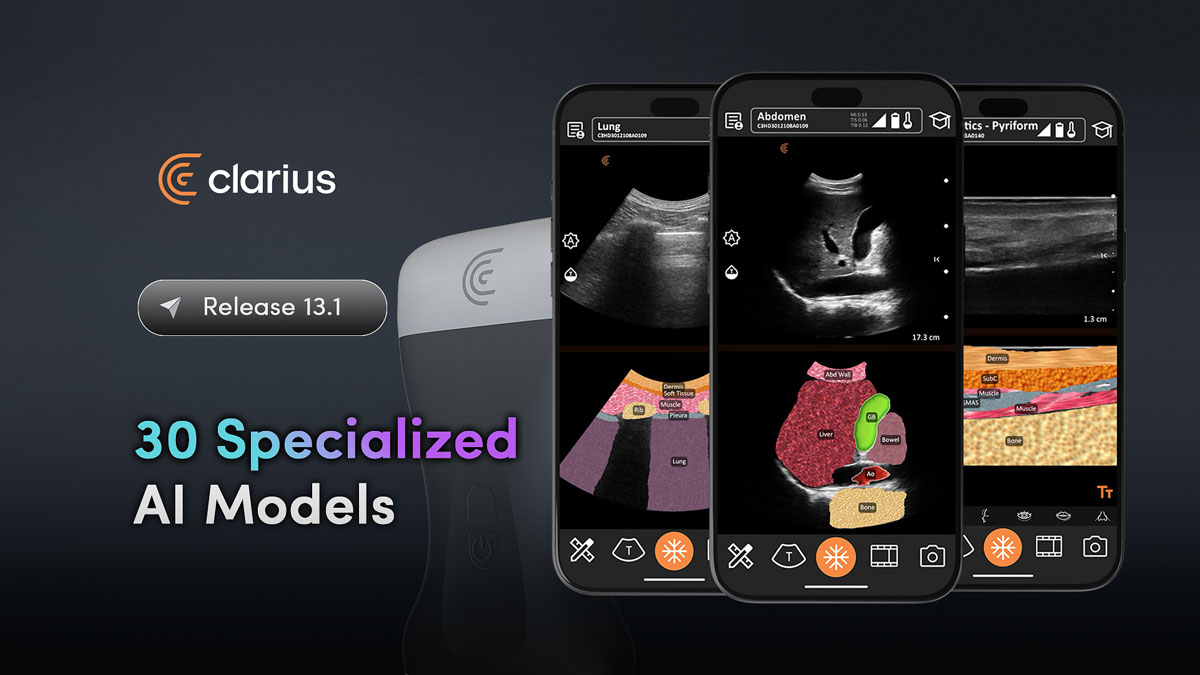
Clarius App 13.1 adds AI for measurements, anatomy overlays and hands-free workflow, all running on the clinician’s phone or tablet
Ten months ago, Clarius Mobile Health counted 16 AI technologies in its handheld ultrasound platform. Its latest software release brings that number to 30.
The Vancouver, British Columbia-based company has integrated 30 specialized AI models into Clarius App 13.1, which runs with its wireless handheld scanners. Clarius describes the lineup as the industry’s largest publicly documented portfolio of integrated AI models for handheld ultrasound. The company introduced its first on-device AI model in 2020.
“The next era of ultrasound won’t be defined by portability alone. It will be defined by intelligence,” said Kris Dickie, chief technology officer at Clarius. “Thirty models is just the beginning. We’ve built the technology, expertise, and momentum to continuously advance what handheld ultrasound can do. We’re not just making ultrasound more portable. We’re redefining what clinicians can expect from it.”
What the 30 models do
Clarius groups the models into three categories:
Diagnostic workflow (12 models): These automate steps in clinical measurements across cardiac imaging, obstetrics, urology and musculoskeletal medicine, from AI-assisted ejection fraction assessment to prostate and bladder volume measurements. The company says they reduce manual tasks while keeping clinicians in control.
Anatomy (14 models): Clarius T-Mode overlays anatomical illustrations and labels on live ultrasound images, helping clinicians recognize structures and build scanning confidence.
Workflow simplification (4 models): Intelligent preset selection, voice commands and speech-to-text features reduce manual interaction during exams.
On the device, updated through software
The AI models run directly on compatible smartphones and tablets, so supported features work without an internet connection during scanning. Clarius delivers new capabilities through software updates, which lets compatible existing scanners gain features without hardware replacement.
Dickie credited the company’s in-house AI development platform for the pace of additions. “We can move from a clinical idea to a working AI model in a matter of weeks,” he said. “Combined with our experience bringing regulated AI solutions to market, this allows us to accelerate innovation and put increasingly intelligent ultrasound capabilities into clinicians’ hands through software.”
Clarius says its portfolio includes FDA-cleared AI models and CE-marked capabilities for European markets. Feature availability varies by scanner, market and regulatory authorization.
Clarius App 13.1 is available now for compatible Clarius wireless handheld ultrasound scanners. More information is available at clarius.com.