

By Matt Skoufalos
After more than two decades in the medical imaging field as a radiologic technologist, and nearly 30 in active and reserve duty with the U.S. Army, Anthony Anderson has spent the past 12 years of his life working in sales for CMS Imaging of North Charleston, South Carolina, as its medical account manager presenting Fuji and Shimadzu equipment in Tennessee.
The retired drill sergeant began life in a small town in southern Georgia, earning a football scholarship that led him to college in California, and then to the University of Washington, where he “got to play a little bit” under College Football Hall of Fame Coach Don James. Upon graduating with a degree in physical education, Anderson then returned to school to become a radiologic technologist.
By 1990, he had joined the OR staff at Swedish Medical Center in downtown Seattle, where he worked alongside members of Orthopedic Physician Associates, a practice that cared for athletes from many of the city’s professional sports franchises, including the Seahawks, Mariners, and Supersonics. One of them, Dr. Richard Zorn, was impressed by Anderson’s unflappable demeanor in the operating room, and asked whether he’d be interested in joining the group.
“You’ve got to know somebody, be in the right place at the right time, and work with the team doctors,” Anderson said. “Once they saw how I was and how I carried myself, that’s how I got my initial start in. We’re not intimidated by stars, and they want that professionalism. Once guys have proven they’re professionals, they like it.”
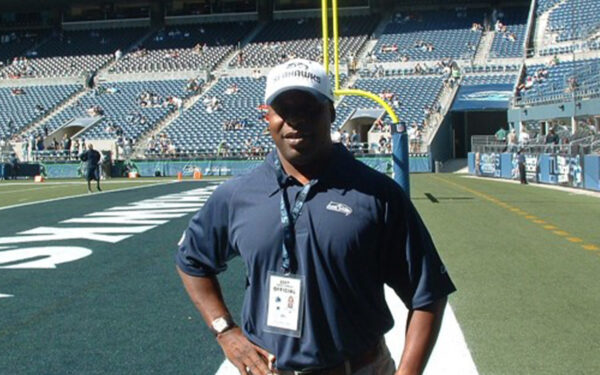
From that moment on, Anderson went to work as a team RT for the Seattle Seahawks. On Sundays, he was on the sidelines of every one of their home games, ready to help acquire the images that would allow team physicians to determine whether an injured player was too seriously hurt to return to the game.
“It’s totally different, and that’s why everybody that works in a hospital environment can’t work in a sports medicine environment,” Anderson said. “The patients aren’t going to be walking and talking through, and we have to be as fast as we can because the game is still going on. These guys have pads and pants on; with any type of head injury, you have to shoot through the helmets.
“We’re not being critiqued by a doctor or radiologist,” he said. “The ortho guy has to make that determination on the spot, broken or not broken, ready to go back in. Usually any player is going to have a trainer and a doctor come with them, and they’re going to evaluate them.”
Just like the players on the field, working on an NFL sideline is fast-paced, high-stakes, and demands immediate results. Although they’re employed by the home team, medical professionals on NFL sidelines are responsible for treating players from the visiting side as well, and Anderson said he’s never worked a game without taking X-rays of multiple people during its duration.
Throughout the length of a season, injuries mount, and team physicians are tracking the health of every player as it’s tested by repeated stressors in practice, training and the game. Periodic imaging allows those same physicians to determine whether those players’ injuries are on the mend or continuing to mount. Anderson has stories of being on hand while physicians managed player injuries with contrast imaging and pain medication.
“We can do everything from minor finger injuries all the way up to lumbar spines if we have to,” Anderson said, adding “it’s pretty rare if we do that.”
“We don’t do trauma,” he said. “If they get put on the backboard, anything major or cervical, they have to go to the hospital. If they can walk or ride on the cart, we will do that: extremities, shoulders, hands, wrists, ankles, shoulders, feet.”
X-ray is the most commonly utilized modality during an NFL game; many teams keep computed tomography (CT) scanners at their practice facilities, and only those franchises that locate their stadia nearby have access to them within enough time to image a player during the course of a game. MRI would take too long to acquire an image within the duration of a game.
Anderson was part of the Seahawks from the late 1990s until about 2011, when he moved to South Carolina with the Steadman Clinic. Around that time, Dr. Spero Karas became the head team physician for the Atlanta Falcons, and invited Anderson to come with him. The Seahawks had been flying Anderson out from South Carolina to Seattle for every home game – as the Army had been to retain him as a drill sergeant – and the commute was significant.
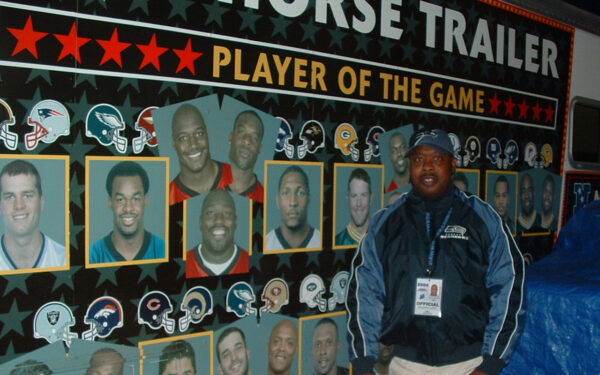
By the time he made Atlanta, Anderson had been with the Seahawks for two Super Bowl appearances, but he didn’t get to work the contest himself until he landed with the Falcons when the team hosted Super Bowl 53 between the L.A. Rams and New England Patriots. In Georgia, Anderson has also worked the SEC Championship Game, Chick-fil-A Bowl, Heritage Bowl, Peach Bowl, and any other event that needs X-ray support. He still laments the near-miss of working the 2020 NCAA Final Four at Mercedes Benz Stadium, which was unfortunately cancelled by the novel coronavirus (COVID-19) pandemic.
These days, working with the Falcons is almost a moonlighting gig for Anderson, who can foresee the end of his time on the sidelines. Since there are two RTs at every contest, he will handle about five Falcons games himself, and hand off the others to his colleagues Mark Seavey and Rodney Smith of Children’s Hospital of Atlanta.
“I’ve been in it so long, I’ve seen every team,” he said. “They’re more excited about it.”
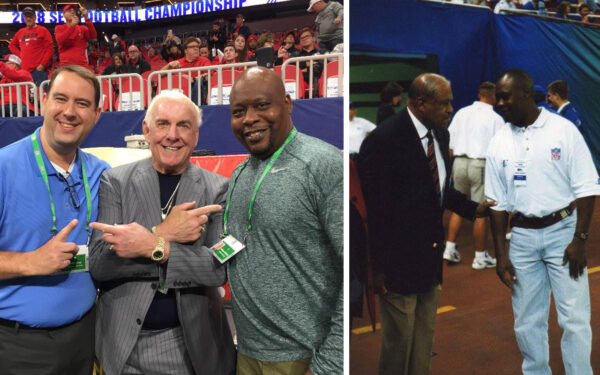
That having been said, Anderson definitely has his share of treasured memories from his experiences in the league. Working with the Seahawks during the Marshawn Lynch era is among them; meeting stars like John Randle and Jerry Rice is another.
“I’ve seen Beast Mode” – Lynch’s nickname – “full up and in person from the beginning to the end,” Anderson said. “I was there when Terrell Owens did the Sharpie celebration in the end zone.”
Anderson is also aware that the portability of his imaging career has allowed him to enjoy moments like those he’s seen first-hand from angles that fans and spectators could only catch on video.
“Every time I would stand on the sideline, I’d think about people spending four or five hundred dollars to sit above me, and I’m on the sideline,” he said. “We get paid, but we don’t care, we got the best seats in the house.”
“You think about all the RTs in the country, and there’s less than 100 that get to do this,” Anderson said. “That’s a really small funnel. I’ve gotten to do things that people would think and dream about.”