

By Matt Skoufalos
 As an outreach liaison for teleradiology company Excalibur Healthcare of Moorestown, New Jersey, Betsy Cook connects its radiologists with healthcare systems and hospitals who need their services. As a component of her work in service delivery operations for Excalibur, she also produces the RadCentral podcast.
“At Excalibur, whether you’re the person answering the phone, or you’re the person doing IT, we’re all supposed to be informed about radiology,” Cook said. “It’s part of our company culture.”
“The podcast idea came out of this idea that we’re sharing this information, and we want to extend that conversation out into the public,” she said. “It’s one of the reasons why I really like working here, because I get to have these conversations with enlightening people about healthcare and subject matters that, five years ago, weren’t even on my radar – because I wasn’t doing radiology; I was making clothing.”
Cook came to Excalibur after her own entrepreneurial venture, National Picnic, was winding down as a full-time endeavor. She established her brand with the motto, “creatively casual clothing for adult women,” and a desire to parlay her love of sewing into a small business.
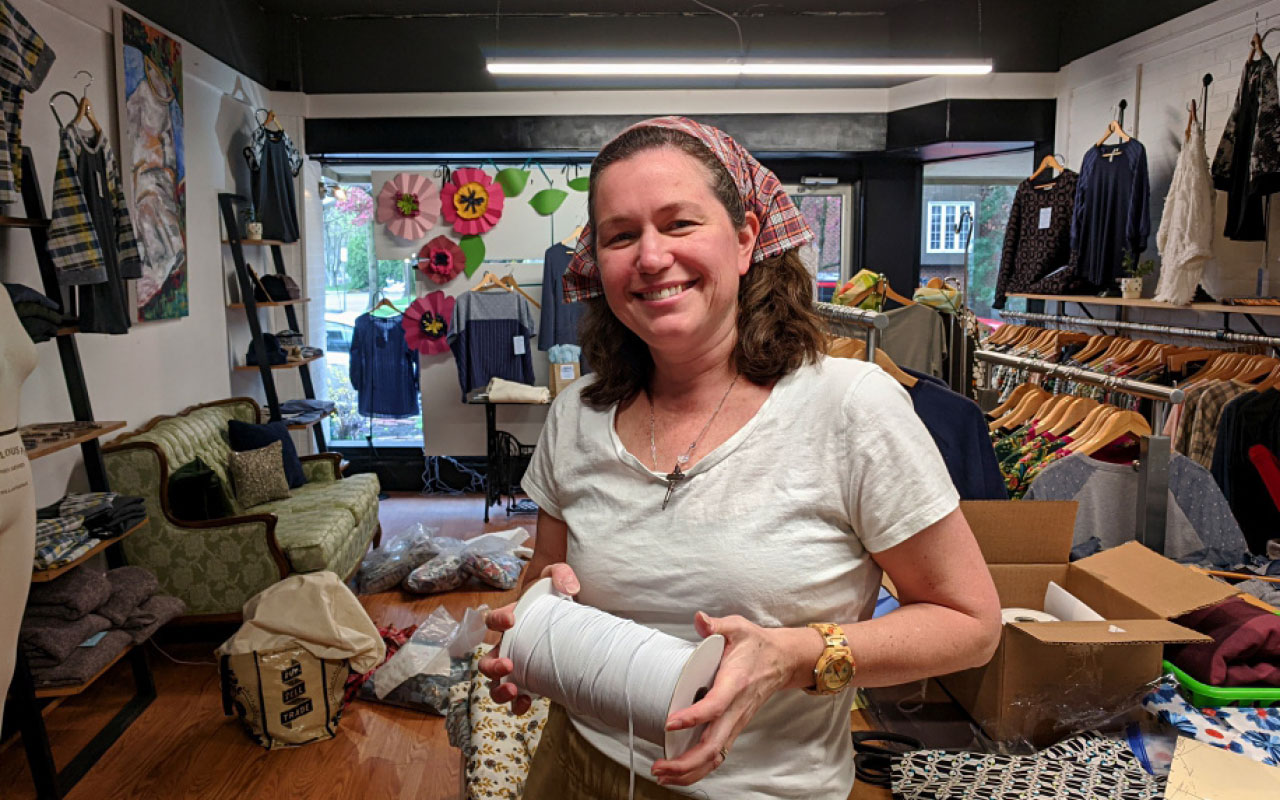
Cook traces her earliest days as a clothier to a junior high home economics class, in which the teacher who put a needle and thread in her hands unlocked a lifelong passion for the physical sensation of sewing. She returned to the elective again and again throughout high school.
“I’ve wanted to sew things ever since, even if it’s not for business,” Cook said. “I just love to sew. It’s just in me, and if I don’t do it, then I feel like I have to get back to it.”
“I have a muscle memory for sewing the way someone else might have a muscle memory for shooting a three-pointer,” she said. “It’s what I want to do, and I’ve done it enough that it comes really easy.”
Cook’s first sale came after she had made her own pair of Jams: drawstring Hawaiian board shorts that hit national popularity in the late 1980s. After seeing her wearing them, a field hockey teammate complimented them, and commissioned a pair of her own. Cook remembers asking all of $2 for the work.
“I should have charged a lot more,” she laughed. Whether or not it was lucrative, the experience taught her, “If you’re good at it, you start to realize how quickly you can make something.”
For as much as she enjoyed sewing, Cook put the hobby on hold throughout college, and didn’t really return to it until she’d purchased her home. She realized quickly that “there’s suddenly all these projects that a sewing machine would really come in handy for.” She retrieved her mother’s old sewing machine, and began making things she needed for the household.
“It started to get where the machine was in the house, so I just started making clothes again, because that’s what I wanted to make,” Cook remembered.
Eventually, she splurged on a $1,200 computerized sewing machine from the Sew and Vac in her hometown of Collingswood, New Jersey. She’d been making things for herself and her daughters, and realized she wanted to create her own designs. When enough people started trying to commission her work, Cook began to believe she could start a business venture.
“There’s a moment that you get to when you’ve sewn so much, and you’ve stared at so many patterns, that you start to realize that you don’t need the patterns, and you can start making your own patterns,” she said.
“I researched industrial sewing machines, and joined a forum for small business entrepreneurs that make products that are stitched,” Cook said. “I found out that I needed to get myself a couple industrial sewing machines, and go to trade shows to buy fabric, so that’s what I did.”
“Then, I decided, ‘I’m launching a brand, and I’m going to try to make this my livelihood.’”
Unfortunately, Cook soon grasped the size of the gulf between being a neighborhood seamstress and a department-store wholesaler. At trade shows, she couldn’t get retailers to take a chance on ordering her products against competitors that were infinitely bigger, better resourced, and delivering garments with a bigger profit margin.
“I thought I was going to be a mogul, and I didn’t know how to go about it, and I quickly learned that it was a game that I was too inexperienced to play,” Cook said.
“I wasn’t interested in sewing clothing to someday hand it off to a factory in Vietnam, because then I wouldn’t be sewing the clothes,” she said. “It’s a completely different thing if you love it because you’re physically handling the stuff. I actually liked manufacturing more than being a design house.”
Instead, Cook took her business to her fans. She retailed items at local craft fairs and markets, trunk shows and pop-ups, and built a customer database to whom she could sell directly through her online presence. By turns, she operated storefronts in the textile district of Center City Philadelphia, suburban Haddonfield, New Jersey, and a multivendor maker space in her Collingswood hometown.
“If a buyer doesn’t like my things, I know my customer’s out there; I just need to get to them directly,” Cook said. “You develop a fan base, and they start looking you up online. I’m like a secret-menu maker.”
These days, when Cook sews, it’s for herself, which is something she never got to do when she was trying to make it work as a business. It’s brought her even closer to the thing she loves, giving her the freedom to follow her inspiration, and know that she’s got no regrets at having tried her hand at it professionally.
“Now I go assist with radiology, and then I come home, and I can just do what I want with my fabric,” she said.
Off The Clock Nomination