
By Meredith Gammons, M.H.A., M.B.A., R.T.(R)(MR)(M)(CT)(BD), ASRT Director of Governance, with reporting by ASRT Staff Editor Lorin Bentley and ASRT Scanner Managing Editor Lee Ross
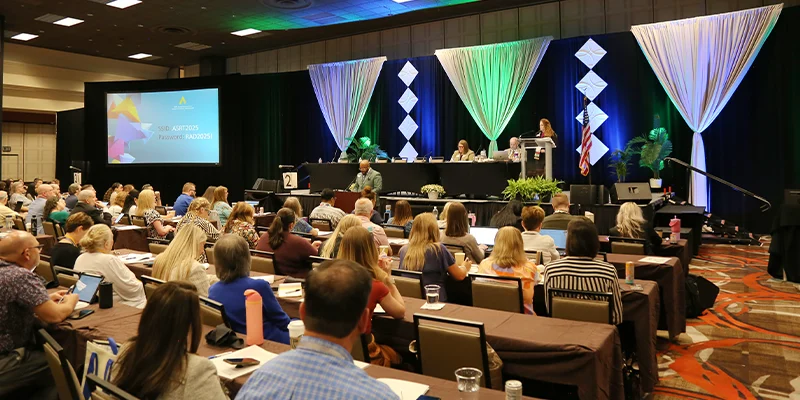
In June, medical imaging and radiation therapy professionals from across the country convened in Albuquerque, New Mexico, for the American Society of Radiologic Technologists’ Educational Symposium and Annual Governance and House of Delegates Meeting.
It was the perfect location for the annual gathering because this year marks the 100th anniversary of Route 66. The legendary highway that connected Chicago to Los Angeles passed through Albuquerque. Established in 1926 – just six years after ASRT was founded in Chicago – the “Mother Road” became a symbol of connection across the country.
That spirit of connection continued with ASRT’s annual governance gathering. Delegates, educators, clinicians and industry partners convened not only to review organizational business but also to exchange ideas and shape the profession’s future.
Driving Policy
Central to the annual gathering is the House of Delegates meeting. This governing body represents ASRT members and makes decisions on its policies, professional standards and strategic direction.
Delegates from affiliates and ASRT chapters discussed and made decisions that will update ASRT’s practice standards, advisory opinion statements and much more. The structure of the meeting and the work performed leading up to the event ensured that ASRT members’ voices were represented and that the organization remains responsive to the evolving needs of medical imaging and radiation therapy professionals nationwide.
The meeting also included reports on the organization’s progress and strategic initiatives. These updates not only offered insights into the ASRT’s past and future work but also maintained transparency by welcoming members who were interested in a detailed understanding of how the organization operates.
In addition, the sergeants-at-arms who helped maintain order highlighted ASRT’s emphasis on professionalism and fairness in governance discussions, and chapter meetings brought together professionals to openly discuss the challenges unique to their practice areas.
A Smooth Road to Governance
Leading up to the meeting, multiple committees debated and helped prepare each issue for consideration before those concerns reached the House of Delegates floor. Potential updates to the society’s governing documents were reviewed by ASRT’s Committee on Bylaws to ensure they remain current and effective. The ASRT Commission evaluated recommendations related to practice standards and professional position statements before forwarding them to the House for debate and approval.
Beyond those groups, ASRT held open forums, hearings and online community discussions for members of the profession to share their perspectives. By engaging in these conversations, medical imaging and radiation therapy professionals help ensure that decisions reflect the diverse experiences and challenges faced in facilities across the country.
Members’ voices formed the foundation of support for the society’s decisions. While delegates cast the official votes, the governance process extends beyond those seats; ASRT members have always played a pivotal role in the process.
Education at the Forefront
Alongside governance discussions, the ASRT Educational Symposium highlighted emerging trends and challenges shaping the radiologic sciences. The one-day symposium on June 25 offered 17 sessions covering topics ranging from patient care and professional ethics to technology innovation and workplace dynamics. Attendees explored issues affecting technologists, educators and imaging leaders.
Collaboration in a Complex Workplace
Workplace culture and professional collaboration were one of the symposium’s themes. Keynote speaker Nan Gesche, M.A., opened the event with a session titled “Cracking the Collaboration Code.” Her presentation focused on how communication styles and interpersonal dynamics influence teamwork and productivity.
“Collaboration isn’t something ‘nice to have’; rather, it’s something that directly impacts how work gets done,” Gesche said. “It isn’t just what you do or how you do it – it’s how you show up and engage others.”
As healthcare systems become increasingly complex, effective collaboration across disciplines is essential for maintaining quality patient care. However, workplace pressures can make collaboration more difficult.
Managing those difficulties, including burnout among radiologic science professionals, was the topic of a talk by Kerry Dunn, Ed.D., R.T.(R)(M), and Jennifer Mashburn, M.P.H., R.T.(R)(VI). They presented research and personal insights, and explored the relationship between workplace culture, staffing challenges and post-pandemic clinical demands. The presentation covered the warning signs of burnout and strategies for advocating for healthier work environments.
“Burnout is a topic that is not often spoken about,” Dunn said. “But it’s especially pervasive in our profession because we have so many confounding pressures and components.”
Technology Transforming Practice
Technological innovation was another theme of the symposium, particularly as artificial intelligence and advanced imaging tools are reshaping how technologists work. An important concept for technologists to understand is the digital twin – a virtual patient model built from imaging data, advanced modeling techniques and artificial intelligence.
Kori L. Stewart, Ph.D., R.T.(R)(CT), CIIP, discussed how this technology could transform patient-centered imaging by simulating procedures and offering personalized treatment strategies. However, building accurate models requires high-quality medical images, Stewart pointed out.
“Radiologic technologists play a foundational role in digital twinning because these technologies depend on high-quality, consistent imaging data,” she said.
Artificial intelligence is also reshaping professional responsibilities in areas such as research and publishing. Bethany Stearns, M.S., R.T.(R)(MR)(CT), and Vesna Balać, Ed.D., R.T.(R)(MR), led a session examining how AI tools can support scholarly writing while maintaining ethical and academic standards.
“Failing to understand an organization or journal’s expectations around AI can lead to unintentional ethical violations or questions of academic integrity,” Balać said.
By exploring both opportunities and risks, the session explained how to use AI responsibly as the technology becomes increasingly integrated into clinical and academic work.
Building Community
The ASRT Expo, June 25-26, brought together industry partners and imaging professionals to explore the latest developments in medical imaging technology and services.
Several traditions have been part of the annual meeting for decades, such as the pin exchange, where technologists from across the country trade commemorative pins representing their state societies. The Honors Evening recognizes members who have demonstrated outstanding service and leadership in the radiologic sciences, while the installation of officers event recognizes the incoming members of the board of directors and highlights the contributions of the outgoing leaders.
Together, these activities strengthen the professional relationships that support collaboration across the profession.
Giving Back
Community service was another recurring element of the annual meeting.
This year, attendees donated new books for children ages 5 and younger as part of a partnership with Read to Me! ABQ Network, a local organization that promotes early childhood literacy by distributing books through schools, community centers and public spaces. Fundraising events also supported national advocacy and professional development efforts. The Rocking Route 66 ASRT-PAC Fundraising Event raised funds for the society’s public policy initiatives, while the ASRT Foundation Bash supported scholarships, grants and professional development programs for imaging professionals.