

By Matt Skoufalos
For as much as medical imaging technology remains a cornerstone of future healthcare lines of service and treatment planning, decision-makers don’t always contemplate the longevity of the facilities constructed to house the devices that will provide those services.
When it comes to planning any capital project, especially one involving medical imaging equipment, it’s a truism that mistakes made early in the process can have unintended, negative consequences that stifle future capacity and growth opportunities, said Tobias Gilk, senior vice president of RAD-Planning and founder of Gilk Radiology Consultants. RAD-Planning is a consulting firm made up of architects dedicated to radiology, nuclear medicine, and radiation therapy projects.

As imaging systems are focused on faster acquisition of higher-quality images, facilities must be designed to maximize patient throughput. For MRI services, that means allowing for the inclusion of preparatory infrastructure – patient interview and screening spaces, sub-acute waiting spaces, changing areas – to support patient turnover at rates that achieve manufacturer-advertised thresholds. It also means contemplating the needs of current and future patient populations, including those with implanted medical devices, and those who require higher acuity care delivered by additional medical staff and supportive technologies.
“Most facilities are still focused on, ‘How small can I make the scanner room?’” Gilk said. “‘How can I shoehorn this new scanner into a poorly suited existing space, minimize my cost, [and] accelerate my design and construction project?’”
“Those short-term gains often come at the expense of the longer-term, more profitable gains to come,” he said. “Lowest first cost compromises the gains that exist and will continue to grow in image acquisition.”
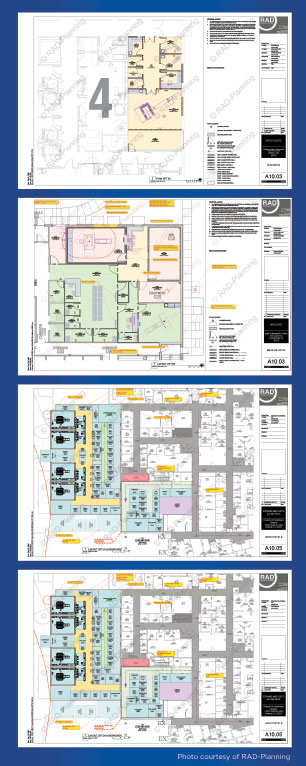 Many facilities will try to save on design costs by working with architectural partners recommended by vendors providing the equipment they’ve selected, or by re-using old templates from prior installations. However, vendor-provided architectural designs often are built around minimum service clearances required for device maintenance, and aren’t necessarily inclusive of zoning and construction codes, staffing thresholds, or the evolving needs of patients and the medical equipment that will deliver their care in the future, Gilk said.
“If we’re going to copy and paste the next MRI like we did the previous one, the default mode completely ignores all the changes that are undergoing in radiology and MRI in 2026,” he said. Vendors delivering an “off-the-shelf” plan have “every motivation to make these spaces as small as possible so they can appear to have a competitive advantage over the other guys,” Gilk said.
Yet when space savings is presented as delivering cost savings, or when spaces are designed and built to bare minimums, that approach can limit future growth while also impeding clinical and design flexibility. Instead, he said, decision-makers should include in their calculations people who understand the workflow that imaging space will facilitate and its constituent parts. That conversation should touch on the patient population it will serve and how those people will circulate within the building, the technological needs of support staff that will attend to them and manage the medical technology involved in their care, and how to plan for emergent circumstances in that process.
“Instead of taking the copy-and-paste imaging suite and looking at it as, ‘Here’s a design; what do we want to change?’ work for the solution from the point of view of ‘How do we want to deliver patient care?’” Gilk said.
Through RAD-Planning, Gilk was a consultant on the Imaging Services Design Guide produced for the U.S. Department of Veterans Affairs Office of Construction and Facilities Management. It’s a freely available toolkit for healthcare facilities operators to consult when contemplating the design of spaces that will serve medical imaging patients. The design guide also includes three-dimensional planning files that they can overlay on their own spaces with the equipment they plan to include there, offering a starting point for facilities conversations.
Gilk also identified as another key facet of the design process interpreting the language of architectural professionals into concepts that imaging professionals can grasp. Speaking about architectural drawings as cross-sectional views of a building, for example, can help cross-sectional radiologists regard a floor plan as “a coronal view of a building with a 1-meter slice thickness,” he said.
“Sometimes just translating what they’ve seen a billion times before can help them immediately build their competence and confidence,” Gilk said.
Another aspect of facilities and project planning that often can’t be standardized is regulatory approval, which varies across states (and even among municipalities within the same state). In some parts of the country, clearing regulatory hurdles “can take many months or a year,” Gilk said. Even excluding those demands, however, the work of needs identification and outlining the scope of a project can be condensed to a much more compact timeline when all stakeholders are involved from the beginning and have a shared vision of the project outcome. In architectural terms, this is described as “programming,” but it boils down to a clear understanding of the types of work that will be done in the space, the people who will perform it, and the equipment they’ll need to do it.
“Once you have a needs assessment [that includes] equipment, spaces, [and] operational models to support, you can come up with different ways to arrange the boxes and architectural expressions of what that might look like,” Gilk said. “The needs assessment – what architects call programming – [is expressed as] how we translate that activity of what the building needs in order to support the performance needed.”
Comprehensive needs assessments and programming work must contemplate future throughput volume increases, technological applications and potential re-uses of the space that will outlive the people tasked with its design by many years. Defining the underlying mission statement of a project involves modeling its immediate, idealized workflow as well as “crystal-ball-gazing” anticipating subsequent changes that can affect technologies with lifespans of a decade-and-a-half or longer, Gilk said.
“Odds are the replacement piece of equipment is going to require different power, or air conditioning, ceiling height, width and length of the room,” he said. “Squeeze this down to the bare minimums, and you’re also committing yourself to unnecessary costs of demolishing and rebuilding that room to serve the same purpose for the next piece of equipment.”
In anticipating operational changes and organizational flexibilities in the clinical demands for a piece of medical imaging equipment, Gilk notes the “massive disintegration” that has de-centralized imaging services into specialty and subspecialty deployments: freestanding imaging centers dedicated to women’s health, cardiac imaging in support of cardiology units, and sports medicine imaging associated with orthopedic groups, to name just a few. Those applications have needs as varied as the patient populations they serve, and planning their successful implementation requires more than a cookie-cutter effort, he said.
“Today, radiology and imaging services are being distributed throughout the enterprise because we’re finding that these can be so useful in patient- or condition-specific areas,” Gilk said. “The same CT scanner is going to have wildly different needs in a cardiology or electrophysiology practice versus being adjacent to your emergency department. They may require wildly different spaces and equipment to be able to support the care, and must be carefully tailored to a specific clinical mission.”
When considering the lifespan of an imaging facility build-out, Gilk begins by asking clients whether they own or lease their properties. An outpatient imaging center with an eight-year strip mall lease may be forced to confront more limitations on its future flexibility than a community hospital making an investment that might have to last for decades.
Thinking about how much and in what ways medical imaging practices have changed in the past decade-plus in terms of patient populations, referrers, and studies performed can lend some insight into the future demands of the space, he said. An additional foot or two of width can facilitate the ease of equipment replacement or the inclusion of supportive devices, like anesthesia machines, respiratory equipment, and infusion pumps, buying future flexibility for clinical practices and support personnel as well as technology.
Finally, as important as future-proofing designs can be, so, too must consideration be given to receive input from the professionals who will be working in the space.
“Failing to have those kinds of conversations with clinical stakeholders and front-line staff like technologists often leads to projects that may look beautiful on ribbon-cutting day, but people start working in it and wonder, ‘Why did nobody ask me how we deliver patient care?’” Gilk said.
“Make sure the voices of the folks who are involved in the clinical care process are involved with this,” he said. “There’s no shortage of gorgeous-looking facilities that do not meet the needs of contemporary patient care. It’s really important to get somebody who’s had a lot of experience with radiology facilities, and not just in a retrospective sense. It’s most expensive and most mission-disruptive to go back in and fix problems that you should have thought of when you built the facility in the first place.”
“It’s important to get it right the first time,” Gilk said, “and it’s important to recognize where the limits of your own knowledge are. Oftentimes, folks who run design and construction projects don’t have that immediate point-of-care understanding. They’ll do things with the best of intention, but it requires that folks really understand the workflow, the process, the patient needs.”
For smaller community hospitals, some of the biggest challenges related to rolling out an imaging facilities project involve financial and physical constraints.
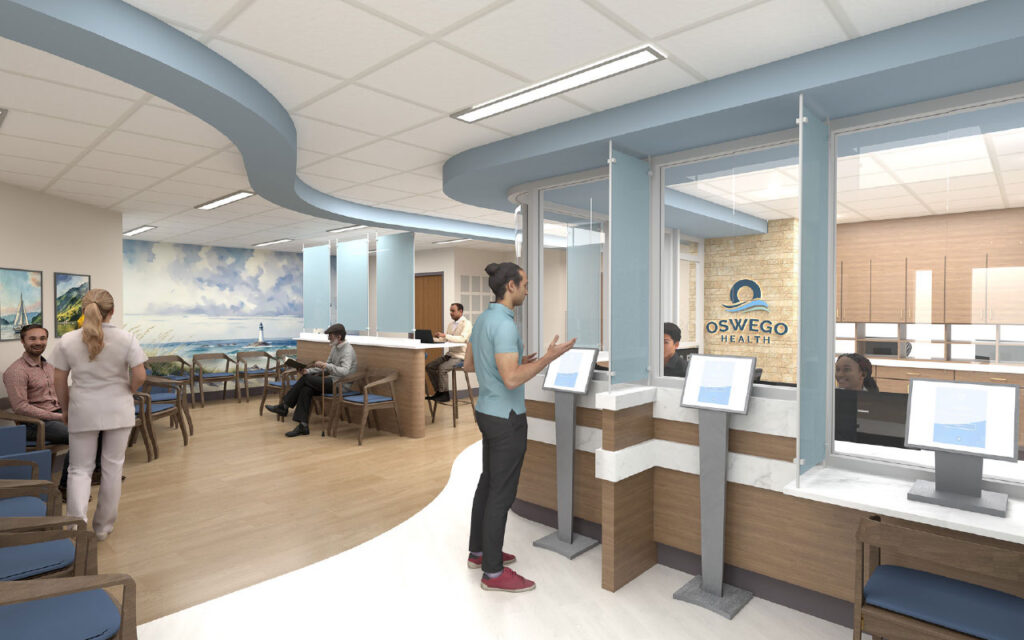
In October 2025, Oswego Health in Oswego, New York, announced a $14-million renovation and expansion project at Oswego Hospital that will streamline patient flow, expand the emergency department, consolidate imaging services into a centralized location and align that department to streamline patient access to it.
David Ruel, vice president of ancillary services at Oswego Health, said that the biggest consideration the project team faced was how to wrangle all of the functions of that work into less than 18,000 square-feet of space.
“We always look at every project with the intent to future-proof, but square-footage is the biggest thing for us,” Ruel said. “We have a landlocked building. We used a shoehorn and got every inch of space out of this.”
The upgrades also include procuring two, state-of-the-art CT scanners to improve patient access to services. By situating the CT devices in close proximity to the emergency department, and consolidating two imaging centers within the building into a shared space, the physical redesign also facilitated workflow improvements that allow staff to be more responsive to patient needs.
“My techs are producing 40 to 50 scans a day,” Ruel said. “The need is out there; the resources are few and far between. One of the reasons I brought the department back together was so I can use one tech to run two rooms as opposed to four techs.”
Overall, Ruel said, a small community health system like Oswego doesn’t have the resources to de-centralize its imaging services. The hospital upgrade project was offset by a state Healthcare Facility Transformation grant and nearly $600,000 in community contributions. Despite ever-increasing study volumes, “when scanners are $2 million apiece and finances are limited, trying to put four MRs around the county is rough,” Ruel said. “We use mobile providers to get them out to the community.”
Even if a proposal ultimately is determined to be financially or logistically infeasible, Ruel credited his institution for the seriousness with which it vets every business idea. He credited the committee review process within the hospital as engaging, open to suggestion and understanding about the practicalities of the work that staff are asked to perform.
“This organization and the management team is always willing to hear, look, and come up with ideas,” Ruel said. “When we began the new project, it did not turn out anything like the first pass. Having the service spread at two ends of the building wasn’t effective; the team was willing to hear that and look at that as a solution, and they understood it.”
In addition to flexibly minded leadership, Ruel also described the value that familiarity with previously successful projects can lend to a new one. The Oswego Hospital project represents the 11th of his career, and Ruel’s prior experience has helped avoid potential pitfalls with state regulatory agencies, as well as supporting ongoing imaging department operations during the build-out process.
“Knowing what your state body wants, knowing what the ACR wants, knowing the guidelines; having foreknowledge of that certainly helps you plan this,” he said. “We’re talking an 18-month project in phases, and still caring for those patients we currently have.”
Projects like the one undertaken by Oswego Health reflect an industry-wide expansion of imaging services, as hospitals and health systems work to better align their offerings with community needs. Healthcare organizations often site their projects strategically, with a goal of improving access to care and reducing patient travel, said Chad Beebe, deputy executive director of the American Society for Health Care Engineering (ASCHE), a professional membership group of the American Hospital Association (AHA).
“This often includes expanding outpatient and community-based imaging locations, upgrading equipment to support evolving clinical demands, and adding advanced modalities where population health trends justify the investment,” Beebe said. “The goal is to deliver the right level of imaging care in the most appropriate and accessible setting.”
Construction trends vary, with rural and community hospitals tending to focus on essential diagnostic imaging services for patients with limited access or emergent needs, Beebe said. Academic and urban imaging centers and health systems, on the other hand, may host advanced imaging services that offer greater complexity of care, support research and professional education, or specialized clinical services.
In whichever environment a project is undertaken, “building infrastructure capacity for medical imaging requires careful coordination of power, cooling, space and compliance requirements,” Beebe said.
On the power side, electrical systems should be sufficient not only to support normal operations, but also continuity during extended outages, he said, making “redundancy, emergency power, and protected circuits for critical imaging equipment” necessary components of any imaging project.
“Cooling requirements are equally important,” Beebe said; “imaging rooms must be designed to manage both equipment and room heat loads through adequate chilled water capacity, ventilation and humidity control.”
Like power systems, cooling systems are expected to be able to maintain uptime during unforeseen complications, and that resilience doesn’t only extend to device uptime.
Healthcare organizations rank physical and cybersecurity risks among the top threats to their facilities, staff and patients, and are taking greater care to contemplate them at the top of any planning discussion.
In the 2026 edition of the annual hospital construction survey conducted by Health Facilities Management (HFM) magazine and the American Society for Health Care Engineering, some 300 healthcare professionals were polled about their perspectives on budgeting, construction and equipment purchasing trends. Their topline takeaways for construction involved the integration of physical and cybersecurity countermeasures.
In a brief accompanying the results, writers Chris Dimick and Jamie Morgan described the work of security-related design features as necessary to prevent physical and verbal attacks on staff and patients, cybersecurity breaches, child abduction and pharmaceutical theft. Among those security features most recommended are surveillance cameras and lighting, parking lot fencing, vehicle bollards, weapons control systems and control plans that can contemplate the eventuality of access restriction or facilities lockdowns.
Just as important as physical security is cybersecurity: only 34 percent of respondents said their security officials and information technology teams collaborate in developing “physical environment-related cybersecurity measures,” and only 38 percent said facilities management teams are involved in those conversations. Connecting new and legacy clinical systems, equipment, and software is especially important in managing vulnerabilities established by the Internet of Things (IoT), like web-enabled controls on heating, ventilating and air-conditioning (HVAC) and fire safety systems.
Acute care hospitals remain the top building project currently under construction among survey respondents, followed by ambulatory care, and, for the first time, central energy plants, as increased power demands are pressing facilities to reduce costs and carbon emissions.
Ultimately, the blueprint for tomorrow’s imaging environment is less about square footage and more about foresight. As technologies evolve, care models decentralize, and patient expectations rise, the most successful projects will be those that begin with clarity of purpose. By aligning clinical workflows, infrastructure and long-term strategy from the outset, healthcare leaders can create spaces that not only meet today’s demands, but adapt seamlessly to what comes next. •