
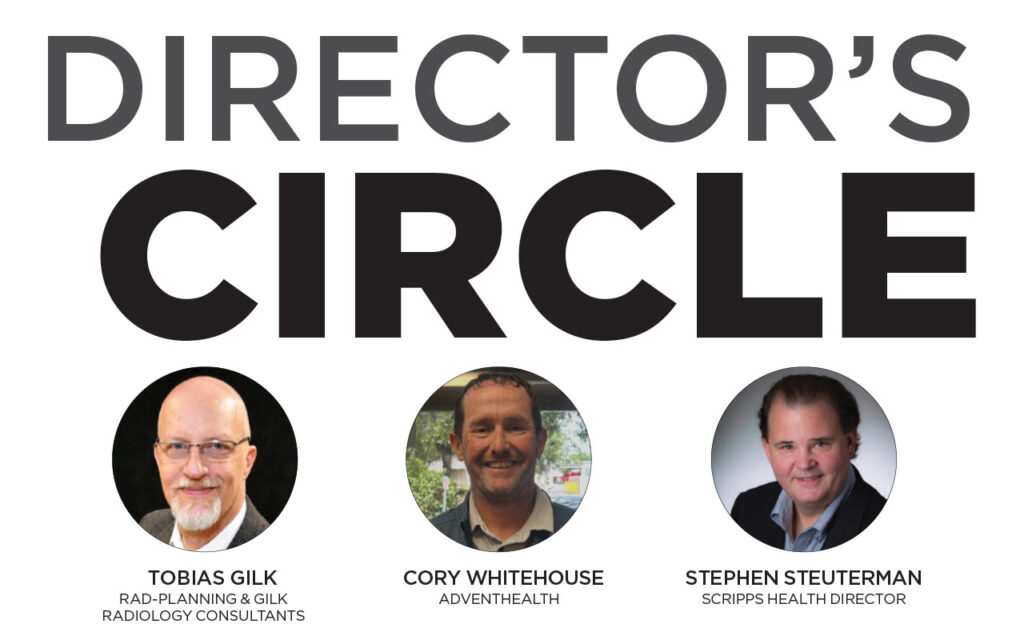
Safety is an important aspect of healthcare delivery and that includes the safety of the patients, providers and everyone involved. ICE Magazine contacted several radiology/imaging safety experts to participate in this roundtable-type article.
Three leaders in radiology and imaging safety agreed to share their expert insights with the ICE Magazine community. Participants include:
- RAD-Planning & Gilk Radiology Consultants Principal Tobias Gilk, MRSO, MRSE;
- AdventHealth Clinical Director at AdventHealth Imaging Center Cory Whitehouse;and
- Scripps Health Director of Medical Physics & Radiation Safety Stephen Steuterman.
Q: WHAT ARE THE MOST PRESSING SAFETY CONCERNS CURRENTLY FACING YOUR RADIOLOGY DEPARTMENT OR IMAGING CENTER, AND HOW ARE YOU ADDRESSING THEM?
Gilk: For better or worse, I’m not “in the trenches” at a hospital, but instead am trying to wrestle with a number of the “big picture” issues related to safety. Perhaps my biggest concern of this moment is the severe strain that I see in MRI services, everywhere: cost reductions, throughput increases, smaller workforces, and increased patient complexities. In my corner of radiology, MRI, where there are no meaningful minimum safety requirements, this often means that safety efforts get “shortcut,” imperiling patients and staff, alike.
Whitehouse: We just changed to virtual supervision of contrast administration. It has been a journey. We are now seeing great success but starting the program was very unsettling for clinical staff. We implemented an education process as well. The soft go live really helped elevate concerns while we started the program at sites.
Steuterman: A primary focus for us remains on balancing image quality with radiation dose reduction, particularly in CT imaging, where minimizing exposure without compromising diagnostic image quality is critical. To address this, we require the use of procedure protocols and leverage tools such as the ACR Appropriateness Criteria to help ensure imaging is necessary and appropriate. In MRI, safety continues to be a top priority due to the complexity of screening for ferromagnetic implants, pacemakers, neurostimulators, and other devices. We maintain strict screening protocols and ongoing staff education to mitigate these risks.
Q: HOW DOES YOUR FACILITY ENSURE COMPLIANCE WITH RADIATION DOSE MONITORING AND DOSE REDUCTION PROTOCOLS FOR PATIENTS AND STAFF?
Gilk: I know you didn’t mean it this way, but I actually had to chuckle when you used “compliance” and I was thinking about MRI safety. If you were looking strictly at mandatory compliance (not what we ought to do, but what someone makes us do), then there functionally is no MRI safety compliance … because there are no MRI safety minimums.
Whitehouse: We have the dose monitoring program Radametrics. We stay in compliance with radiation monitoring with our radiation physics team. They help us stay compliant in monitoring and advising our staff. We also have a radiation safety monitoring course the staff completes yearly in our online learning.
Steuterman: We maintain a robust radiation safety and dosimetry program for our staff, including initial and annual training that emphasizes correct dosimeter usage, timely badge exchange, and adherence to safety protocols. For patients, we utilize advanced dose monitoring software to track radiation exposure, particularly for CT and fluoroscopy. The software includes dose alerts customized by modality and exam type. This allows us to compare data across facilities, assess trends and optimize protocols. Additionally, we hold bimonthly multidisciplinary meetings with imaging administration, radiologists, modality leaders, supervisors, and our medical physicist. These meetings cover equipment updates, regulatory changes, workflow reviews, and protocol evaluations, ensuring a continuous cycle of quality improvement and safety compliance.
Q: CAN YOU DESCRIBE YOUR PROCESS FOR CREDENTIALING AND ONGOING TRAINING RELATED TO IMAGING SAFETY, ESPECIALLY WITH MODALITIES LIKE CT, MRI, AND FLUOROSCOPY?
Gilk: This is one of the bright spots in MRI safety. We’ve had radiation safety officers (RSOs) for forever, and over the past decade we’re beginning to see facilities adopt MRI safety officers (MRSOs)! At the moment, this role is not explicitly required by state licensure, or accreditation organizations, or CMS Conditions of Participation, but there are now thousands of trained and credentialed MRSOs across the country and around the world! This level of knowledge is well beyond what MRI techs are exposed to in their training programs, and can often improve a provider’s safety and patient access to MRI exams. There are a number of different MRI safety training seminars and courses, but there’s only a single credentialling group, the ABMRS and their certifications for MRSOs, as well as physicians (MRMDs) and medical physicists (MRSEs).
Whitehouse: The staff has radiation safety training yearly to those modalities. Our physics team works with the state for credentialing.
Steuterman: All imaging staff are required to hold the appropriate state licenses and certifications upon hire, which are closely monitored for timely renewal. This process is managed collaboratively between human resources and imaging leadership. Staff receive both initial and annual safety training, tailored to their specific modalities. Our radiation safety program includes general safety principles followed by modality-specific sections, including CT, fluoroscopy, mammography and nuclear medicine. This structured training ensures staff are up to date with the latest safety standards and best practices in each area.
Q: WHAT STRATEGIES OR TECHNOLOGIES CAN BE IMPLEMENTED TO IMPROVE PATIENT SAFETY AND REDUCE THE RISK OF ADVERSE EVENTS DURING IMAGING PROCEDURES?
Gilk: Oh, how I wish I could waive a magic wand and get CMS to accept, adopt, and embrace MRI safety best practices as minimum standards. But if I were king for the day, I’d require all hospitals and imaging centers to have appointed MRSOs, and all radiology practices to have MRMDs. I think having a clearly delineated line of responsibility/authority for MRI safety might be the single best thing that we could do to improve safety conditions. I think without effective governance structures, many of the tools or technologies that I might suggest (and that we really need) would be far less effective.
Whitehouse: Creating a culture of education and not being punitive. The staff takes classes in our online training program to speak up when necessary. We also utilize a safety culture survey that helps us identify possible safety issues or cultures that are not conducive to safety.
Steuterman: Patient safety begins with proper identification. Staff are trained to verify multiple identifiers, such as full name, date of birth, and medical record number, to prevent misidentification. We also perform daily pre-exam order reviews to ensure the exam matches the clinical history and is appropriate. This gives us time to consult with radiologists or referring providers if clarification is needed. During scheduling, patients complete pre-screening questionnaires relevant to the modality, such as allergies for contrast studies or metal screening for MRI. These are reviewed again at the time of the exam. These multiple checks significantly reduce any risk of adverse events.
Q: HOW CAN ONE FOSTER A CULTURE OF SAFETY AND ENCOURAGE INCIDENT REPORTING, FEEDBACK, AND CONTINUOUS IMPROVEMENT WITHIN YOUR IMAGING TEAM?
Gilk: Oh, now you’ve touched a nerve! In MRI the existing incident reporting structure is so convoluted and confusing that – further motivated by shame and embarrassment – MRI accidents are concealed and suppressed with alarming frequency. I have a citizen’s petition to the FDA to modestly improve one part of MRI accident reporting (https://www.regulations.gov/document/FDA-2025-P-1100-0001). But to make a big difference, I would encourage everyone to share accidents and near misses with an MRI-specific adverse incident reporting system that I’m a partner in establishing: CAIREreporting.org.
Whitehouse: We try to foster a culture where the staff feels comfortable with leadership enough to speak up about their concerns. If they are empowered to seek out leadership, and know it will be a positive experience, they will be more likely to do so.
Steuterman: We actively promote a culture of transparency and non-punitive reporting. Staff are encouraged to report any safety concerns using an online portal or call center, both of which can be accessed anonymously. We also run routine quality assurance (QA) reviews where one site evaluates a set number of exams from another location. These audits assess image quality, documentation, positioning and artifacts. Findings are shared with staff and used for continuous improvement. As the medical physicist, I maintain regular informal and formal touchpoints with staff, encouraging them to bring forward safety, equipment or workflow concerns confidentially. The goal is to build trust and reinforce that safety is a shared responsibility.
Q: LOOKING AHEAD, WHAT INNOVATIONS OR CHANGES IN POLICY DO YOU BELIEVE WILL HAVE THE GREATEST IMPACT ON IMAGING SAFETY OVER THE NEXT 3-5 YEARS?
Gilk: I don’t want to sound like Debbie Downer, but I think the greatest impact to MRI safety in the near term will likely be complacency, and it won’t help us. I don’t see any serious or institutional approaches to improving MRI safety on the near horizon. My fear is that we’ll continue a slow slide into greater and greater risk. Absent a changemaker in a national structure, or – God forbid – another high-profile MRI fatality, I think everyone working towards improving MRI safety has signed on to be Sisyphus for a while longer.
Whitehouse: I think we must leverage technology in all ways to better protect our patients. There are constantly new ways emerging to keep patients safe from MRI, safer ways we can better screen our patients. To leveraging technology like Volpara in MA to better diagnose cancer via mammograms and utilizing CAD to help us with MRI breast exams, we can keep our patients safe and produce the best outcomes for them. Also, since we went to virtual supervision of contrast, we have noticed that more instant support when we have contrast reactions because the radiologists are much easier to get in touch with. They are just a touch away. This is just a few instances where we have leveraged technology to keep our patients safe and create a culture of safety; and produce the best outcomes for our patients.
Steuterman: Technological advances are improving imaging safety. New CT innovations such as photon-counting detectors offer lower doses with enhanced image quality. In MRI, hardware and software improvements are shortening scan times and reducing contrast requirements. Additionally, AI is playing a growing role in supporting radiologist workflows. These innovations collectively can be safer, faster and more efficient imaging in the years ahead.