

By Matt Skoufalos
In an effort to evaluate new learning models for radiology students in academic settings across the globe, radiologists in Kingston, Ontario, Canada and Nairobi, Kenya are partnering on a four-year research project integrating distance learning, teleradiology and virtual reality.
Radiologist Omar Islam has headed the radiology department at Queens University in Kingston, Ontario, Canada, since 2019. In 2020, Islam’s department sought to establish a partnership with a sister department of Diagnostic Imaging and Radiation Medicine at the University of Nairobi in Kenya.
They called it the Global Health International Education Exchange and Visiting Professorship, and it was funded by a grant from the United Kingdom Association of Commonwealth Universities. Learners on both sides of the Atlantic would share in joint teaching and grand round sessions delivered remotely, a research project, and an in-person, visiting professorship – initially deferred by the novel coronavirus (COVID-19) pandemic.
“They’re our sister department on two sites, separated by thousands of miles,” Islam said. “Since 2021, we have shared at least four rounds at various intervals each year, taking turns. The most common is our monthly grand rounds: they do up to three and we do nine a year.”
During the pandemic, organizers focused on the online educational exchange, from which emerged a docket of rounds and other learning programs. The grant project, ongoing currently, explores diagnostic imaging lectures delivered through virtual reality (VR).
Islam believes the study represents the first of its kind in the world to evaluate the use of VR devices for medical education. Such an approach represents a departure from distance-learning instructional models like Zoom calls, PowerPoint presentations, and self-guided learning modules. The research will evaluate, through surveys, testing, and learning feedback, whether the virtual approach is helpful, different, or better than other contemporary learning methods.
“Medical education is best delivered in a one-on-one format, ideally with the person right next to you, so you can have a nice dialogue as it’s discussed,” Islam said. “We use the VR headsets to transport the educator and the learner into the same room in cyberspace.”
“They’re in the same room, in a live format, viewing imaging cases and discussing the cases back and forth, bringing that thousands of miles distance between them down to zero,” he added.
Professors and learners take turns donning the equipment, and their fields of vision are projected onto a screen for the rest of the residents to view. The professor wears the VR headset for an hour, and then the learners take turns with the other headset, reviewing medical cases, and answering questions.
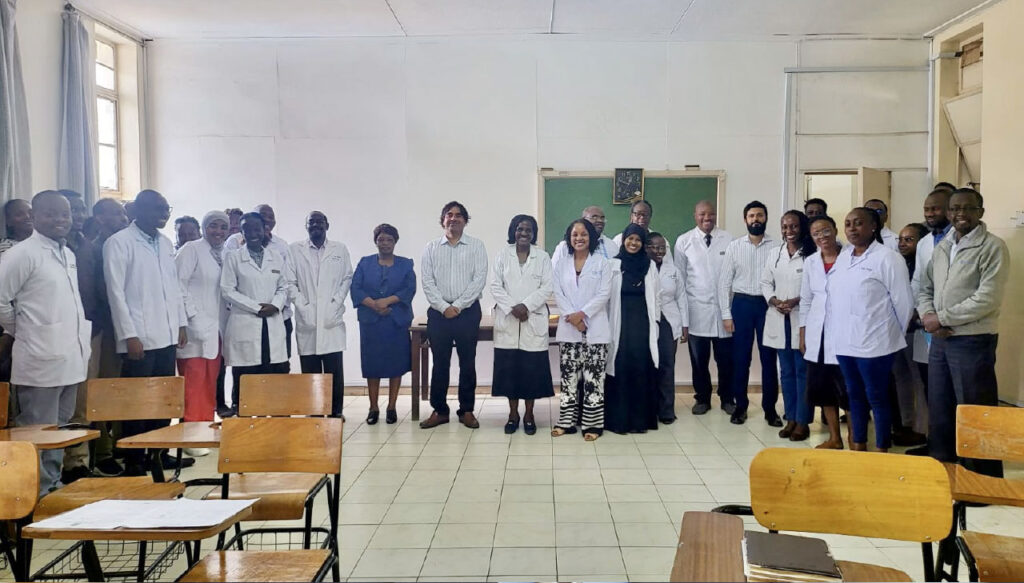
Participating in the learning study are 58 residents in Nairobi, who will complete 12 rounds per year over the four-year study period. Topics are developed from curriculum established by the Royal College of Canada curriculum and the technology partner in the research is a Saskatoon, Saskatchewan-based VR headset manufacturer called Luxsonic.
Much of the initial feedback has been positive, with the major exception of technical glitches related to the instability and speed limitations of the Kenyan Internet. In 2020, Queens paid to establish a Wi-Fi network at the University of Nairobi, and the Canadian team is still “trying to up the speed of the Internet on their end,” Islam said.
“That’s one of the negatives; the other issue has been the use of the joystick and the goggles,” he said. “It’s heavy, so that’s one thing; not everybody is used to that. Some of our younger radiologists who play video games are really into it, but some are not.”
“In terms of the actual delivery of content, the ability to interact on a live basis thousands of miles away has been much more enriching than looking at a slide in a didactic lecture,” Islam said.
The VR format also allows students to scroll through an image database live, alongside the professor, and manipulate the images in the virtual space. That’s a massive departure from the learning environment in Kenya, where there is no PACS system, and patients control the physical films of their own imaging studies.
“The learners can manipulate those images that pop up on the screen just as if they were sitting next to us in front of a radiology monitor in our office,” Islam said. “That’s been the differentiating feature over other methods.”
“In Nairobi, the films are owned by the patient, so when the images are done, they take the films and go, and there’s nothing left back unless the physicians are able to snag a copy, or take screenshot images with their phones,” he said.
“Obviously, the quality is not the same, and you can’t screenshot thousands of images, so they have limited electronic imaging libraries. When you’re doing educational sessions with VR goggles, you’re now in the electronic PACS world.”
As the research teams evaluate both the quality of the education and the educational medium, Islam said that he’s found the VR tools revitalized his approach to the classroom.
“I’ve done one of the sessions so far, and it was really neat,” he said. “It brought back the joy in teaching. I’ve been doing this for 24 years now, and after a while, it becomes semi-automatic. This method is new and hopefully engaging for everyone.”
“The ability to do different methods of educational exchange through being transported into this virtual world was really neat, and there was no loss in quality of images and no loss of sound.”
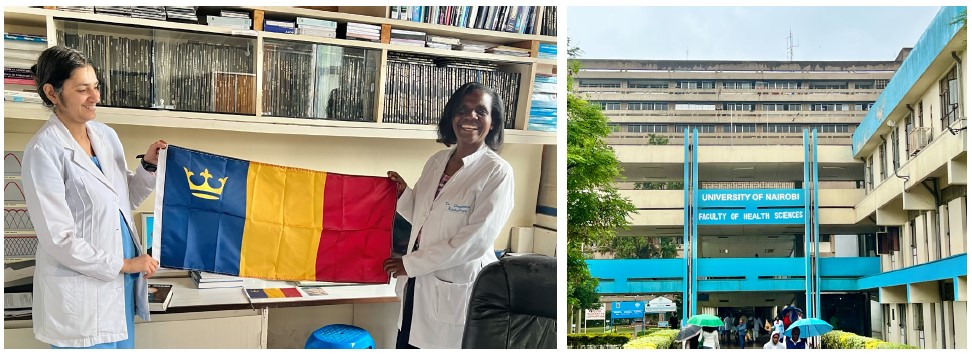
Last year, Islam had the opportunity to visit the Kenyan students through the visiting professorship program, spending a week teaching and evaluating residents in person that he had only met previously in the virtual education setting.
“Medicine is kind of a global language,” Islam said. “We developed really strong bonds with the faculty and the students. They are smart, and very keen to learn, and get better, and support their patients and their country.”
“They enjoy what they do, and want to do more, which made it a really fun trip and a good way to establish bonds over shared goals of improving radiology,” he added.