

 By Matt Skoufalos
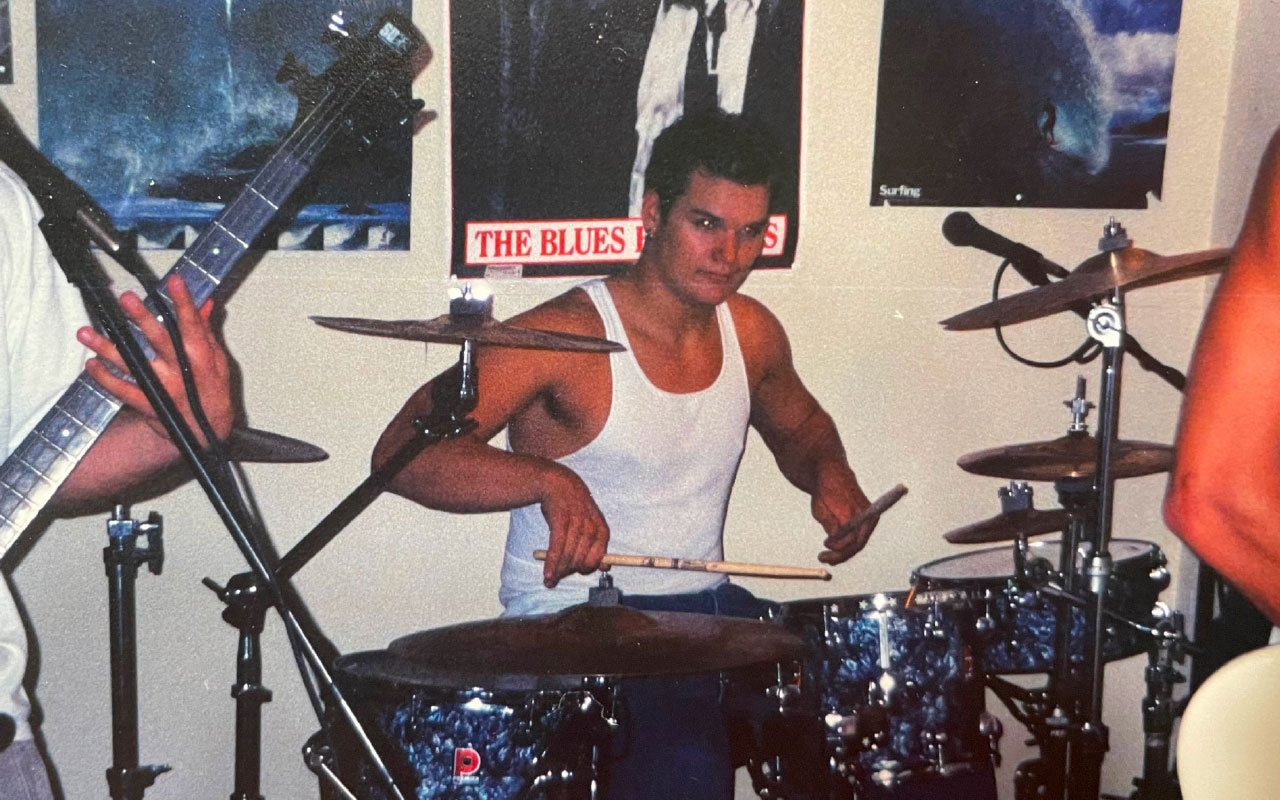
Long before he’d found his place in the imaging informatics world, Mac Beauchemin lived the life of a touring punk rocker. Growing up in Arnold, California, he was raised in the wilderness and the snow of the gold rush country between Yosemite and Tahoe. His mother, Suzanne, has been a piano teacher for 50 years; his dad, Mike, a welder who “played a little banjo and did a little singing.” Mac’s interest was rooted in the drums from an early age.
“My uncle, Bob Yater, played keyboard in a rock band that would play these [neighborhood] parties,” he recalled. “I would sit there at four or five years old and stare at Tommy Parker, their drummer. My parents eventually bought me a cheap drum set, and I started playing piano with my mom.”
Mac played in high school concert and marching bands, wrote parts for some marching competitions, and started a punk trio with his best friends, playing talent shows and then gigging at pizza joints in the Modesto and Stockton areas that would host shows on weekends.
“And then we all went to college, and that band split up,” he said.
Despite performing with a few replacement players through a couple years at Sonoma State University, Mac’s high-school band eventually re-formed. The performers socked away as much money as they could during the semester, working as valets and touring over winter and summer breaks. They called themselves Kalifornia Redemption; together, they released two records and completed four or five national tours between 1998 and 2003.
“We played all over the Midwest; the South, the West coast,” Mac recalled. “Still to this day, I travel a lot for sales, but I saw a lot more of the country touring.”
During that time in music, the punk rock scene was thriving nationally thanks to the kinds of bands that Mac and his mates had formed. The late 1990s success of unsigned California acts like Sublime, which sold tens of thousands of tapes from the back of their van, and Green Day, which exploded on the strength of a vigorous touring schedule, were proving the do-it-yourself (DIY) model had legs.
Of course, success is never guaranteed in the entertainment industry, and Kalifornia Redemption played “many a show for the bartender and the door person,” Mac said. Other bills were more remarkable. Among the many acts the band shared a stage with were The Mighty Mighty Boss Tones, No Means No, and Tilt, whose lead singer, Cinder Block, was an early punk ambassador in Mac’s life.
 “In Petaluma, there’s a famous concert venue called the Phoenix Theater; we used to play it all the time because it was our local venue,” Mac said. “I got to meet Cinder Block and do soundchecks with them. I loved the Mighty Mighty Boss Tones, I love ska music; that was a star-struck moment. But [meeting] Tilt was the moment where I was at a loss of words. They were one of the first punk rock bands I’d ever heard.”
Kalifornia Redemption formed other friendships on the road, sometimes by pure chance. Mac recalled a moment driving down a Texas highway when another band full of punk rockers pulled up alongside their van, and screamed, “Who are you guys?”
“We yelled back and forth, traded CDs across the highway, and became very good friends with them,” Mac said. “They were from Indianapolis. We played a few shows on the way, booked in and around Indy, and we stayed in their house.”
“We also met a lot of good bands and formed good relationships playing clubs; bands like Next to Nothing from New York City, with whom we toured south and east. Our first tour, we started in San Diego, jumped on with another band for 40 days all the way out to Florida, and played a bunch of shows on the way back.”
Today, the bandmates still get together a few times a month at their Oakland studio. Gigs are fewer and farther between, but Mac said there’s a new, 12-song record in the works. As the band Heater, they contributed a cover of the Operation Ivy song “Plea for Peace” for the compilation album Mooorree Than Just Another Comp from Lavasocks Records and Sell the Heart Records. (That track is available to stream on Spotify along with the Kalifornia Redemption catalogue.)
In the past 30 years, more than just time has changed the way that unsigned bands operate. Simply put, the methods they used to employ no longer offer the same opportunities. Websites like BYOFL.org (Book Your Own F—ing Life), which emerged from the magazine MAXIMUMROCKNROLL in 1992, helped self-funded touring acts compile a list of inexpensive resources to chart their courses on the road. Most performers are simply trying to earn enough money to reach the next destination and play again.
“Until we got a little bit of support from a small label and a booking agent, who was just a local guy, we used BYOFL,” Mac said. “We’d mail promoters a merch kit, and they’d call us back and say, ‘I’ve got a show for you.’ That’s how we did almost all our tours. It was all over the phone.”
“Nowadays, I feel like you need to either have serious finance, or you’ve got to know somebody,” he said. “The organizations that could help you from afar without requiring money – I don’t know that that exists anymore. You need to have financial backing, or know the right people to get your name out there, or you have to get lucky.”
“Even with a little bit of help, it seemed more hands-on and grassroots,” Mac said. “You could do it if you had the want and the dedication. You could make it pretty far. It wasn’t all fun, but if you had that dedication, if you were all really into it, I found it all quite rewarding.”
After his touring days ended, Mac was approached by a friend who worked for a staffing agency to fill a temporary receptionist position at a PACS company, so he put on a tie, sat at a desk, and made himself indispensable. It wasn’t long until he was hired on full-time, and then moved from PACS sales support, to lead development, and then to sales. He met Parag Paranjpe in the technical and development side of the business, and after Paranjpe left to found HealthLevel, he invited Mac to join the sales team, where he’s remained for years.
These days, Mac is focused more on passing along his love of playing and performing music to his daughter, Bailey. At 16, she’s already been to five or six times the number of shows he’d seen by that age; Mac chalks it up to living in the Bay Area instead of the mountains. But when she sits down behind the drum kit, nothing puts a bigger smile on his face.