

By Matt Skoufalos
For the next eight years, the U.S. Bureau of Labor Statistics anticipates significant opportunity in the imaging field for MRI and rad techs: a need to add 16,000 professionals annually to meet the growing demand for medical imaging services across a variety of patient populations.
At Children’s Wisconsin, Imaging Manager Jennifer Peterson took a look at those numbers and saw an opportunity to push back against the deficit. For the past 18 months, she’s spearheaded the development of a dedicated pediatric imaging technologist training program, creating just the second such school in the United States. It’s intended to help address the ongoing shortfall of radiologic technologists in the field, especially in a specialty that’s traditionally lacked the same level of attention as others.
“Typical to other service lines, we’re experiencing an imbalance between the number of qualified applicants for a job and the number of jobs posted,” Peterson said.
“Before COVID, we’d seen this spike in vacancy rates, with a declining supply of certified exam-takers versus the job vacancy rate of radiographers over time,” she said. “We want to educate pediatric technologists in the workforce, and develop a pipeline for the imaging workforce.”
The program, which was created in partnership with the Joint Review Committee on Education in Radiologic Technology (JCERT), should receive its first cohort of 10 students in September 2026. They will be taught by four faculty members – a program director, clinical coordinator, and two clinical instructors – from Children’s Wisconsin. Additional affiliations are being explored with institutions located in Wisconsin, Michigan and Minnesota.
To certify their education, the Children’s Wisconsin pediatric imaging training program will endeavor to have 85 percent of its graduates successfully complete the American Registry of Radiologic Technologists (ARRT) credentialed exam on their first attempt, and 100 percent of graduates complete it within two attempts. Peterson said the program aims to place 80 percent of its students on a jobsite within one year of graduation, and maintain an annual attrition rate of less than 30 percent.
“You set that bar, you re-evaluate, you continue to push yourself,” she said. “How can we continue to align within our own department, and push forward and be a contributor at a different level?”
Students’ education will be delivered through online coursework and virtual learning as well as in-person schooling at a dedicated learning environment housed within Children’s Wisconsin. JCERT helped craft the course by identifying faculty to support that program and their levels of education, a manageable class size based on the number of techs, equipment, didactic policies and procedures; and ASRT guidelines for coursework.
Applicants will be admitted through a direct process, which requires them to have completed a minimum of an associate degree, college-level anatomy and physiology I and II, medical terminology, and algebra.
A second “two plus two” pathway would be available for students at colleges and universities with which Children’s Wisconsin has formed affiliation agreements. Students at these institutions would attend them their freshman and sophomore year, and then, once accepted, complete their junior and senior schoolwork at the hospital within their schools.
“[JCERT has] a really well laid-out structure for you to follow to make sure that you’re having your students graduate,” Peterson said. “We want people operating at the top of their licenses; certified technologists that are well-versed in what they do and what they need to do.”
Peterson said that creating the program reflected her efforts to make an impact on the vocational vacancies in pediatric imaging. She credited the “overwhelming support and excitement” of her colleagues, “from the start to where we are now,” in its development. It launched April 22.
Peterson said she was grateful “to have the support of our executive team to do things differently, look at process improvement, and focus on education.”
“The awesome thing about pediatric institutions and imaging as a whole is everybody wants you to win – on behalf of the program, on behalf of the profession,” she said. “It’s a really tight-knit group, and with support all around, has really been an incredible thing to be a part of.”
The importance of professionally trained technologists isn’t just underscored in the quality of images that they’re obtaining, Peterson said; it also lies in learning how to work with board-certified pediatric radiologists, how to position young patients, and how to manage safe radiation doses for the most medically vulnerable kids they may encounter at Children’s.
“In an adult imaging program, they don’t have that dedicated patient population of pediatrics, [but this training] sets them up for more success,” Peterson said. “This education can be transferred and helpful to those patients you’re seeing in adult institutions or in a rural area.”
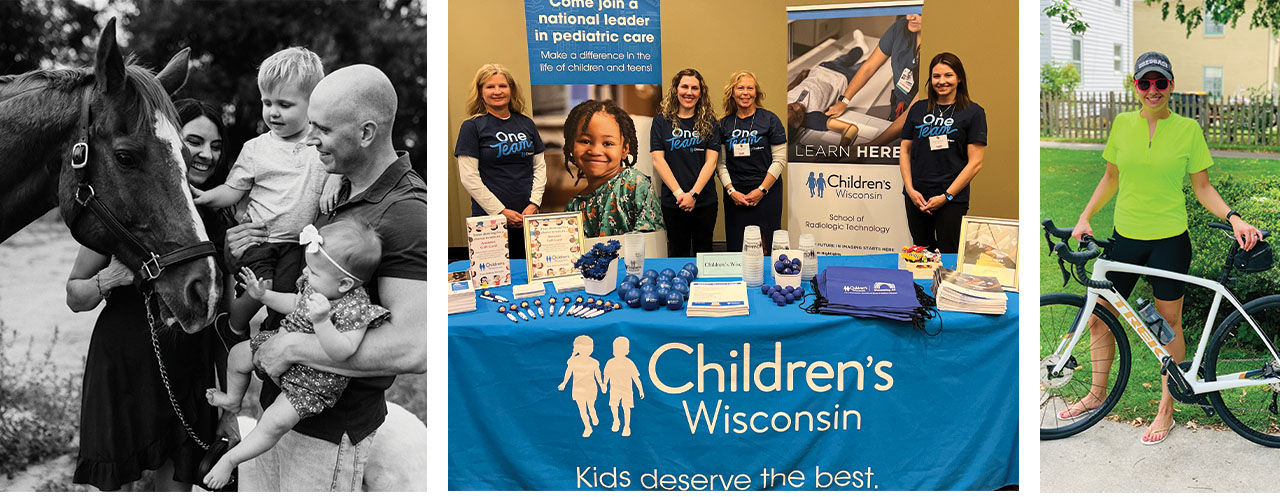
At work, Peterson is thinking about how to develop the next generation of talented caregivers for children, while at home, she is raising Arthur, 4, and Aggie, 2, together with her husband of nine years, Trevor. Peterson is also a lifelong equestrian, who’s competed in dressage at the amateur level; sadly, last year, she lost her lifelong partner, a 29-year-old horse named Zu.
“You always are trying to do something with purpose, and your competitor is yourself,” Peterson said. “We joke that you don’t know true partnership until your partner is 1,200 pounds and has a mind of their own.”
These days, she keeps active with a Milwaukee group called Team Phoenix, through which women who have survived cancer train together for a sprint triathlon – a 500-meter swim, 15K bike, and 5K run. A 2018 survivor of Hodgkins lymphoma, Peterson said the experience of training with people who understand what she’s been through is “rejuvenating.”
“Health is important, well-being is important; as a cancer survivor, your life depends on it,” Peterson said. “You do much better when you stay active, so it’s a really important thing to keep in focus.”