

By Matt Skoufalos
Sometimes, an unexpected setback can pave the way for a new opportunity. For Angelica Jaramillo, it was the back injury she sustained while working as a radiologic technologist at the University of Texas Southwestern Medical Center. As she recuperated, Jaramillo was temporarily reassigned to the radiation safety office to perform less physically intense responsibilities.
What started as a recovery assignment evolved into much more. Drawing from her years of frontline experience as a rad tech, Jaramillo brought a practical perspective to safety work that the department hadn’t had before. In the process of auditing various imaging facilities across UTSW, she became an invaluable asset, offering first-hand insight grounded in the daily realities of patient care and imaging workflow.
“I learned all the regulatory requirements and audited to my heart’s content,” Jaramillo said.
Her attention to detail and grasp of imaging operations stood out so much that, when a colleague was promoted to an imaging manager role, they asked Jaramillo to join them and assist in auditing construction projects under their oversight.
“It started with me trying to keep track of our capital in imaging and perioperative services,” Jaramillo said, “but I noticed so many times that they’d have to go back and ask for more money to finish these projects.
“Before I came on board, they were budgeting only for the price of equipment, and not taking into consideration any of the cost of construction,” Jaramillo said. “Now, even before we replace equipment, we have to prove that it’s worth it.”
Jaramillo didn’t just bring technical experience to the table, but a drive to understand the entire ecosystem of UTSW imaging projects, from compliance and safety requirements to construction logistics. She helped communicate the practical impact of design decisions as they played out in real-world clinical settings.
“A lot of our capital projects were having issues because imaging equipment has such unique installation requirements to keep everything safe,” Jaramillo said. “The people who work in these rooms don’t know how they’re built, but I had the perspectives of being a rad tech and working in the radiation safety office.”
Jaramillo said she’s driven by a desire to create an environment that will serve everyone who interacts with imaging equipment – patients, technologists, service technicians, even cleaning crews. Whether it’s something as simple as keeping enough head clearance to improve workflow, or something as complex as a negative air pressure system in a SPECT/CT suite, she emphasizes designing for safety and usability.
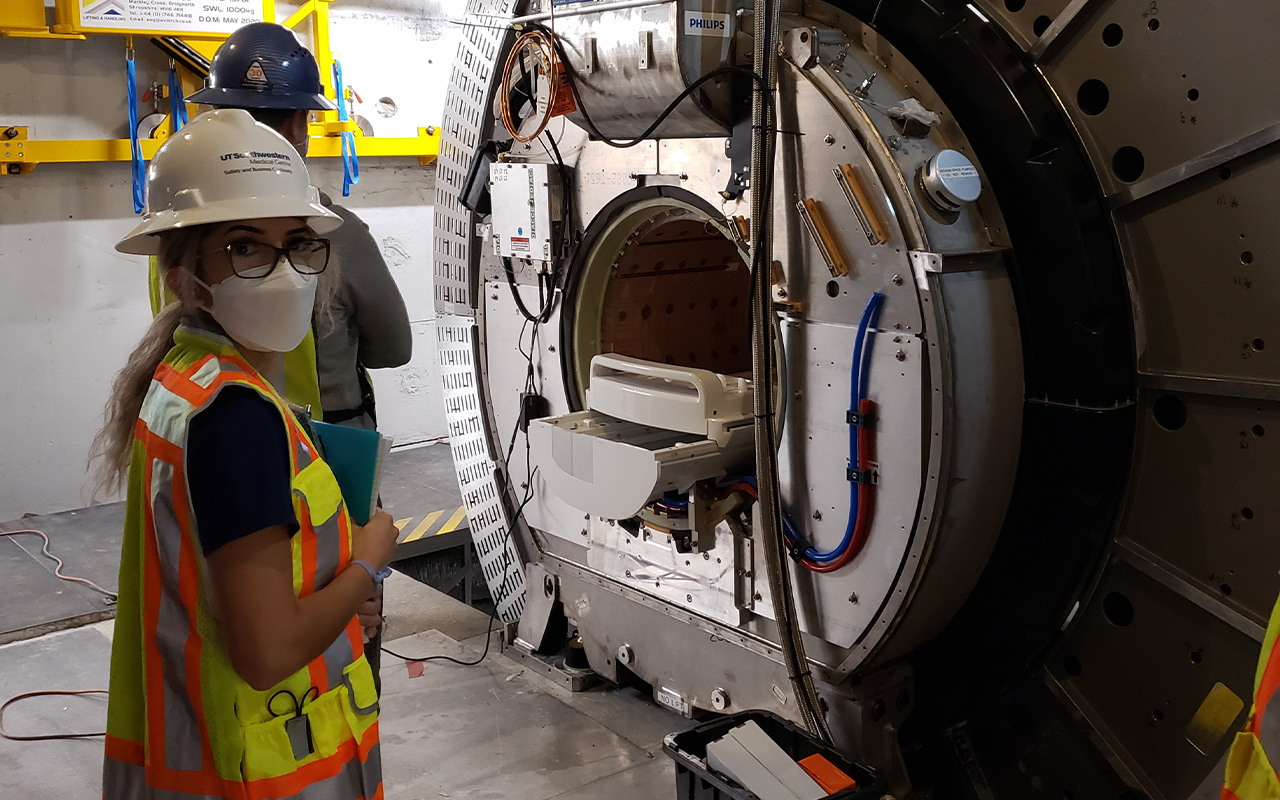
During a recent PET/CT suite construction, Jaramillo caught a critical oversight just in time; one that could have compromised image quality and led to costly rework. The construction team was preparing to install lead shielding directly on top of the concrete slab upon which the imaging equipment would be situated, and then pour Quikrete over the lead to create the finished floor.
“The medical physicist wanted an extra set of eyes” during a routine lead inspection, Jaramillo said. “I said, ‘You’re going to have to rip all of this out.’ ”
Project documentation had specified that the PET/CT scanner must sit directly on the structural concrete slab, not on top of lead, or any poured material. Had the lead been installed as planned, it could have shifted over time due to the weight of the scanner and the softness of the lead. A slight misalignment could have thrown off the scanner calibration, leading to image degradation that can undermine diagnostic confidence and patient care.
Intervening before the lead was installed saved the team from having to tear up both the shielding and the concrete overlay, preserving the integrity of the project, the performance of the imaging system, and the quality of care patients receive.
Following that incident, Jaramillo created a comprehensive modality requirements inventory – a master checklist encompassing shielding specs, construction materials, structural needs, airflow and pressure requirements, and much more – becoming an internal go-to resource for imaging-related construction.
As she took on more responsibilities, Jaramillo didn’t wait for someone to teach her what to do next. She immersed herself in architectural drawings, building codes, technical manuals, and design standards, learning to speak the language of engineers, architects, and administrators alike.
What has begun as self-preparation soon became intrinsic to her work, which evolved into a critical bridge between clinical operations and capital planning.
“I remember in one of my first meetings, one of the old-school project managers told me I couldn’t attend a meeting because the men ‘got really heated,’ ” Jaramillo said. “Now, any time they need to award a design contract, before any leadership sign off, they’ll send it to me and say, ‘Please review this.’ ”
While balancing the demands of her career, Jaramillo is pursuing concurrently a master’s degree in biomedical engineering and imaging informatics, which will broaden her professional opportunities. Along the way, she taught herself Python – initially to support her coursework – and found herself drawn into the possibilities of programming. For one of her first Python projects, Jaramillo created a billiards tournament app for her partner, who was frustrated by a glitchy, hard-to-use app.
“There’s only one out there and it’s not very good,” she said. “I figured I could make something simpler that actually worked the way we needed it to.”
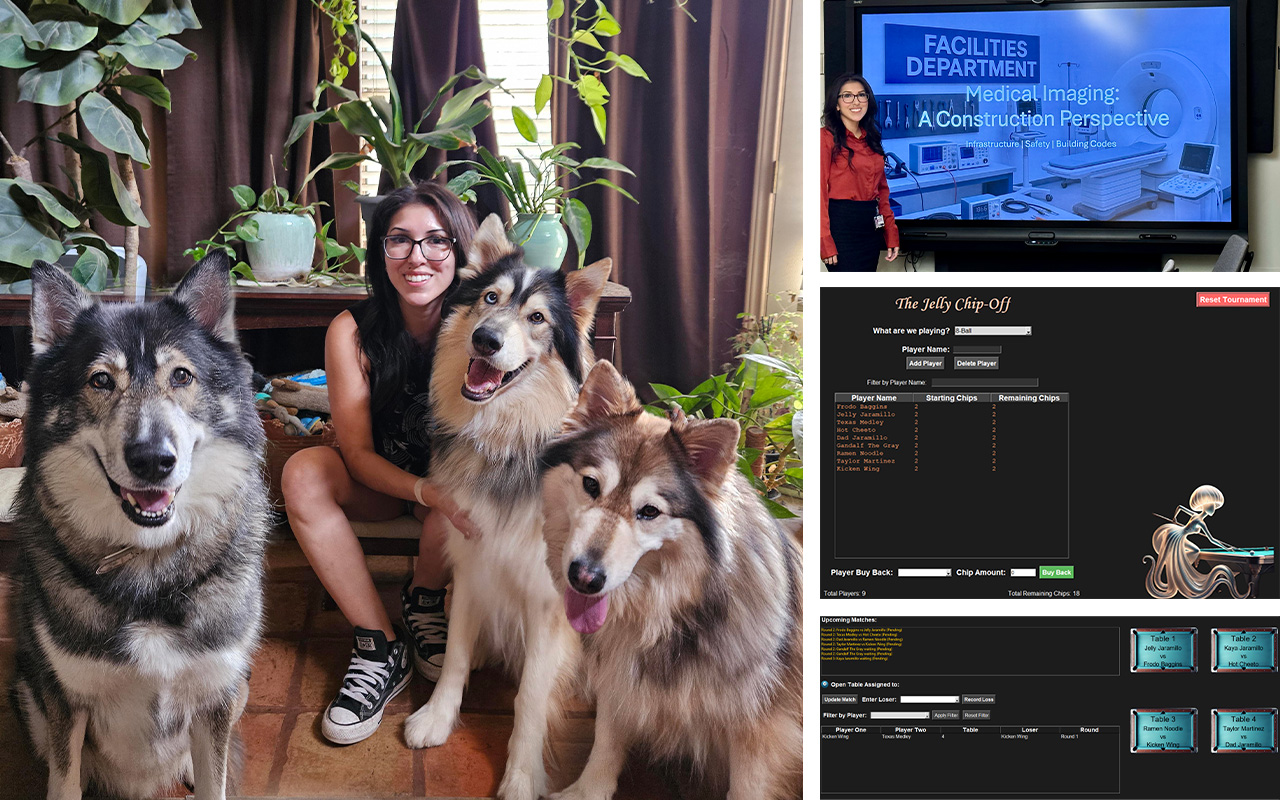
Outside of academics and coding, Jaramillo is also a fiction writer who’s working on her first novel. When she’s not at her desk, she’s keeping pace with her high-energy pack: a trio of huskies named Kaya, Lycan and Treiko.
“I didn’t intend to have three,” she said. “They had babies … and then I accidentally kept one. He’s my grand-pup!”
While she tends to shy away from the spotlight, Jaramillo credits several mentors with encouraging her to step forward when needed. Their support has helped her find the confidence to present her work, lead projects, and take on roles that stretch her comfort zone.
“I can come into meetings in defense of imaging, or with something being wrong,” Jaramillo said. “I’m driven by efficiency.”
“I accidentally became important just because I wanted to fix things and make them better.”