

 By Matt Skoufalos
Shakespeare famously wrote,
“What’s in a name?”
“That which we call a rose/By any other name would smell as sweet,” Juliet’s soliloquy continues – a timeless meditation on the difference between the written word and the symbolic meaning we charge it with conveying.
For Mario Pistilli, executive director of imaging services at Children’s Hospital Los Angeles (CHLA) and recent ICE Diamond Award winner, his first name came with more attention than he’d have preferred as a youngster.
The Bahamian-born Mario moved to the Chicago, Illinois area in the 1970s, just prior to entering the first grade, and experienced a fair amount of culture shock in the transition.
“I’d never seen a snowflake, nor a paved road; everything was new to me,” Mario said. “We didn’t have TV, so I was not familiar with anything on TV.”
Growing up around cousins with names like Michael, Ronald, Bradley and Hank, he was the only Mario in the family. His Italian father liked its connection to Mars, the Roman god of war, and said it sounded masculine and strong. But as a kid, being the only Mario made a lot of extra work for his social interactions.
“I always hated my name, from the get-go,” Mario said. “I have a bunch of male cousins who all had regular names; then I come to Chicago, and nobody is named Mario. I always wanted to be Joe, Mike, Jim, Bob – anything but Mario.”
However, by the time Mario had entered college at the University of St. Francis in Joliet, Illinois, his name had undergone a significant cultural shift, due in no small part to the 1981 release of the Nintendo game Donkey Kong.
According to a 2022 feature on IGN.com, game designer Shigeru Miyamoto had pursued the licensing rights to characters from Popeye. After failing to acquire them, Miyamoto created Mario, initially called “Jumpman,” a ladder-climbing, mallet-wielding, princess-pursuing plumber; the playable protagonist of the story.
Donkey Kong was followed by several video games featuring Mario including the wildly popular Super Mario Bros. and Mario Kart.
There’s no telling how much the popularity of that name was driven by popular fascination with the gaming platform. A review of American baby naming trends shows that “Mario” peaked in commonality in 1980, the year prior, at the 102nd position. In Italy, it’s declined in usage since the late 1990s.
But for Pistilli, the moniker that had been his albatross as a youth transitioned to a pleasant icebreaker in his young adulthood.
“That’s when I was like, ‘Oh, this isn’t so bad,’” he said.
“People instantly made the connection when they heard my name, so I just rolled with it, and it became a thing.”
Beyond chatting him up with catchphrases, people occasionally gifted him Mario-related items – artwork, figurines and such. After accepting a position at Children’s Hospital of Los Angeles, however, his former team at St. Joseph’s Hospital in Joliet sent along the package that burst the dam of Mario-related giving.
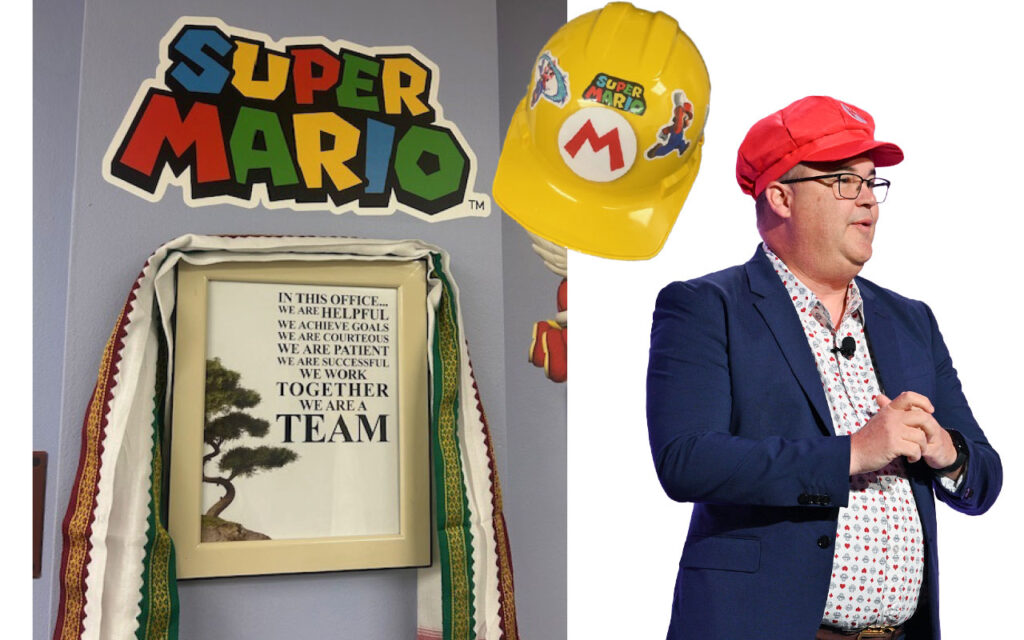
“They got together and surprised me with this big tube of Mario graphic wall clings,” Mario said, “so I decorated my office with the Mario stuff. As people saw that, they started adding to it and adding to it.”
In Pistilli’s office at CHLA, there’s a shelf with Mario figurines, toys, mints, stickers, a lapel pin, Christmas ornaments and more. When he earned his doctorate, Mario suddenly found himself in possession of a Doctor Mario statuette. As he is central to institutional construction projects at CHLA, Mario is the proud owner of a hard hat with the signature “M” over the brim. And every year on March 10 – MAR10, when “Mario Day” is observed unofficially – he’s found his office decorated with Nintendo graphics.
“One year they passed around a Mario hat and took selfies,” Pistill said. “It’s just become a thing.”
The article in his collection that brings Mario the greatest pride is an illustration of Mario that a pediatric patient drew for him. The child unfortunately succumbed to the illness that had brought her to the hospital, but her artwork is a fixture in his workplace and his heart.
“I have it in my office, and it’s my reminder of why I’m here and why I do what I do,” Mario said. “It’s a real source of strength for me.”
For the kid who grew up rejecting the attention his uncommon name drew, Mario ultimately has embraced it; taken ownership of it, if you will. In the pediatric space, it’s become an even more powerful touchstone; a way to connect with children who are going through some of the most challenging health circumstances anyone may face.
“I’ve totally embraced it for years now,” Mario said. “It’s a great way to connect. I love it when people give me Mario stuff. It’s a sign they’re thinking of me in a good way.”
Through working in pediatrics, Mario said, the resilience of children has bolstered his own outlook on life’s challenges, and given him the benefit of perspective on his own struggles.
“Even the worst stuff I deal with in a day is nothing compared to what our patients deal with every day,” Mario said. “They do it with a smile, and laughter, and hope.”
“There’s so much to love about pediatrics,” he said. “We have insanely smart people; caring and passionate people. It’s exciting to be in that incubator of talent and knowledge with people who are so willing to share it.”
“The culture here, because we’re all in this for kids – everyone here is welcome to contribute,” Mario said. “It’s a great atmosphere for people who are willing to work. You can walk out of here satisfied and fulfilled.”
If stepping into the mythical space held by an iconic hero like Super Mario can help him to perform under those circumstances, Pistilli is happy to do it.
His childhood peers who didn’t understand what being a Mario could mean have given way to new generations who are delighted by that same name — and all, as Shakespeare once wrote, that’s in it.