
By Matt Skoufalos
Any healthcare organization is only as strong as the individuals that comprise its workforce, and in the medical imaging department, that truism is particularly pronounced. But if successful institutions rely upon not only the hardest working, but also the most qualified professionals to lead and maintain their clinical and service roles, where are they trained, and in what ways?
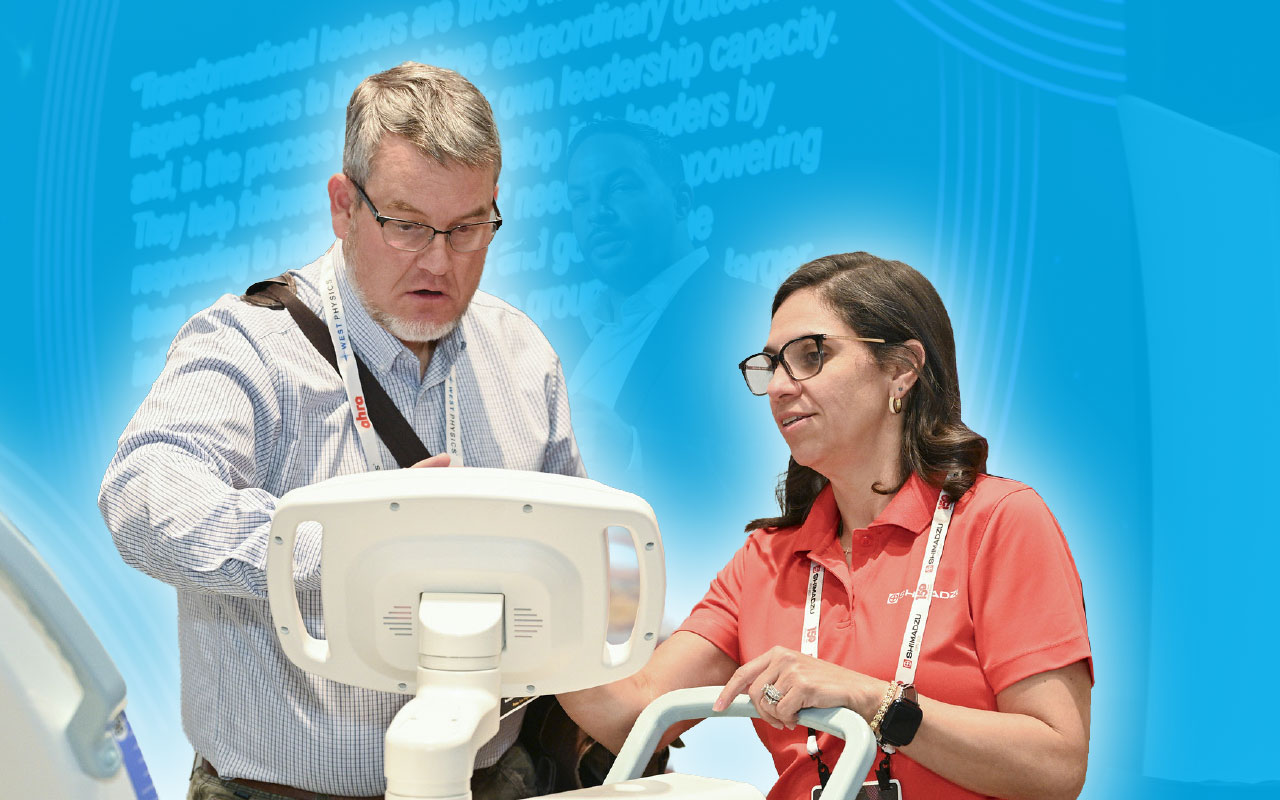
The annual meeting of AHRA: The Association for Medical Imaging Management has long been a cornerstone event for imaging leaders seeking education, professional development and networking opportunities. A new partnership between AHRA and the Association for Radiologic & Imaging Nursing (ARIN) adds to the longstanding practice of leadership development at the heart of the AHRA annual meeting, and enhances its professional education and training offerings.
UT Southwestern Medical Center Imaging Operations Manager Tricia Trammell believes the AHRA annual meeting plays an important role in empowering the imaging leaders of today and tomorrow.
“The education options are fantastic! There is a basic track for new leaders and an advanced track for established leaders,” Trammell said. “The keynotes are always amazing and inspiring. The design team goes to great lengths to ensure an amazing line-up of speakers and a variety of topics that will ensure every leader will find sessions that will bring value to their leadership and operations.”
UC Health System Director of Radiology Jacqui Rose, MBA, CRA, FAHRA, said she attends the AHRA annual meeting for “networking, learning and listening.”
“There is no better, more conducive environment for learning and networking than what the AHRA annual meeting provides us,” Rose said. “We always have a great venue with amazing content and vendor support that is phenomenal. As imaging leaders, we couldn’t ask for more in one location.”
Everyone who attends the meeting gains something from it, she said, “from the senior/lead technologist to the new or experienced manager or director.”
“We all need to gather, learn, listen and network with our peers across the nation,” Rose said. “Every year, we all leave with multiple tidbits, big and small, of great ideas and practices that can improve our organizations and the outcomes of our patients nationwide.”
At the Gathering Place, AHRA attendees interact with leading imaging companies from across the nation, and peer-to-peer socialization offers an informal way to catch up on industry trends and share relevant professional expertise.
“The vendor engagement is amazing, with an environment that enhances our ability to bring the best to our teams,” Rose said. “The amount of support from all areas is beyond belief and every year, we can all count on leaving the meeting feeling rejuvenated and refreshed with more knowledge and best practices to put in place at home.”
Longtime AHRA attendee John Beall said that the conference is a must for any medical imaging professional who wants to grow, regardless of their role, tenure or level of experience in the field.
“Whether you’re just starting out or leading a large department, there’s something here for you,” Beall said. “I’ve attended almost every annual meeting since 2015, and I’ve never left a meeting without bringing something valuable back with me.”
“While I go to learn, I am really there to listen about what challenges others are facing, what’s working, and what’s changing in our field,” he said. “I genuinely enjoy spending time in the exhibit hall as well. It’s not just about seeing new technology; it’s about engaging with vendors who really understand and support technologists and imaging leaders.”
Some of the professional training that bolsters the skills of medical imaging teams is only available directly from the original equipment manufacturers (OEMs) that develop the imaging devices themselves. Julia Sheehy-Chan, vice president and head of education and workforce solutions for North America at Siemens Healthineers, said that her customers turn to the manufacturer for specific education that elevates their overall quality and consistency of patient care in their organizations.
“They see pockets of excellence, but there’s also variability across teams, across shifts, or different sites within the health system, and that can create a sense of inconsistency and sometimes stress,” Sheehy-Chan said. “Ultimately, they are trying to maintain high patient throughput, no matter what shift or what site, and they want to maintain a consistent patient care quality. Consistency across the network is important; standardization is a big buzzword.”
It’s not uncommon for clinical staff to have been trained in-house upon hiring, and maybe again by a vendor only when a hospital or health system is bringing a new piece of imaging equipment online. However, Sheehy-Chan said customers also frequently want OEM support to ramp up staff, standardize in-house practices, and sustain competency as procedures or workflows evolve over time. Their clinical training needs may also include just-in-time support and capacity-building.
“A good example is Advanced Education Support,” Sheehy-Chan said. “That’s an annual subscription that provides customers with ongoing access to our clinical experts through planned virtual support and, if they need it, onsite training. It’s really designed to give them confidence when they go live with new systems and address real-world questions when they arise. If a new staff member wasn’t there for the initial training, within 48 hours, they have their scheduled appointment. We start with a two-hour block, and most questions can be answered in that timeframe.”
Similarly, the Siemens Technologist Education Program (STEP) is a professional development and certificate program for working imaging technologists that blends clinical skills, leadership development and mentorship instruction. At the end of training, STEP participants participate in a continuous quality improvement project, which Sheehy-Chan said can help curb attrition and retain top-tier in-house talent.
“When technologists feel [like their employer has] invested in [them], they perform at higher levels,” Sheehy-Chan said.
To achieve this, organizations should choose offerings that are foremost relevant to the real work staff will perform on the job, in a busy clinical environment, and among existing day-to-day and operational constraints, Sheehy-Chan said. That training should contribute to individual employees’ sustained growth, support organizational goals and be translatable into measurable improvements within their departments. Institutions turn to an OEM to facilitate staff “system proficiency and deep clinical knowledge linked to those systems, expanding and sustaining capabilities as workflows evolve, and leadership readiness, so expertise stays embedded in the organization,” she said.
Certain services can be provided virtually: those that refine and develop protocols, improve post-processing support and offer remote scanning assistance. Remote guidance can help clinical teams review complex cases to be processed, or help when conducting imaging in a remote or rural location that might not have support specialists. Then, there’s Coach, a Siemens Healthineers consulting and staff development program “explicitly framed around performance growth,” Sheehy-Chan said.
“Rather than having a one-time training event, we’ll spend a lot of time developing particular modalities, and focusing on where gaps may be,” she said. “We focus on multiple, smaller items over a period of time, and that allows Coach to work on multiple things to make incremental improvements without a massive disruption to the operation.”
In addition to remote offerings, options like Siemens Healthineers SmartSimulator, a cloud-based solution, allows the OEM to provide “more flexible and blended” delivery of professional education through both distance learning and simulated learning experiences, Sheehy-Chan said.
“That allows staff to train and practice in a simulated device environment while they can have that ramp-up experience,” she said. “You have the best of both worlds: as close as possible to their real scenario while actually not taking the equipment offline.”
Kim Rowland, director of strategic partnerships and military programs at the Radiologic Service Training Institute (RSTI) of Solon, Ohio, said the organization continues to see growing demand for multi-vendor service knowledge among the diagnostic imaging service professionals who seek out education and training there.
“Healthcare organizations, independent service organizations and third-party service providers are all being asked to support increasingly complex imaging environments while also managing workforce shortages and operational pressures,” Rowland said. “As a result, ongoing education is no longer optional; it is essential.”
“At RSTI, our philosophy has always been that we are building engineers, not simply teaching system repair,” she said. “We invest heavily in maintaining functioning imaging systems in our labs because real-world experience matters. The goal is not only to help technicians complete a repair, but to help them understand system operation, workflow and critical thinking in the field.”
Rowland maintains that the most valuable training programs offer hands-on training on real imaging systems and current technology platforms, guided by instructors who are experts in today’s imaging technologies in classrooms and labs with small student-to-equipment ratios.
“Employers increasingly value technicians who are adaptable across multiple OEMs and modalities,” Rowland said. “Continuing education helps improve confidence, reduce downtime, strengthen retention and create advancement opportunities for technicians who want to grow their careers.”
“In many cases, organizations are investing in education as a long-term workforce strategy rather than simply a short-term technical requirement,” she said.
Professional training offerings also must be diversified and specific in order to best match the myriad demands of various imaging environments, said Richard L. “Monty” Gonzales, president of the College of Biomedical Equipment Technology (CBET) in Schertz, Texas.
On one side of its client spectrum, the CBET works with large organizations like Advent Healthcare, Kaiser Permanente and the Mayo Clinic; on the other, it supports independent service organizations (ISOs) who typically operate in rural, distributed and community institutional environments. Their needs align in that each requires highly skilled biomedical engineers to maintain and service their medical imaging equipment; where they differ is in exactly how service professionals are tasked with achieving those ends.
“Having worked with multiple different organizations over the last year on developing innovative approaches to professional development and upskilling, not a single one of them has come back to us with the same exact requirement in terms of what they think training looks like for them to best support their mission,” Gonzales said.
Sometimes institutions want to improve the efficiency of in-house staff training programs, such as was the case with clinical engineering management experts TRIMEDX of Indianapolis, Indiana; PartsSource of Hudson, Ohio; and CBET imaging training subsidiary NVRT Labs. The college worked to develop a customized training program that could “up-skill” 80 to 100 TRIMEDX engineers annually, saving time and money while intensifying training needed for their careers.
“They came to us, and said, ‘Look, we’re spending about this much money on a program that takes our technicians off-cycle and out of operations for about two months, and it’s no longer palatable. We have to more rapidly address the staffing shortage that we have.’ ”
“Their aim, and ours, was to make training more efficient and cost-effective without sacrificing quality,” Gonzales said.
In response, CBET collaborated on a device-specific training program incorporating virtual reality (VR) lab content, online training from seasoned engineers, and concluding with an immersive, one-week, hands-on class at RSTI in Ohio.
“We’ve already put 60 to 80 engineers through that program, and they’re emerging as entry-level imaging technicians,” Gonzales said. “That’s a unique example of a customer coming up and saying, ‘What can we do differently?’ We’re working directly with the close partners that we have in the industry, listening to the industry, listening to the gap that exists, and working with them to address that.”
In another example, CBET worked with the U.S. Department of Defense (DoD) SkillBridge program to train military veterans for civilian careers during the last six months of their active-duty service contract. That program leverages servicemembers “with fantastic, transferable skill sets, such as electronics or avionics … a generally good work ethic … and they’re used to working in teams, independently or remotely,” Gonzales said.
“With little training and the right connections, we placed those servicemembers directly into a healthcare system or an ISO or an OEM,” he said.
In a partnership with the Association for the Advancement of Medical Instrumentation (AAMI) and the American Healthcare Apprenticeships, CBET has helped create a pipeline to recruit new biomedical professionals from graduating high-school students. In collaboration with HOSA-Future Health Professionals (formerly Health Occupation Students of America), all three entities recruited high-performing U.S. high-school students in STEM programs from 38 states to compete for scholarships and apprenticeships in technology-based careers.
“HOSA said, ‘If you get 50 enrolled in this program in your first year, consider that a success.’ We’re four or five months in now, and we’re already at nearly 1,500 students, and could not be more excited about the potential of that program.”
Students selected through the process participate in a six-month, online program developed in partnership with AAMI, at the conclusion of which they are qualified to test for the Certified Associate in Biomedical Technology (CABT) entry-level credential. The top students are guided towards those career paths through scholarship and apprenticeship opportunities.
“That’s probably the most innovative and unique way we’ve been able to really expand recruitment; to open up that talent pipeline at an entry level,” Gonzales said.
However, employers are also encouraging medical imaging professionals to seek career training in what he terms “critical skills,” which include communication, customer service, professional ethics and leadership.
“I have been so focused on the technical skills and development of those programs for so long that I kind of acknowledged those other things, but I didn’t realize what a deficit the industry was at regarding their own perceived level of competency in that area,” Gonzales said. “Not surprisingly, the majority of technicians don’t necessarily pride themselves on these other skills that are also important because they’re so immersed in the technology, troubleshooting and problem-solving in that area; and that’s where their true strengths are.”
“A lot of them would tell you when they start their early careers, ‘I don’t want to be a leader. I never want to be in management,’ until they do, and so developing those skills early through their careers and having that in their arsenal of skills and competencies is really important for them,” he said. “We trained about 1,000 technicians last year in those areas. We’re working with several organizations now to develop customized leadership training programs internally, and they’re not looking for a cookie-cutter approach.”
“Training a technician to be a leader should be viewed similarly to training someone to utilize a new piece of equipment,” Gonzales said. “When we hand someone a new piece of technology, or expand their requirements to support a new medical device, we do not assume competency-training is a prerequisite. Neither should we assume that someone is a good leader and naturally possesses the necessary skills to be one.”
Francis Vonder Haar, chief operating officer at the InterMed Group of Alachua, Florida, views his organization’s offering as knowledge embodied by its employees – professionals who are trained along individually developed career paths designed to serve the needs of its customers.
“We prioritize what we do with what the customer needs most,” Vonder Haar said.
“We also develop deliberate, active career paths for our people,” he said. “We examine the chosen career path for each individual and determine what’s required for that person’s success. As our staff move and mature in their profession, we encourage them to expand into new roles; not just go deeper technically. We collaborate not only on the what, but the how.”
In addition to interpersonal and leadership skills, Vonder Haar points out that ISO technological training differs from OEM professional education in a handful of critical ways, most of them related to proprietary service delivery processes.
The diagnostic imaging field changes as rapidly as technology ramps up, and its workforce must achieve that similarly rapid pace. To empower imaging professionals to keep up requires a continuum of professional development opportunities from professional associations, OEMs, ISOs, trade colleges and other skill delivery mechanisms.