


By Matt Skoufalos
Although the field of theranostics has been around since the 1940s, the advances that will catapult it into more widespread implementation as a frontline cancer treatment are still emerging. The field has so much potential for growth that the FDA approvals of just two new theranostic agents in the past year have had an outsized impact on the survivability of patients with difficult-to-treat cancers.
Dr. Ryan Avery, who directs the nuclear medicine department at the Northwestern Medicine Department of Radiology in Chicago, said that these recent advancements in theranostics provide “an additional column of treatment response” for patients battling the disease.
“For a long time, cancer treatment has been focused on surgical resection, chemotherapy and radiation oncology,” Avery said. “There’s been some diversification, particularly in the chemotherapy paradigm over the last 20 years, related to checkpoint inhibitors and antibody-directed therapies that have well-tolerated side-effect profiles.

“What nuclear medicine is providing through the field of theranostics is very exciting for us: a similarly targeted approach to treat cancer that is both efficacious and also provides minimal side effects,” he said. “It’s a rapidly expanding field due to many targets that can now precisely deliver cancer treatment.”
Beyond FDG: A New Generation of Targeted Agents
Avery distinguishes these treatments from traditional approaches to cancer treatment that involve positron emission tomography-computed tomography (PET-CT) studies with fluorodeoxyglucose (FDG), a sugar-based radioactive tracer that studies tumors through their metabolic activity.
“As most cancers are highly metabolic, it continues to be a great way to detect them, but the specificity still leaves something to desire,” Avery said. “People thought of PET-CT as being synonymous with FDG, but now, it’s completely expanded. We’re seeing a rapid increase in the available agents that we can use for targeting cancer.”
One of those methods has been lutetium-177 dotatate radioligand therapy, which binds to somatostatin receptors in neuroendocrine tumors. Novartis received FDA approval for its version of the therapy under the brand Lutathera in 2018, and an expanded approval for use in a greater number of patients in 2024. Then, in September 2026, Curium’s Bexlutry lutetium dotatate injection was added to the list of FDA-approved theranostics to slow or stop the growth of tumors by targeting hormone receptors on cancer cells. Yet even these recent approvals have lagged behind those in Europe by a decade or so.
PSMA PET-CT and the Shift in Prostate Cancer Care
However, in that time, additional theranostics agents have continued to emerge as viable solutions to different cancer treatments.
“We were just waiting and waiting, but the beauty is that, during this period, a new agent was coming along that was showing to be very promising for targeting prostate antigens,” Avery said.
“Neuroendocrine tumors are hard to treat, but there’s a lower incidence of them,” he continued. “Prostate cancer is one of the most prevalent cancers in men, so we knew that this agent was going to be very impactful, and it was going to move PET-CT and nuclear medicine to the forefront of being able to diagnose prostate cancer and provide a whole new way of treating it.”
In the summer of 2026, that agent – Pluvicto, also from Novartis – was FDA-approved for the treatment of prostate cancers through PSMA (prostate-specific membrane antigen) PET-CT, an approach that Avery expects to deliver an even more significant impact as research into its effectiveness rolls on.
“Recently, the prostate cancer working group has incorporated PSMA PET-CT into the clinical trials,” Avery said. “Having that in the paradigm is going to lead to more studies and more acceptance as the data comes forth, but the early data says that PET-CT is going to be the examination that you would want to have for detection and staging of prostate cancer now.
“One agent, in a sense, totally turned everything on its head as to how we’re going to detect prostate cancer.”
From Last-Line Therapy to Earlier Treatment
That sudden upheaval of expectations seems par for the course for what radiologists anticipate is yet to come as novel theranostics agents continue to emerge. Pointing out that the word theranostics itself is a portmanteau combining “therapy” and “diagnosis,” Avery notes that as effective diagnostic agents emerge from disease detection studies, “the field of nuclear medicine immediately jumps into, ‘When are we going to be able to look and see if we can get a therapeutic agent that works similarly?'”
“Right now, we’ve all extended a whole new approach to provide treatment for neuroendocrine and prostate cancers, and those patients had really run out of any options,” Avery said. “These were introduced to the U.S. healthcare system as last-line therapies; previously those patients would have had nothing, so we were giving them life.
“What’s been more exciting is now that theranostics has got its foot in the door, these therapies are being moved up in the treatment line, which could be even more useful to the patient’s treatment process,” he said.
As theranostics approaches to cancer treatment continue to emerge, Avery also believes that they eventually can be combined with other treatments, like systemic chemotherapy and radiation therapy, to provide an incorporated approach leading to better health outcomes for critically ill patients. He cited the team-based approaches to lung cancer that have included surgical resections, chemotherapy and radiation oncology as collectively delivering the kinds of improvements that have made big differences for patient survivability.
“I think right now, we’re really suffering from a kind of a paradigm shift in thought about providing these therapies, because a lot of people are just used to the diagnostic component of nuclear medicine,” Avery said.
“I wish I could just tell people it’s not that hard,” he said. “It’s very easy to get a theranostics suite or theranostics clinic up and running without taking away from your general workday, and you’re able to provide something that’s highly advantageous for the patient.”
Avery also points to the lagging theranostics market in the United States compared with that of Europe, where these approaches have been in use for more than a decade for a spectrum of cancers that also affect Americans.
“With all PET agents, we’re already thinking, ‘Well, could this be possibly a new theranostics agent?’ There’s so many advances in receptor binding and localization of specific cells that with the new PET agents and the new therapeutic agents, we’re really just at the beginning of how much potential we’re going to be seeing from this,” he said.
Advancing the market for these technologies is what Avery described as “quite a bonanza of capital” focused on clinical research and the commercial viability of its outcomes. If the landscape can shift so significantly beneath the movement of two new PET-CT theranostics agents, “I can only imagine how much more the field is going to explode,” he said.
Bringing Theranostics to Rural Patients
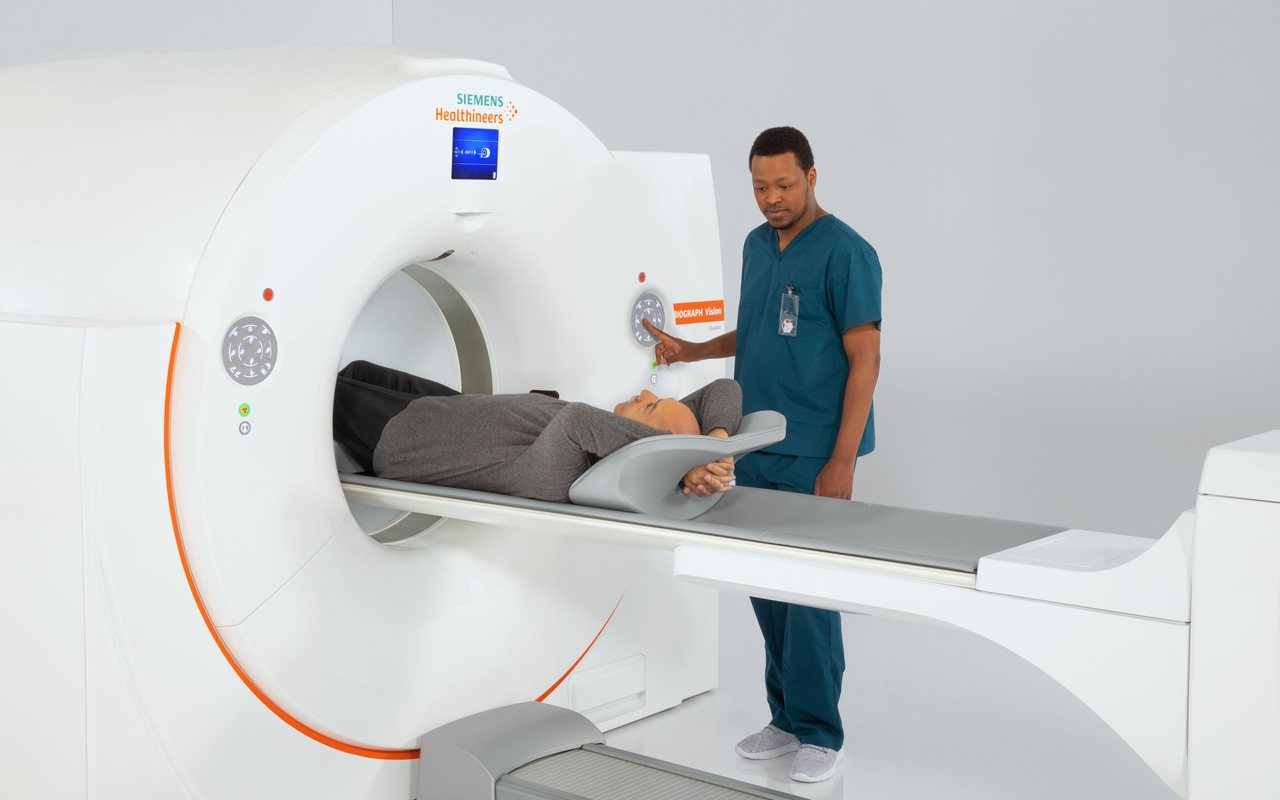
Lady Sawoszczyk, theranostics program executive at Varian, the cancer care business of Siemens Healthineers, and the former global head of theranostics solutions for the Siemens Healthineers molecular imaging business, said that until healthcare leadership buys into the profitability of theranostics technologies, it won’t develop the breadth of patient reach it needs to demonstrate its ability to deliver on its promise. In addition to needing injection rooms to administer theranostics, PET or SPECT-CT, and the physical infrastructure of a nuclear medicine department, institutions wishing to roll out theranostics services also need qualified staff and sufficient financial support.
“Nuclear medicine has always been established in main hospitals and large academic institutions,” Sawoszczyk said. “Where they are not is in these rural areas. I didn’t realize how challenging it is in the middle of the country to receive Pluvicto.”
Sawoszczyk described the circumstances of a farmer who drove five hours to an urban center to complete their theranostics treatments. With sessions scheduled six weeks apart, subsequent appointments weren’t always conducive to the demands of working a farm, however. If the regional health center closer to their home had offered theranostics services, their drive would have been just one hour instead of five.
“Why do you want a theranostics program?” Sawoszczyk said. “The answer is this. They may not be doing high volumes, but a number of patients will get treated [who otherwise could not].”
Building a Financially Viable Theranostics Program
Sawoszczyk also said that the success of a theranostics program, like any other line of service in a healthcare institution, relies upon its financial viability. She’s seen clerical errors derail the sustainability of such programs when payers reject claims that send institutions into the red. To combat these challenges, Siemens Healthineers created reimbursement support service teams that can support claims management, respond to denial letters and even guide customers through the broader processes of implementing and supporting a theranostics program.
“We make sure that everything they’re going to code and do will be financially viable to ensure that those patients continue to have access to therapy,” Sawoszczyk said.
To the same end, she said the company has similarly found value in helping its customers create “a cancer care value program” that incorporates all that Siemens Healthineers has to offer, from molecular imaging equipment and software to radiopharmaceuticals and dosimetry, across its entire portfolio.
“We do a market assessment, including of their existing program if they have one; look at gaps and barriers to scaling, and develop a vision for the next five to 10 years,” Sawoszczyk said. “Every single program is completely customized. We assign key performance indicators (KPIs) and deliver on commitments.”
The package is implemented through teams of consultants who remain with a site for two years, delivering twice-monthly updates, and then roll back their involvement to monthly check-ins in the subsequent, third year.
“They’re looking at it as a way of being hand-held through best practices to being scalable,” Sawoszczyk said. “We have 76 active accounts in the U.S. alone, whether scaling or net-new. Some have the expertise in-house, and they just want imaging equipment; many are really looking into this and saying, ‘This is exactly what I needed.’ It is a value that is an enormous help.”
A Barrier-Free, Interdisciplinary Approach
Philipp Graner, head of theranostics customer development and sales enablement at Varian/Siemens Healthineers and former senior director of theranostics solutions for the Siemens Healthineers Molecular Imaging business in North America, said that the key to implementing a successful theranostics program is “to be more barrier-free” and recognize the interdisciplinary nature of the care pathways that underpin its work.
“The cross-department workflow is so important in being successful for treating the patient,” Graner said. “We can help with the services and make sure our partners are ready for the next step, to scale, even to start.
“We are not just selling a technology,” he said. “We are really trying to support and help our customers with a tailored program approach.”
As that interdisciplinary approach emerges in academic institutions and leading-edge medical centers, Graner foretells its expansion to the outer reaches of their satellite locations and in-network clinics in rural and distributed communities. He argued that the benefits of adding outpatient infusion centers in serving populations in farther-flung communities are central to the mission of larger healthcare networks in meeting patient needs as well as expanding service lines.
One of the myths companies like Siemens Healthineers are still working to dispel is that running a theranostics program is contingent upon operating a cyclotron, investment in which “even at big academic centers, is a very tedious and long-term project,” Graner said. Most currently available theranostics have half-lives long enough to allow them to be delivered across the United States without deteriorating.
“The beauty of theranostics is that, compared to other cancer treatments, the side effects are close to none,” Graner said.
Overall, he said, what will drive broader expansion of theranostics is deeper partnerships among commercial and academic entities that spur more clinical trials, academic research and dosimetry advances to help personalize individual patient treatment plans. To expand that will require changes to legislation that will allow these care pathways to be reimbursable to practitioners and healthcare institutions.
“That’s another field where we will be more and more active to make sure that personalized treatment for those patients is there,” Graner said. “We want to work with different industries together outside of just our portfolio.” •
From PSMA PET-CT to lutetium-based radioligand therapy, theranostics is moving from a last-line option toward earlier, more personalized cancer care. For imaging leaders, the opportunity – and the challenge – lies in building the PET/CT capacity, staffing, reimbursement support and partnerships needed to bring these treatments closer to the patients who need them.