

Transformative solutions striving for earlier detection and improved patient journeys
Traditional breast cancer imaging is faced with critical screening and diagnostic challenges – from workflow bottlenecks and reading inconsistencies to clinician burnout and patient accessibility. The stage is set for desperately needed innovation to propel us into the future of breast cancer care.
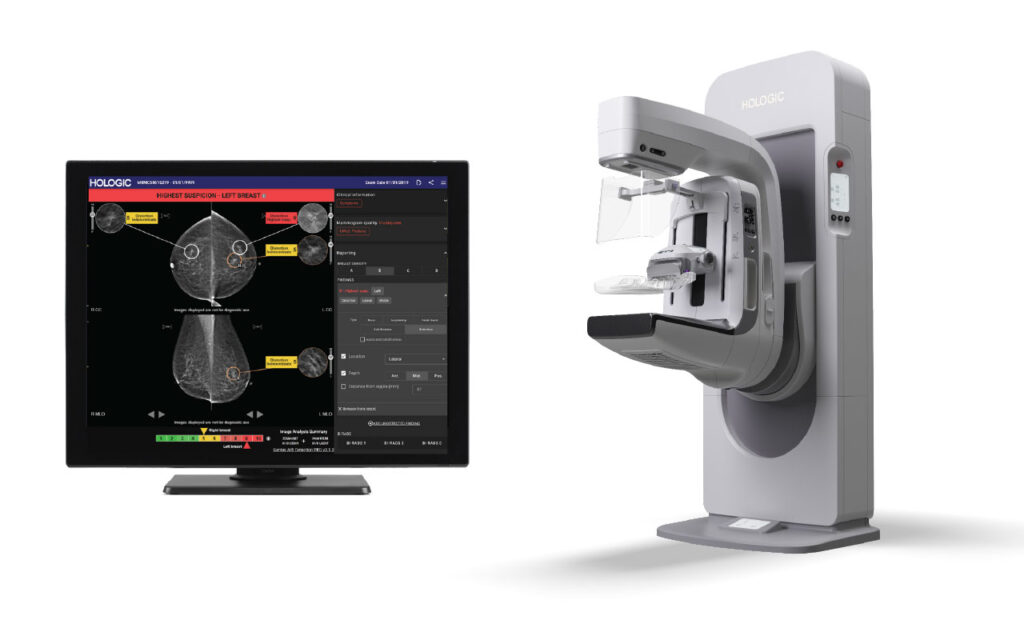
That’s where Hologic has stepped in with its breakthrough combination of Genius AI Detection PRO and the Envision mammography platform. Together, they directly tackle these industry challenges. By engaging cutting-edge technology, they can deliver improved processes and results while also supporting more accessible and comfortable screening for patients.*
Tackling False Positives
False positives and positioning errors cost more than just time. Not only do they slow down workflow and require additional imaging, but they can also negatively impact patients.
False positive results remain concerningly common, occurring in 10-12% of mammograms in women 40-49 years.1 These results can create anxiety for patients, discouraging some from receiving potentially life-saving supplemental imaging. In fact, research found that the number of women returning for a follow-up screening dropped from 77% to 61% after a false positive finding required an additional mammogram.1 These false positives can also lead to emotional distress, additional costs and time wasted for patients, so it’s critical to prioritize reducing them.
Hologic’s Genius AI Detection PRO solution can help. With its integrated 2D/3D deep learning algorithm, the software supports improvements in cancer detection performance.2 The platform’s ability to read priors for mammography images can increase specificity, in addition to driving additional reduction in false positive recall due to analysis of temporal changes.3
Addressing Positioning Challenges
The largest percentage of MQSA-related quality failures is attributed to poor positioning.4 Nearly half of those positioning failures are attributed to inadequate visualization of the posterior tissue and/or the pectoralis major muscle, and sagging of the breast.4 Positioning is also the leading mammography deficiency reported by ACR5 and a significant issue for radiologists and technologists.
Only portions of the breast that are included on the mammographic image can be evaluated for signs of cancer,3 making proper positioning critical for accurate detection. Better patient positioning, and other technologist-associated factors, have been associated with earlier detection and fewer missed cancers.6
The Envision mammography platform offers a solution to help: Tilt positioning. This unique feature enables a more comfortable and accessible imaging experience.** In fact, 10-15% of the patient population has limitations that may result in sub-optimal imaging7, putting them at an increased risk of potentially missed cancers. With improved patient positioning thanks to the Envision platform’s Tilt technology, there may be greater breast tissue capture compared to the standard of care.7
Maximized Efficiency In and Out of the Exam Room
As the radiology industry faces a workforce shortage driven by issues such as burnout, inefficiency and increased demand for imaging9, AI stands to play a key role in improving workflow so providers can focus on the most important part of their job: the patient.
Genius AI Detection PRO solution is designed to tackle these issues and give clinicians valuable time back in their day. The perceived fatigue with using Genius AI Detection PRO solution was significantly lower than the perceived fatigue without it,10* with the solution supporting a 24% reduction overall in reading time and perceived fatigue.10
The solution includes various features that contribute to a reduction in perceived fatigue and reading, while also improving administrative task efficiency. These include an intuitive case score, which allows radiologists to organize cases and allocate time based on case complexity, and time-saving pre-reporting capabilities that automatically send findings to the radiologist’s report.
The Envision mammography platform also offers time-saving features that help improve efficiency in breast imaging. Envision delivers a fast 3DTM scan time of no more than 2.5 seconds11, up to 10x faster than competitors and the fastest scan time on the market.12 The system’s reduced scan time is designed to minimize compression time and patient motion, compared to systems with longer scan times.13
These time-saving mechanisms are critical. Technologists report that a typical screening patient spends about 50 minutes at their imaging facility, with about half of that time spent on positioning and image acquisition.8
Additionally, the Envision platform is designed to track more than 700 new analytics parameters across the subsystems of the gantry, compared to Hologic’s Selenia Dimensions and 3Dimensions. This new tracking allows for predictive service potential, saving users from unnecessary downtime.14
Supporting Early Detection for All Patients
There is a key demographic that is often left behind in breast screening: patients with limited mobility. Screening mammography compliance rates are lower in populations who may face limitations or challenges with positioning during imaging than in women without mobility-restricting cases15, specifically 47% lower among women who are dependent on a wheelchair.15
Technologists report being unable to position patients as effectively as they would like in 10% of screening mammograms,8 facing particular difficulties when that patient has mobility issues. The challenges with positioning a wheelchair-bound patient can add more than 10 minutes to their screening mammogram,8 negatively impacting efficiency, patient time and care.
The Envision platform could be the key to helping improve the standard of care. Its Tilt technology may help with the positioning of patients with limited mobility, possibly resulting in greater tissue capture.7 With the Envision platform, Hologic tackles image quality for patients with limited mobility and challenges the status quo with an inclusive system that affirms that all patients are entitled to the best quality of care.
A Future of Precision and Collaboration
The fusion of AI with next-generation mammography technology is paving the way for a future where breast cancer detection is faster, more accurate and more patient-friendly. Hologic’s Genius AI Detection PRO solution and Envision mammography platform work hand-in-hand to bolster health centers and radiology departments, supporting clinicians and patients alike. By combining the power of advanced AI and mammography technology, they enhance the screening and diagnostic process from start to finish.
For more info, visit hologic.com.
ADS-04412 Hologic, Inc. ©2025 All rights reserved. Hologic, Genius AI Detection PRO, 3D, Envision are registered trademarks of Hologic, Inc. or its subsidiaries in the United States or other countries. Intended for medical professionals and use in the U.S. only. Hologic, Genius AI, 3D, Envision are registered trademarks of Hologic, Inc. or its subsidiaries in the United States or other countries. Intended for medical professionals and use in the U.S. only. *As compared to not using the Genius AI Detection PRO solution **As compared to not using Tilt positioning
1. Diana L. Miglioretti, Linn Abraham, Brian L. Sprague, et al. Association Between False-Positive Results and Return to Screening Mammography in the Breast Cancer Surveillance Consortium Cohort. Ann Intern Med.2024;177:1297-1307. [Epub 3 September 2024]. doi:10.7326/M24-0123
2. S. Pacilè, et al. (2023, May). Application of artificial intelligence to mammography-tomosynthesis combined images for breast cancer screening. [conference presentation]. SBI 2023
3. K240301 510(k) Summary.
4. Bassett, Lawrence & Farria, Dione & Bansal, Swati & Farquhar, Marybeth & Wilcox, Pamela & Feig, Stephen. (2000). Reasons for Failure of a Mammography Unit at Clinical Image Review in the American College of Radiology Mammography Accreditation Program1. Radiology. 215. 698-702. 10.1148/radiology.215.3.r00jn32698.
5. Albus, K. (n.d.). Frequent deficiencies (revised 8-2-2024). American College of Radiology. https://accreditationsupport.acr.org/support/solutions/articles/11000047152-frequent-deficiencies-revised-5-2-2022-
6. Anubha Wadhwa, Julie R. Sullivan, Mary Beth Gonyo, Missed Breast Cancer: What Can We Learn?, Current Problems in Diagnostic Radiology, Volume 45, Issue 6, 2016 ISSN 0363-0188, https://doi.org/10.1067/j.cpradiol.2016.03.001.
7. Miller, L. (2014, September). What every mammography technologist would like their radiologist to know about: Our patients. Mammography Education, Inc.
8. Based on an internal survey of 58 Patients and 7 Technologists. Inspired Health, November 2023. Unpublished internal Hologic data on file.
9. Hudnall, C. E. (2024, July 3). Burnout Fueling Workforce Woes. American College of Radiology. https://www.acr.org/Clinical-Resources/Publications-and-Research/ACR-Bulletin/Burnout-Fueling-Workforce-Woes
10. S. Pacilè, et al. (2024). Evaluation of a multi-instant multi-modal AI system supporting interpretive and noninterpretive functions. Accepted for publication in the Journal of Breast Imaging. https://doi.org/10.1093/jbi/wbae062
11. VER-12082 (1.0)
12. Competitor publications.
13. Smith, A. Improving Patient Comfort in Mammography. Hologic WP-00019 Rev 001 (2017).
14. SRS-01327; AT_02-REQ-17382
15. Olsen, J., Pohlman, S., & Shames, J. (2024). HSR24-155: Disparities in Real-World Screening Mammography Compliance Rates by Body Mass Index and Mobility-Restricting Diagnosis—A Commercial Claims-Based Analysis. Journal of the National Comprehensive Cancer Network, 22(2.5), HSR24-155. Retrieved Jul 30, 2025, from https://doi.org/10.6004/jnccn.2023.7164