



By Matt Skoufalos
The work that it takes to land a medical imaging leadership position requires years of professional experience, the achievement of advanced degrees and technical certifications, and the ability to work effectively in a variety of situations with different people. Continued advancement within that career, or retention of a leadership role once earned, is the work of succession planning – the process whereby a healthcare institution seeks to ensure stability in its management structure throughout an extended period of time.
Succession planning is an exercise in human resource management, capital strategy, and institutional memory. The logistics involved vary by setting, facility, budget, and institutional priority. But as top-tier talent can be difficult to source, and harder to retain, it’s an exercise that can contribute significantly to the long-term health of an imaging team, department, clinic, or hospital.
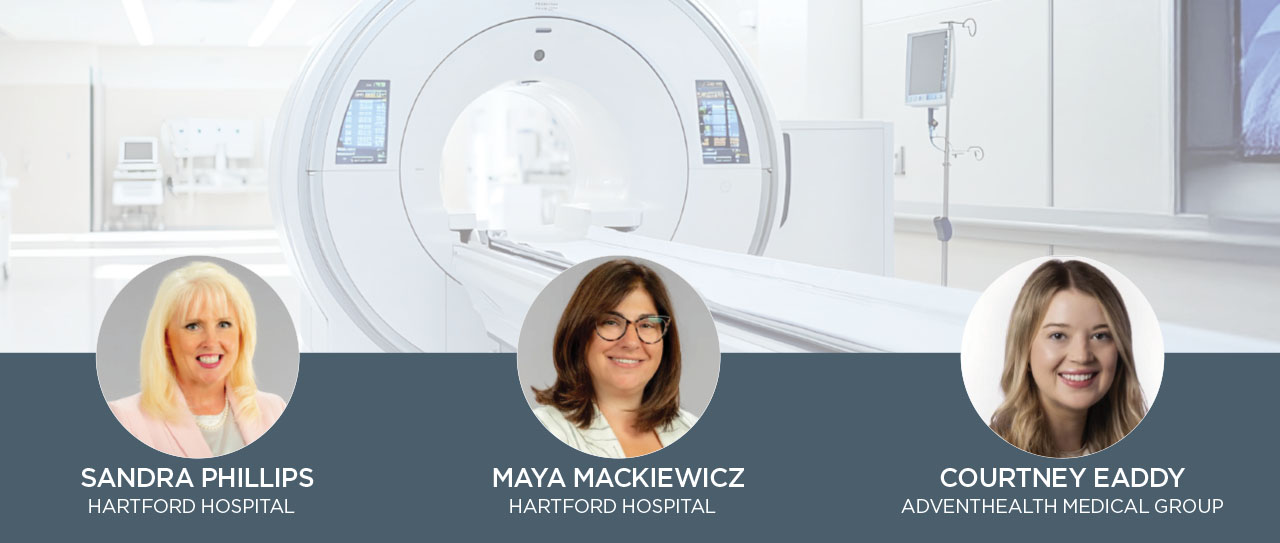
As radiology director for Hartford Hospital and the Bone & Joint Institute and Workforce Manager for all Hartford HealthCare Radiology, Sandra Phillips plays a pivotal role in shaping the structure and strategy of imaging services across the Hartford HealthCare system in Hartford, Connecticut.
From defining job descriptions at every level to overseeing leadership pipelines, Phillips ensures that the radiology departments at Hartford HealthCare are aligned, credentialed, and resilient in the face of persistent change.
“For imaging leaders, it’s our job to know the specific credentials each person needs for every modality, the required job descriptions, and the preferred qualifications for their roles,” Phillips explains. “We base our assessments upon conversations with peers, internal benchmarking, and guidelines from accrediting bodies like The Joint Commission.”
In the event of a planned leadership transition, Phillips said that she considers “a variety of skills” when identifying the person best suited to assume that role. Beyond technical proficiency and workplace professionalism, she said she pursues leaders who are great communicators, mentors, and advocates for the people they supervise.
“It is not just about moving into management,” Phillips said, “it is about having the emotional intelligence and people skills to lead. A lot of people can go into management, but they must have the ability, knowledge, skill, and knowhow to be a people person. Those soft skills are very important.”
Aside from being able to manage among different personality types, Phillips said she sees leadership potential in people who are comfortable taking initiative; those who spot a concern, and, beyond simply identifying it, recommend a solution. She also commits herself to elevating the talent in her organization by facilitating their improvement through coaching, mentoring, and identifying their individual strengths and weaknesses.
When deciding where her employees are in their career tracks, Phillips uses a nine-block assessment tool: a three-by-three grid that helps evaluate employee performance based on potential for growth.
“I map out my management team and ask, ‘Where are they now? Are they ready to move? Are they comfortable in their current role, or should we start preparing them for the next step?’” she said.
“If I left tomorrow, I know my team would be fine,” Phillips said. “I always have a backup plan, and a backup to the backup. Our business has to run whether I’m here or not. But it’s not about me being irreplaceable, it’s about building sustainable leadership. My people are invested, and I invest in them.”
Phillips said she views succession planning as “an operational reality,” and the driver behind her proactive approach to organizational stability. Despite thorough planning, however, sometimes budgetary or other constraints play a larger part in determining the outcome of a management strategy for which she’s advocated.
“Healthcare management isn’t easy,” Phillips said. “We’re all managing rising costs, inflation, and resource limitations. We’re navigating a staffing shortage while leading a new generation of workers who prioritize work-life balance and purpose.
“It makes every leadership hire a strategic decision,” she said. “To attract and retain talent, we have to be creative – not just competitive in pay, but intentional in how we support their development and long-term growth. It’s up to me to present the data and build the case.”
The landscape for healthcare employees in the wake of the novel coronavirus (COVID-19) pandemic remains one that faces a persistent shortage of talent, no matter how aggressive a recruitment and retention strategy any institution may support. Phillips said she sees challenges and opportunities on the horizon, as clinical education programs expand to support planned growth in developing new technologists
“Hospitals are investing more than ever in training and onboarding,” Phillips said. “Imaging schools are at capacity, but they face a bottleneck: there simply aren’t enough clinical sites to accommodate the number of students coming through.”
“It’s a tough balance,” she said. “We want more technologists, but we can only support so many at a time. The situation is improving, and by 2027, I believe we’ll be back to selecting the best of the best.”
Courtney Eaddy is the senior manager human resources business professional for the Central Florida Division of AdventHealth Medical Group. From her perspective, imaging management leadership roles demand executive presence and strong ability to communicate, build trust, and adapt quickly.
“Developing future leaders is an intentional process,” Eaddy said. “At AdventHealth, we identify high-potential internal candidates and support their growth through mentorship, leadership development programs, and exposure to strategic initiatives and key meetings. These experiences help prepare them for future leadership roles.”
In carrying out management responsibilities, the best leaders also can leverage their relevant expertise, be it specific knowledge of technologies or formalized education. Eaddy also believes in the power of mentors to help them transition into leadership roles, and identify any areas where new managers could benefit from additional coaching.
“Interviewing for leadership roles goes beyond technical skill,” Eaddy said. “We are looking for individuals who embody our mission and service standards. Our process often includes a culture fit interview, where candidates are assessed on how well they align with our four Service Standards: Love Me, Own It, Make It Easy and Keep Me Safe.”
In her organization, Eaddy said succession planning efforts may be generated internally within a department before a C-suite team signs off. The first phase of that process involves connecting with organizational vice presidents to help identify any internal candidates who may be a good fit for a promotional opportunity. Thereafter, those vice presidents consult with the HR department about their selections, and create talent profiles, which are then presented to C-suite executives.
Ultimately, succession planning at AdventHealth reflects the work of a shared partnership between human resources teams and executive leadership, with individual reports made to an executive board that has final approval over the proposals. The length of time it takes to place a new candidate in a leadership role is dependent upon the nature of the position sought, and whether the ideal candidate is an internal hire or must be recruited.
“Building a strong leadership pipeline starts with creating a culture that supports growth and recognizes potential,” Eaddy said. “We work closely with our talent acquisition team to identify both internal and external candidates when leadership roles become available.”
“While many of our leaders grow from within, external recruitment allows us to bring in new perspectives and specialized expertise when needed,” she said.
“Retention strategies like mentorship, career-pathing, and professional development play a key role in ensuring we’re cultivating leaders who are engaged, committed and aligned with our mission,” she added.
Although she’s been with Hartford Hospital for 21 years in various roles, Maya Mackiewicz recently became the operations manager for its radiology department, a new position at that institution.
An ultrasound tech by trade, Mackiewicz started working with her associate’s degree, grew into a lead tech position, and then transitioned into a supervisory role. When Phillips assumed her directorship within the hospital, she sought to fill leadership gaps by transitioning leads like Mackiewicz into supervisors.
“When I started here, there were five of us, and now there’s 26 people,” she said. “Now it’s 24/7. As the department grew and our volume increased, there was a leadership need that started taking me off the floor. Sandy transitioned us to managers, so we’re off the floor; when there’s a need, we step in.”
Under Phillips’ mentorship, Mackiewicz completed a bachelor’s degree, and then a master’s degree in healthcare administration. She credits her boss with identifying her innate leadership qualities – among which she described an ability to take control of a situation and drive towards a solution – and finding ways to apply them to the needs of the hospital where they work.
“Being in healthcare for so long, if you want things to change, you have to be the person that is willing to make the change, because otherwise, nothing is going to change,” Mackiewicz said. “It’s easy to get burnt out in healthcare; however, if we want to see things be different, then why not be part of that solution? That’s what drove me.”
Mackiewicz said that when she contemplates the kinds of candidates who will facilitate a succession plan, she considers people who are similarly motivated by achievement and driven to lead in their work environments. Once they’ve been identified, she suggests including those candidates in different meetings, and assigning them responsibilities to see how they manage them.
“There have been situations where we start to train people and it’s not for everybody,” Mackiewicz said; “also, managing people is not for everybody.”
Ideally, she said, the process will yield a candidate who is capable of serving as the back-up to an existing manager, and from there, managers work to debrief with those back-ups whenever they’re gone from the workplace for an extended period of time. Those kinds of one-on-one meetings help to establish which projects can be handed off to individual modality managers, or to other potential candidates who are willing to grow in their roles.
“If I move out of this position a couple of years down the road, there’s people who you definitely can groom to start taking over for you,” Mackiewicz said. “Conversations are important; knowing your goals, your team, and what they want to do. You still want to encourage people to do what they want to do with their lives.”
In all, Mackiewicz said the succession planning process is and ought to be “pretty collaborative.” If the institution has a goal in mind, it’s the job of leaders down the chain to align with that goal; however, she stressed that communication flows both ways.
“We have a balanced scorecard, so if we know that there’s a direction the hospital’s going in, it’s a matter of fitting into that goal and that trajectory, and leadership is pretty open,” Mackiewicz said. “If there’s things we definitely feel like we need, there’s good communication with our department. We can express our concerns, and if we can back it up, they’re very open to our suggestions.”
Another component of succession planning involves establishing the ability to pivot from advanced leadership roles to filling in at the modality level, or even the technologist level, when that is what’s needed in the patient environment.
“At one point one of our sister hospitals lost all their ultrasound technologists,” Mackiweicz said. “I was the one recommended to get over there and help them get re-established as a department. That brings a whole other set of responsibilities.”
Despite the variability in settings to which imaging leadership must be responsive, there are commonalities to the experience of managing people. The more complex a working environment, the more difficult it can be to find a leadership style that meets their variety of needs.
Healthcare leadership is different from the leadership that governs any other kind of business entity; the same strategies do not always apply. Recruitment and retention of key personnel in a succession plan involves finding people who either have or can develop a good rapport with the staff over which they’ll be given charge; whether they’ll be respected in the role often depends upon how they’ve performed within an organization. Sometimes, Mackiewicz said, the outside hire is a necessary move to give a beleaguered team a fresh start.
“Institutional knowledge is very important, especially in a place the size of this organization,” she said. “Coming in already knowing the facility, the layout of the hospital, how everything works in the system – in that case, an internal candidate is the right one.
“If you’ve gone down the road of hiring internal, and that person didn’t work out, you may need a fair amount of change,” Mackiewicz said. “It’s sometimes better than promoting from within, although I do think you should always try to promote from within. That’s really important for growth and longevity.”
