

 By Matt Skoufalos
As diagnostic imaging study volumes spiral and patient wait times for service increase, technology vendors and market-watchers alike all seem to be solving for the same, underlying issue: efficiency. With shortfalls in access to skilled, experienced professionals in the technologist space, and telehealth options increasing in speed and quality, equipment manufacturers believe the answer lies where most of the rest of the economy believes it is to be found as well: artificial intelligence (AI) powered solutions.
At the outset of 2026, they foresee a landscape that for the foreseeable future will be driven by a focus on automated processes, be they in image acquisition and refinement or software-assisted decision-making. The fundamental questions underpinning this push that remain to be answered nonetheless linger. Just how good is AI at doing all the things it’s being tapped to do, and, perhaps as important, who’s going to be paying for it?
These questions were hot topics at the Radiological Society of North America’s (RSNA) 111th Scientific Assembly and Annual Meeting (RSNA 2025).
Pooja Pathak, vice president and general manager of mammography at GE HealthCare, said that her customers are looking for cost-effective technological (and non-technological) solutions that will help drive clinical impact and streamline workflow.
Breast imaging is a “very high-volume” line of service, Pathak said, with 40 million mammograms performed every year. Ninety percent of images come back normal, and so radiologists who are looking for changes to breast tissue over time, need high-quality images that are clear, consistent, and support high-confidence decision-making, screening out negative results to sharpen their focus on tougher cases.
“In mammography, what we offer is transforming the exam workflow,” Pathak said. “On the gantry itself and in the room, we provide zero-click acquisition, so that when the exam starts, the technologist can be focused on the patient and not the screen or the equipment.”
“We’ve eliminated and simplified steps, and brought in prior information to compare different laterality of images at the console itself,” she said. “This ensures that the exam quality is maximized in efficient workflow.
The primary GE HealthCare mammography platform is Senographe Pristina, which competes on a reputation for being patient-centric and clinically reliable. The Pristina Via, which debuted at the end of 2024, is designed to emphasize workflow efficiency, with a fast image-to-image cycle time that relies upon vendor-neutral prior image comparison to eliminate slowdowns. Pathak described it as “thinking systematically to simplify in-room workflow.”
Pristina Recon DL, its latest offering, leverages advanced AI-powered software to detect cancers as early as possible with enhanced 3D image reconstruction.
“It uses two deep learning models to provide clear, sharp, consistent image quality,” Pathak said. “It seamlessly integrates with the customer’s existing technology. In addition, it allows customers to have simplified workflows, and deploys in multivendor fleets.”
AI-driven technologies are embedded throughout the mammography workflow, from image reconstruction to reading and interpretation, thanks to a partnership between GE HealthCare and imaging informatics partner DeepHealth, which produces a cloud-based, AI-enabled viewing system for exam room workflow and interpretation.
 “Radiologists can prioritize their work lists to look by severity of cases, and have an AI aid in the diagnosis itself to assess risk and have faster, more confident diagnoses,” Pathak said. “Any findings there are automatically uploaded to the report. You have clinical insights into where the radiologist is reading.”
Pathak said that GE HealthCare is working to seek out other opportunities to embed AI-powered solutions into mammography functionality that helps with risk assessment in a way that helps eliminate “one-size-fits-all” delivery of care.
“What’s the optimal, more personalized imaging experience for women?” she said. “There’s lots of exams that need to be retaken, and AI technology is available, almost like a copilot, to have a second pair of eyes before they rule out whether the study needs to be recalled. Saving time and the mind-share of radiologists to work on critical cases, that’s where we see future direction and impact of AI.”
The inclusion and expansion of AI-powered technologies in the medical imaging space underscores how many formerly hardware-driven solutions are now being approached with software-based approaches; Pathak said GE Healthcare is working on both.
“We’re innovating in both areas, and you will see more from us,” she said. “Evidence does show that AI in mammo can be an effective aid to diagnosis. All of these things are not just about speed and delegating [diagnostic responsibility]; they’re also about improved patient access.”
“I do think that there’s some guardrails that will keep a good tension between having the right level of evidence about how much you can automate and how much you can scale while still providing the best clinical outcomes in the safest possible way,” Pathak said. “We are continuing to get more involved in creating that change so that industry can be a partner with clinicians and key government officials to drive at the same speed as access and reimbursement.”
Michael Cannavo, president of Image Management Consultants of Winter Springs, Florida, said that radiology administrators’ goals may differ only slightly depending upon their work environments. In a hospital setting, Cannavo said, the majority of those motives are profit-driven, including employee retention. In private practice, however, decisions turn around what is best for the radiologists who own and operate the business. Like technology vendors, decision-makers are relying upon AI-powered technologies to deliver on both.
“You’ve got to serve God and Caesar both,” Cannavo said. “They’ve got to keep the radiologist happy and keep the hospital happy, and they have two entirely different agendas.”
“In a hospital setting, administrators want to keep their technologists happy because it’s hard to find a good tech,” he said. “Here, the use of AI is very important moreso from the reporting than the diagnostic standpoint; workflow versus clinical. AI can look more closely at clinical indications for the report, and how the report is being generated is a lot faster.”
“Anything that is going to streamline the process is of value,” Cannavo said. “It all comes down to what’s going to make us money, save us money, keep employees happy, and make their jobs easier. We all want to improve patient care, but they’re not going to take the money out of their pockets to improve patient care. If AI is one of the ways that it’s going to do it, people are going to use it.”
Cannavo cited vendors like Aidoc and RadAI, producers of software solutions that generate findings from imaging studies that help inform radiologists’ diagnoses. As these technologies continue to advance, he said there are rumblings among larger practice groups that AI-powered solutions could be leveraged to produce preliminary imaging reports. The question remains whether the products are themselves airtight enough to be used in such a fashion.
“Is there a potential for a lawsuit from a misdiagnosis?” Cannavo asked. “Absolutely. Ninety-eight to ninety-nine-percent accuracy sounds good, but two percent of 200,000 procedures is a lot of missed diagnoses. That’s why it’s an adjunct to radiology, it’s not a replacement for it.”
“The reality is that a radiologist is the only one who’s recognized to sign the report, and CMS is not going to pay for AI to do it,” he said. “If AI misses something, can you sue the AI company?”
Cannavo also spoke about the landscape for AI vendors as being distributed among several hundred small, specialized vendors, each of whom may produce only a few, purpose-built algorithms with very specific utilities. He wondered at the future commodification of the product in a landscape where only a few buyers are shopping for mostly the same things.
“There’s almost 1,200 algorithms for diagnostic imaging interpretation from 600 or 700 different vendors,” Cannavo said. “The market is nowhere big enough to support that. Outside of the vendors, a lot of facilities are using their own databases to train an AI model so they don’t have to pay a third-party company.
“A lot of these algorithms are going to come down into the sub-$20 and sub-$10 level,” he said. “Are they doing better for the patient if there’s a better algorithm out there?”
Cannavo also pointed to how AI-powered algorithms are being utilized in the practice space at present as an indication of future trends. Two of the largest diagnostic imaging practice groups in the marketplace – teleradiology provider vRad and the 400-center network Radnet – are offering patients additional fees-for-services to have AI over-read their diagnostic imaging studies in addition to getting radiologists’ takes.
“It’s great in one sense, but in another sense, it sets up a dividing line between the haves and have-nots,” he said. “If I’m a Medicare patient, I’d love to have it, but I might not be able to spend the money to have AI to provide that second opinion.”
“The goal is to get the cost down and the quality up,” Cannavo said. “If you’re using AI, somebody has to pay for it, whether it’s CMS or the hospital.”
Parag Paranjpe is CEO of HealthLevel, based in Mountain View, California. The company is behind Foundations, a software solution that provides analytics and workflow tools to improve operational efficiency. Paranjpe said that efficiency remains top-of-mind for any decision-maker in the field. Although many technological developments are advertised as being AI-enabled, or AI-capable products, frontline radiologists remain focused on features that can improve the speed and quality of their diagnostic reads, he said.
“There’s always advancement and improvement of the ‘pixel’ AI tools,” Paranjpe said – those designed to improve diagnostic quality – “but I haven’t heard about the universal ‘I love this’ capability just yet.”
“There are significant benefits of the advancements made in the image processing AI space, and radiologists still use it,” he said; “they wish things could be a little faster in terms of automating their workflows.”
Paranjpe said that discussions among radiology leaders is consistently focused on how to abate their ever-expanding volumes of unread images while delivering the quality and speed required by industry performance metrics, which prominently includes reimbursements. HealthLevel is focused on addressing operational inefficiencies through greater data transparency to reveal which strategies and technologies are working and which are not.
“We work with customers who had a feeling that the solutions that already exist go beyond image management and integrity,” Paranjpe said. “They have found more accuracy putting all that information together to drive the benefits.”
“Once you start observing it, you start doing a better job.”
In addition to the question of “who’s paying for AI,” Paranjpe said key differentiators in the sector have more to do with their ability to integrate the technology into their existing operations. For a company like HealthLevel, which provides an integrated data platform, the task that remains is collecting information about how the technology is being used, and how to drive interoperability among those discrete offerings.
“At HealthLevel, we use AI tools extensively, and everyone in the company is expected to know, learn and practice how to use AI tools,” Paranjpe said. “But in a healthcare setting with controlled workflows, it’s not so simple. How these tools actually become useful at the fingertips of practitioners is really important. This is the whole zeitgeist. It’s here to stay, and it’s a good thing, but just like any new technology, we have to learn how to use it.”
Whereas many laypeople are familiar with public-facing software tools like OpenAI’s ChatGPT, enterprise-class AI technologies must improve operational workflow for businesses in order to be valuable, he argued. Software-based solutions that strive to deliver a “zero-worklist” status in the imaging suite is the aspirational aim of all workflow-driven solutions.
“There is so much data, so many drivers, that the computer knows better than anyone else which is the highest-priority study,” Paranjpe said. “That will change the background incentives.”
Katie Grant, Ph.D., head of the magnetic resonance (MR) business at Siemens Healthineers North America, described its recently cleared Magnetom Flow platform and 510(k)-pending Biograph One PET/MR scanner as two of the most recent developments the company is offering to address the overarching customer demands for anything that will help improve workflow and efficiency.
“Folks are so bogged down by the number of patients coming through, and, as we all hear about daily, the number of people to do the work is dropping,” Grant said. “The staff needed to run it — the nurses, the technologists, the assistants, even the radiologists — are now in shortage. How do we make it easier for our customers and the patients?”
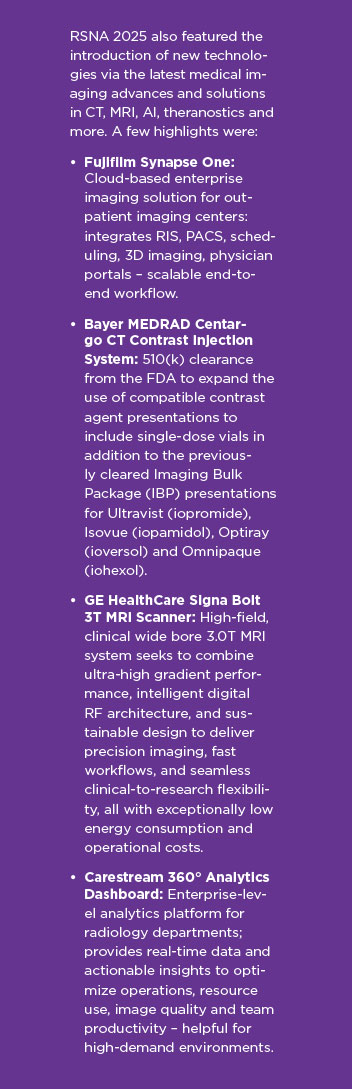
The 70-cm-bore, low-helium Magnetom Flow is a 1.5-Tesla system built around DryCool low-helium technology that helps contribute to its smaller footprint and more versatile deployments. The lighter-weight scanner is as easily installed in an interventional radiology suite or an emergency room as other places such devices previously couldn’t be added. Grant said its energy efficient design also “hits on a lot of sustainability targets,” with the potential to cut energy consumption by as much as 30 to 50 percent per system for one of the most intensive electricity-using devices in the hospital. And, of course, like the other technological improvements most customers are seeking, it’s compatible with AI-powered technologies that automate decision-making, limit software interactions, and generally enable lower-skilled or less-experienced staffers to support the high-volume needs of most diagnostic imaging workspaces.
“We’ve tried to simplify MR as much as possible as we move towards automated MRI,” Grant said. “Push-button exams means you no longer have to have a very knowledgeable or experienced tech, improving speed. You can also turn our automation off at any point if you have a really strong technologist who can manipulate the machine. We’ve tried to build in as much intelligence into these systems as we can.”
Another expression of the AI-powered software approach to diagnostic imaging at Siemens Healthineers is the Deep Resolve Boost software, which Grant said can help to cut exam times in half, greatly reduce motion-driven image artifacts, and enhance patient comfort.
“A lot of our customers have four- to eight-week backlogs,” she said. “If you’re hurting, that’s a long time to wait to get an exam. We were able to shorten exam slot times to sometimes double the amount of exams our customers can order in a day, and that really helped chip away at that backlog.”
The Biograph One combination PET and MR scanner capitalizes on Siemens Healthineers pioneering PET-MR on a single platform, making it useful for theranostics applications as well as shortened patient prep times. The device leverages a new type of simplified, extra-large body coil that enables rapid image collection as well as full-body imaging, which is increasingly in customer demand, Grant said.
“In my mind, it allows you to bring imaging to the patients rather than making them come to you, which will also help from an access perspective,” she said.
“We are really helping to drive access to care as much as we can through our technologies.”