


By Matt Skoufalos
When an inventory of computer chips is stolen from an elite university, radiologist Lily Pham leverages her anatomical knowledge to diagnose various bone fractures that are critical to the caper. When a young scientist is murdered after uncovering unethical research activities, it’s Pham again who digs into the mysterious circumstances around her death. And when a health insurance agent vanishes in San Francisco, ER-physician-and-undercover-CIA-agent Annya Segond is one of the first to connect the disappearance to the sudden approval of pending pediatric cancer insurance claims.
These are the characters at the center of a trio of novels published by Stanford University radiologist Heike Daldrup-Link, MD, Ph.D. Daldrup-Link, who directs pediatric molecular imaging and co-directs cancer imaging in the Stanford University radiology department, is a prolific writer in her field, having penned some 200 peer-reviewed research articles, 20 book chapters and editorials, 11 books, and six patents.
She’s also a member of the Pegasus group, a gathering of physician writers at Stanford who work on their own creative projects, which led to her creating the novels “The Stolen Brain Chip,” “Who Killed Nia Johnes” and “The Claim: A Medical Mystery.” The books are written under her pen name, Elisabeth Link, and published by Monasteria Press. Each aims to celebrate the distinct contributions of women in science and medicine, and places them in settings that allow her characters to set the courses of their own stories – much like Daldrup-Link, who herself imagined a career in writing from an early age.
“My earliest writings were to my grandmother, who lived alone in a forest in Albersloh,” Daldrup-Link recalled. “She had 10 children, and many of us, her children and grandchildren, lived in the same town. We couldn’t see her on a regular basis, but we were able to send her regular letters.”
“When I was a teenager, I started writing columns for a local newsletter that would be offered at our bakery,” she said. “I got a little pocket money for it, and that was great for me at the time. There I would tell stories about our neighborhood, often that involved my dog, Bobby.”
Early acknowledgment of her talents led Daldrup-Link to consider pursuing a career in journalism; however, the struggles of a friend who was on a similar path led her to reconsider. Instead, she redoubled her efforts in the sciences, and became more interested in medicine.
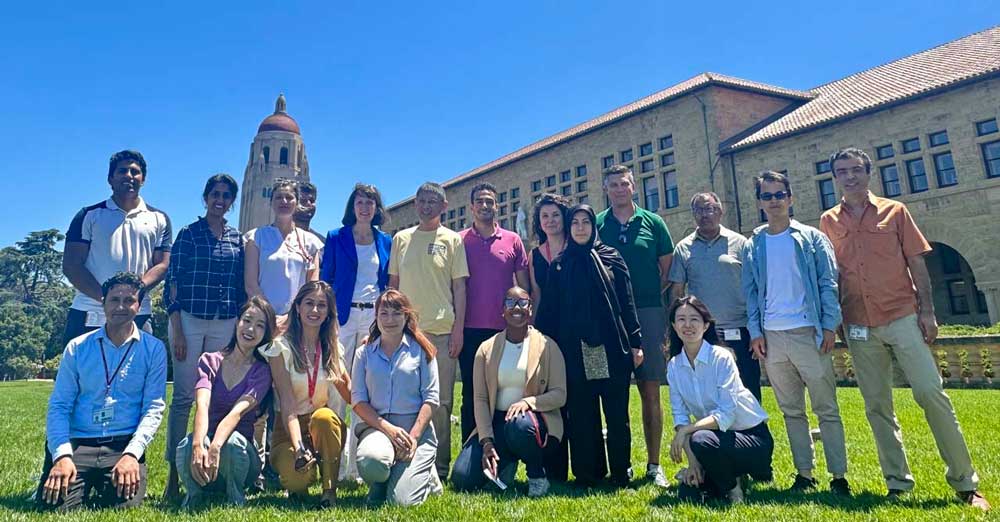
“I always wanted to become a pediatrician, and now I am a pediatric radiologist,” Daldrup-Link said.
During the novel coronavirus (COVID-19) pandemic, Daldrup-Link picked up her writing again, supported by the Pegasus writers. She’d always felt somewhat set apart from her colleagues, and began leveraging those impulses in the character dynamics of her writing.
“Every day as a physician and scientist, I’m entrusted with stories of patients and colleagues who work with them,” Daldrup-Link said. “I hear tales of struggle, resilience, and the unexpected twists of life, medicine and sciences.”
“The triumphs and struggles of brilliant women in science deserve a wider audience,” she said. “Their stories extend far beyond the hospital walls, offering relatable experiences, shining a light on inequalities, and sometimes presenting the wonderfully unexpected.”

Daldrup-Link was insistent that her works would be centered on strong female protagonists – “no damsels in distress,” she said – capable of unravelling mysteries, and whose experiences can be woven into the process.
“I try to show the breadth of different personalities who are out there,” Daldrup-Link said. “It’s fiction; I have a certain experience, and then I play with the idea. There was some experience that I had in the real world, and then something totally different came out.”
A fan of mystery novels, Daldrup-Link also leaned on her knowledge of scientific academia to inspire plot scenarios, like her upcoming novel, which centers on high-end technology and a villain who could create designer babies with it. Her stories are set in a fictional, elite, Silicon Valley university; “this community of very accomplished, perfect individuals.”
“As you engage in the community, there’s all these interactions going on just as in any other community,” Daldrup-Link said. “In the first novel, there is a radiologist (Pham) who is one of the major protagonists. I got feedback about a physician who is also an undercover CIA agent (Segond), so she became one of the other characters in the novel.”

Reader feedback is important to Daldrup-Link, whether it comes from her colleagues in the writing group, her husband or the broader audience who’ve encountered the stories. She is surprised at which of her characters the readers attach themselves. Junior ER physician Julius became a breakout character because he is constantly wilting under the expectations of his overbearing father, and makes more mistakes than his wealthy privilege can smooth out. Segond’s liaison, FBI agent Angus Weber, is a concession to her husband, Thomas Link, who asked for there to be one conventionally written male character that doesn’t function as a nemesis. Even those who cross Daldrup-Link’s path in an unwelcome way in the real world might find their way into the fictional one.
“I highly appreciate the feedback,” she said. “Now, when I meet a bully I think, ‘Thank you, I just got some new input for my next novel.’ And I try to weave in these little characters who maybe come in as a little surprise.”
Sometimes the stories form deeper connections with her readers. Daldrup-Link recounted signing one of her novels for a student who told her how Segond’s perseverance in the story inspired that student to stand up to critics, and to remain on their medical career track.
“Another student sent me a notecard that read: ‘I’m aware that I cannot control the barriers that enter my life, but, like water, I will never be broken. Medicine is an intellectual journey, and I’m determined to reach my goal of becoming the best doctor my patients will ever encounter,’ ” Daldrup-Link shared.
“My heart swelled,” she said. “In that moment, I knew I wasn’t just writing mysteries; I was igniting a passion for science and medicine, one untold story at a time. Women in science and medicine change the world, as undeniable and bright as the colors in the sky.”