

By Matt Skoufalos
Across the medical imaging industry landscape, healthcare institutions are managing around recruitment and retention concerns that include a shortage of professionals across positions, lengthy times to get them prepared for those roles, and increased volumes of imaging studies that must be performed, read, and maintained in the delivery of high-quality patient care.
According to job market forecasts from the U.S. Bureau of Labor Statistics, opportunities are on the upswing for MRI and rad techs through 2033. At six percent, this growth is outpacing that in other fields, with an expected need to add 16,000 professionals annually, replacing workers who transfer out of those careers, or who retire altogether.
A 2023 survey from the American Society of Radiologic Technologists (ASRT) showed career vacancies at an all-time high in 20 years of documentation, up from 12 percent in 2021 to 18 percent in 2024. The 2024 ASRT Consensus Committee Meeting Outcomes attributed those circumstances to burnout, emotional exhaustion, and fewer students entering the profession against increasing numbers of them leaving it for new opportunities or retirement.
“This shortage is not limited to medical imaging technologists and radiation therapists but impacts medical physicists and others throughout the landscape,” the report reads. “Combined, these factors have led to unprecedented numbers of job openings, overburdening the remaining staff and potentially affecting the quality of patient care.”
Julia Sheehy-Chan, vice president and head of education and workforce solutions at Siemens Healthineers North America, said that original equipment manufacturers (OEMs) in the imaging space place an increasing priority on supporting professional education “as a mission-critical objective for the safe and effective use of our equipment.”
“Over time, our equipment has advanced by leaps and bounds,” Sheehy-Chan said. “What’s unique about our sector of imaging is how tightly intertwined the technology is with these highly advanced patient care programs.”
“Education is more important than ever because it’s the only way you’re going to get a specific clinical program off the ground – for example, advanced breast or cardiac imaging, which are critical areas for diagnosis and treatment as our population ages,” she said.
Given the challenge of reading advanced imaging studies, OEMs are looking for ways to accelerate technologists’ professional development to unlock the commensurate benefits of the high-end imaging devices they vend. The analogy Sheehy-Chan offered was ensuring “they’re not using an elite race car just to drive to the grocery store.”
Across the United States and Canada, radiologic technologists are trained through programs at some 1,200 community colleges, universities, and private schools. An ASRT survey published in December 2024 reported that 19,815 students enrolled in ASRT programs in 2023, up from 17,679 the year earlier. According to that same survey, 66 percent of those enrolled in imaging education programs said those programs were full, leading to an estimated 37,929 qualified students being turned away from opportunities in imaging education.
Sheehy-Chan said she’s heard from community colleges that are struggling with clinical placements for technologists-in-training to complete their required clinical hours.
“When we talked to ASRT and ARRT (the American Registry of Radiologic Technologists) about that, they’re thinking about how they can optimize curricula for both technologists and newer roles in the field, such as imaging assistants,” she said.
Solutions contemplated include asynchronous learning, which involves off-hours education scheduling, self-guided coursework, and expanded on-the-job training after hiring. Alternatives to onsite clinical hours could involve virtual experiences like virtual-reality (VR) simulations or other training software.
Even after professionals are certified, however, healthcare institutions find that they still shoulder an educational and training burden in ramping up recent graduates to professional performance.
“A lot of institutions have some sort of get-your-technologist-up-and-running program, but I [am eager to see] which institution will be able to package that and shore it up across the nation,” Sheehy-Chan said. “We’ve heard from people who are taking new grads that it takes them nine months to learn things like radiation safety, site-specific protocols, and sending images to PACS. If they can cut that down to six months, it will result in significant savings.”
Siemens Healthineers is also looking to expand distributed technologies for learning, like its cloud-based SmartSimulator, which replicates the user interfaces of its medical devices virtually. The company already uses SmartSimulator for in-house training of customers and staff, with further potential to expand into other areas of clinical education, Sheehy-Chan said.
“I think the potential for virtual reality training is quite significant,” she said. “We are piloting a VR way to educate our service engineers at present that allows them to record an actual service event with VR goggles on. Customers are interested in using VR for their own training purposes.”
“Expanding those technologies is one way we can solve some of these problems,” Sheehy-Chan said. “A brick-and-mortar training center used to be the be-all-end-all, but now people are so much more comfortable with virtual environments than they were before COVID. They don’t want to take their people out of a clinical setting to travel somewhere.”
Moreover, she said, remote scanning also can provide a great training environment for new grads.
“If you get the privilege of starting as a new grad in a remote scanning environment, it’s peaceful, it’s quiet, and you can have all the benefits of working with a trained technologist without the disruptions that accompany being in-person,” Sheehy-Chan said.
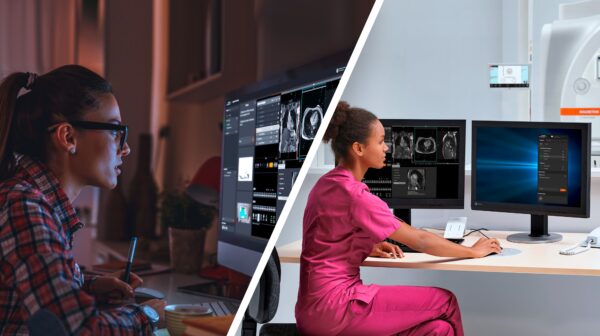
Given the outgrowth in remote imaging technologies and practices, Siemens Healthineers WeScan remote scanning technology is opening new potential career pathways for students seeking roles as onsite tech aides, who are trained to position patients for exams and care for their needs during remote scans. As compared with the training a technologist requires, such as an associate’s or bachelor’s degree, a tech aide credential is more approachable, Sheehy-Chan said.
“We’ve seen so much acquisition (of remote scanning) in the healthcare space,” she said. “You have these giant networks with centers in all environments, and now they’re working on keeping that quality consistent where the patient is being treated.”
Such roles also emphasize the human-centered aspects of patient care, the evolution of which Sheehy-Chan said Siemens Healthineers is tracking over time, as imaging technologies “do more than ever” through remote scanning, artificial intelligence (AI), and other advancements.
Siemens Healthineers is also working with customers to further career development as a retention strategy. This might involve device-specific technology training, modality-specific cross-training, or programs that further advance leadership preparedness and interpersonal “soft” skills. The ultimate goal of such strategies is to retain professional talent in a market that is experiencing “a high amount of volatility,” Sheehy-Chan said, which “can make some of our customers nervous about investing in people and their ability to retain them.”
Radiologist Michele Edison, who directs the diagnostic radiology residency program at AdventHealth Orlando, and who works in the women’s imaging section of the central Florida division of its radiology medical group, said that imaging departments “definitely have vacancies.”
“We have a very successful match program at AdventHealth Orlando,” Edison said. “We’re very fortunate to have a very successful group of radiology residents.”
However, Edison also said the program has an eye toward expansion amid an anticipated national physician shortage in the next 10 to 20 years. Physician training is lengthy, especially that of a radiologist: four years of college, four years of medical school, and then another five or six of residency and fellowship.
“Almost all of our residents have gone into fellowship after residency,” Edison said. “Only one didn’t do a fellowship since the inception of the residency. That’s 14 years, and if you delay your course a little, it can be even more time than that.”
“We need to start thinking about these sorts of things now as a society,” she said.
In addition to the length of schooling required to begin a career as a radiologist, Edison said the field has withstood cultural shifts that may make it less appealing to a younger generation of professionals. Whereas a prior generation of physicians enjoyed a degree of deference based upon the length of their schooling and the effort their depth of experience conferred, there are patients today who may think “Dr. Google is sometimes more correct,” she said.
“Physicians back in the old days were highly respected, and they had a lot of clout,” Edison said. “It’s a different world. I think imaging is maybe less attractive to certain people, and I think that’s a shame because it is a really great profession.”
Incentivizing younger Americans to pursue careers in medicine, and specifically in radiology, is critical, Edison said, because the healthcare space is only becoming more imaging-reliant. Internists surveyed about the most significant changes to their practices in recent years cite the advancement of CT and MRI modalities as among the most critical improvements in patient care “by a pretty significant amount,” she said. That attitude reflects an increasing demand for imaging services among an aging Baby Boomer population that will only need more complex care in the future.
“Every practice in the country can’t hire fast enough,” Edison said. “We’ve had increasing patient imaging volumes without an increase in the workforce. I think the time crunch is real. It’s demanding on the body, on the mind. To provide quality patient care to a patient who feels taken care of, listened to, and happy with their service becomes increasingly challenging if you’re stretched thin.”
In addition to the demand for a greater volume of imaging services, Edison cited the increasing challenges among referring physicians “to feasibly have a grasp on ordering” those studies without comprehensive education about what they’re requesting. “For an internist or a family medicine doctor, it has to be daunting to think about placing orders,” she said.
Training for a radiologist involves putting in study outside of work hours, Edison said. In addition to absorbing “book knowledge,” training in pattern recognition requires a time investment that is difficult to reduce and glean the same standard of proficiency. Viewing heavy volumes of cases helps residents to learn how to identify abnormalities, which makes the notion of abbreviating their academic investment challenging to overcome.
She pointed to conversations led by the Association of Academic Radiology in studying a “Competency Based Medical Education” model employed by the Royal College of Physicians and Surgeons of Canada that is intended to replace time-based training. The idea involves progressing residents through training based on achievement of certain milestones rather than just the time of training. This potentially could reduce or extend the number of years they must spend training in total.
“That is potentially a future way in which we could reduce the amount of time that’s needed to become a radiologist,” Edison said; “however, as someone who graduated with a normal amount of time for residency, it does give me pause. The time is necessary. For some people who are maybe a little slower to learn, it may extend the residency to ensure that they’re adequately trained. If we do this, how will that in the end fare for our patients?”
Career surveys also identify radiologists as “some of the most financially-driven physicians out there,” Edison said, with their salaries and benefits among top considerations in their recruitment and retention.
However, younger physicians increasingly value the time they spend away from the workplace, and seem to be willing to forego some of those earnings to travel, spend time with family, or pursue personal interests. They also are more interested in teleradiology positions rather than physical workplace assignments.
“That’s another way that we are losing some great people for people who need flexibility in their lives,” Edison said. “The full-time, 8-to-5 workday isn’t conducive to a mother with children. Every radiologist, pretty much, in the newer generation, desires at least some hybrid form of teleradiology and onsite. I think that’s a change that is imminent.”
Retention is also challenged by an intense job market that offers varied, high-paying professional opportunities at locations across the country, some of which boast lifestyle advantages over others.
“Clinical demands are ever increasing everywhere, which burdens radiologists,” Edison said. “If you lose a high volume reader from your practice, it further burdens the other radiologists who stand with your practice. You can see how this could eventually spiral out of control.”
“Retention is definitely a major topic for every radiology practice in the country,” she said. “Having a radiologist onsite is critical.”
Edison does believe that increasing the scale and scope of residency programs can help create greater recruitment pools from which healthcare institutions can identify their next crop of imaging professionals. To do that means supporting residency coordinators and teaching faculty who operate what she described as “a labor of love” and “not financially incentivized.”
“It is something you feel passion for and a calling to,” Edison said; “it is not for any secondary gain.”
Beth Allen, director of clinical operations at Banner Imaging, said that, among the ever-evolving demands of imaging department staffing, leadership continually seeks a balance between improving productivity without sacrificing quality or safety. In making those determinations, directors consider details like exam cycle times, patient volumes, hours of operation, PTO coverage, and identifying which tasks can be performed by staff other than technologists.
“It is important to right-size our staffing levels by not having too many ‘extra’ team members, but also not so short that we have to implement patient cancellations due to call-outs, PTO (paid time off), FMLA (Family and Medical Leave Act) or any other unexpected challenges to our staffing strategy,” Allen said.
In concert with its system-wide health careers department, Allen said that Banner Imaging offers college internships in several imaging modalities, and coordinated with curriculum directors to make sure that newly graduated technologists will have success in their first job placements. In turn, Banner develops stronger relationships with technologists in training that may later help address its staffing needs.
“We are very proud of the culture that we have established, not only for Banner Imaging, but throughout the Banner system as a whole,” Allen said. “It is on display to students, new employees and veterans of our staff. It is often a selling feature that helps potential employees choose a post-graduate position with us.”
“Any time someone chooses to go to school, it has to be balanced with the time required to work,” she said. “It is often a difficult commitment to make.”
“The great thing about imaging training is that there is not only the comprehensive educational materials and lectures, but there is also the more vocational, hands-on element to incorporate what has been learned in the classroom to real life,” Allen said. “This is where the ‘art’ of healthcare experience is earned.”
Banner Health employees of six months or longer are eligible for academic benefits like priority on school waitlists, tuition reimbursement, and scholarships. There are sign-on bonuses for certain positions that are difficult to fill, but Allen said that staffing retention is of equal concern.
“Often a great tech will leave for more money per hour, and I get that,” she said. “Sometimes there is a reason it takes more dollars per hour to attract employees. I would like to think we make our offers with more precision than that, and stay in line with what would be expected per hour.”
“We also want to offer a work/life balance to make sure that we minimize burnout and offer schedules that work for individual situations,” Allen said. “This also can be a challenge to find the right fit.”
As more aspects of technologist education have shifted to virtual instruction, Allen said some of the educational partners with which Banner works have reported challenges in keeping the attention of students who grew up in such an environment. Hybrid models of education, which blend virtual and in-person instruction should continue to evolve, Allen said, to prepare students to enter the workforce and be able to contribute immediately upon graduation.
“The programs that we are affiliated with do have imaging simulation labs that allow offsite training so those students have tactile training before starting their internships with us,” Allen said. “In order to set our new grads up for success, we have them in training with a preceptor until we are all comfortable with them to be on their own. We also have modality-specific Teams chat pages to assist with questions.”
“We realize when we hire these students, we have more work to do with them their first year in order to make them successful,” she said. “Imaging is a career full of learning, so no one should expect to know everything just because they earned that degree. We embrace an open culture that encourages questions, feedback regarding successes or opportunities, and communication.”