

By Matt Skoufalos
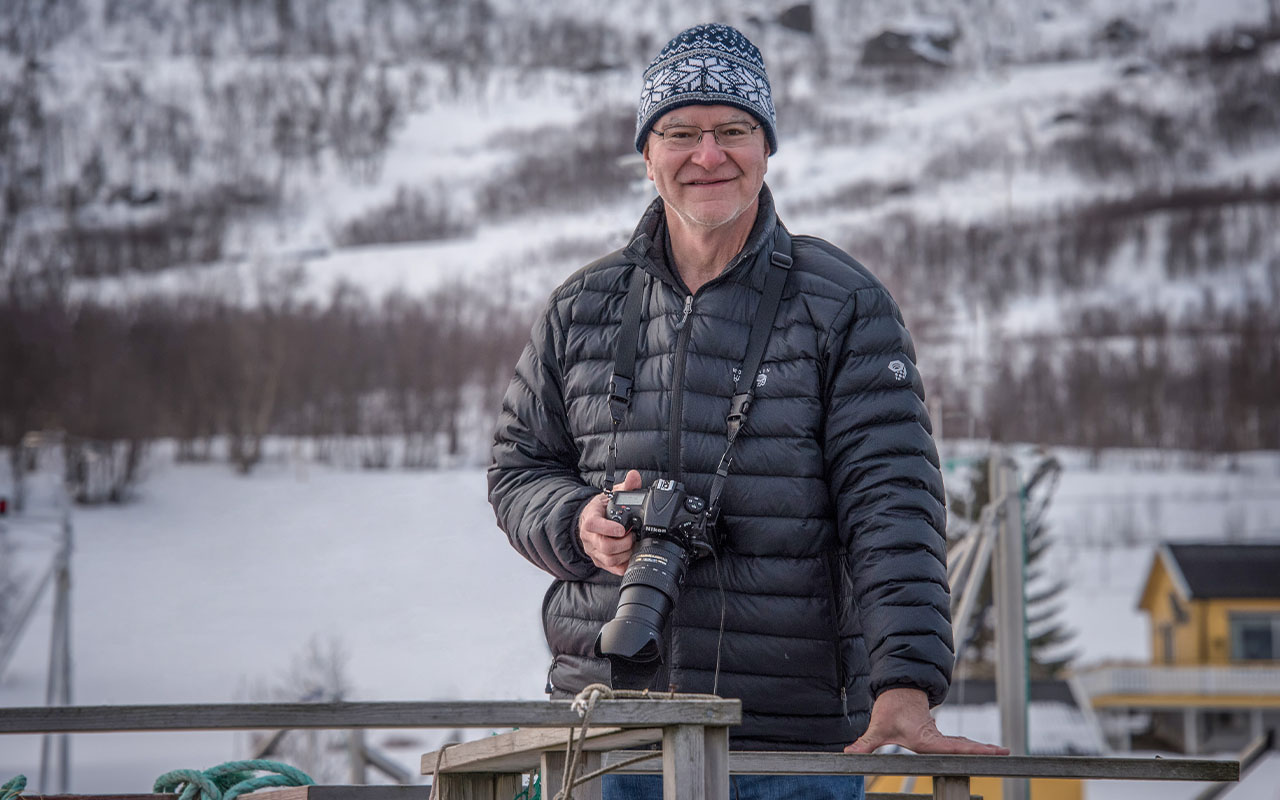
When he’s not reviewing medical images for his role as the medical director for MRI and radiology at Nebraska Orthopedic Hospital in Omaha, radiologist Derek Burdeny is out studying images in the field – quite literally.
Burdeny has spent most of his life in the North American Midwest. Born in Winnipeg, Manitoba, Canada, he graduated medical school at the University of Manitoba before moving to Sioux Falls, South Dakota to work in private practice as a radiologist. He met his wife there, and after completing an imaging fellowship at the University of North Carolina, relocated to Omaha, Nebraska, where the couple have remained for nearly 30 years.
“I grew up in the middle of Canada, where it’s brutally cold,” Burdeny said. “When I moved to Sioux Falls, I figured why not? It was straight south for me, and it had to be better. Sure enough, the winters were actually much warmer than I was used to in Canada.”
“Moving to Omaha was warmer still,” he said, “and it can get really hot in the summertime; pretty miserable in July and August. You’ve got extreme heat and cold.”
Nebraska also gets tornado warnings, which were novel to Burdeny. Being raised in the prairies exposed him to storms and extreme weather, but never tornados. Natural phenomena fascinate him, from the change of the seasons to the habits of wildlife, but tornados first grabbed his attention as a younger man, visiting a farmer in southwest Manitoba.
“I remember in his kitchen, he had a picture of a tornado coming towards his house,” Burdeny said. “I said, ‘Where’d you get that picture? He said, ‘That’s my house.’”
“When I first moved to Sioux Falls, South Dakota, I heard the sirens going off in the city, and I had no idea what that meant,” he said. “I realized later on that it was a tornado warning, and I’d slept right through it.”
The next best thing to experiencing extreme weather from a safe distance is capturing it on film. For Burdeny, photography is a hobby he traces directly to his days after medical school, when a friend with a good camera inspired him to pursue the subject. Burdeny has never received any formal photography training, but has built skill on his own through the years by reading and practice.
Much as his professional career in medical imaging evolved from the study of film into manipulating images with software, Burdeny’s expertise grew expansively in the age of the digital camera.
“In the old days, a tech would give you a film, and whatever they exposed, what you see is what you get,” he said, “whereas, when things went digital, I could take pictures on the edge of a film that was not the best exposure, window and level them, and see all the things there.”
“If you use PhotoShop or shoot in RAW, [the unprocessed data communicated directly from a camera lens], it captures all the information on that picture without any loss of compression,” Burdeny said, “so it’s like the same thing every day when I’m reading MRIs.”
Advanced digital cameras on cellular phones have nearly made point-and-shoot cameras obsolete altogether, with the exception of photographers whose specialty is film work, Burdeny said. Any novice today will start with the advanced functionality on their phone camera, and then maybe push into a semi-professional camera as their interest – and budget – grows.
“The entry-level cameras don’t exist anymore,” he said. “You can even adjust your pictures in RAW on your iPhone.”
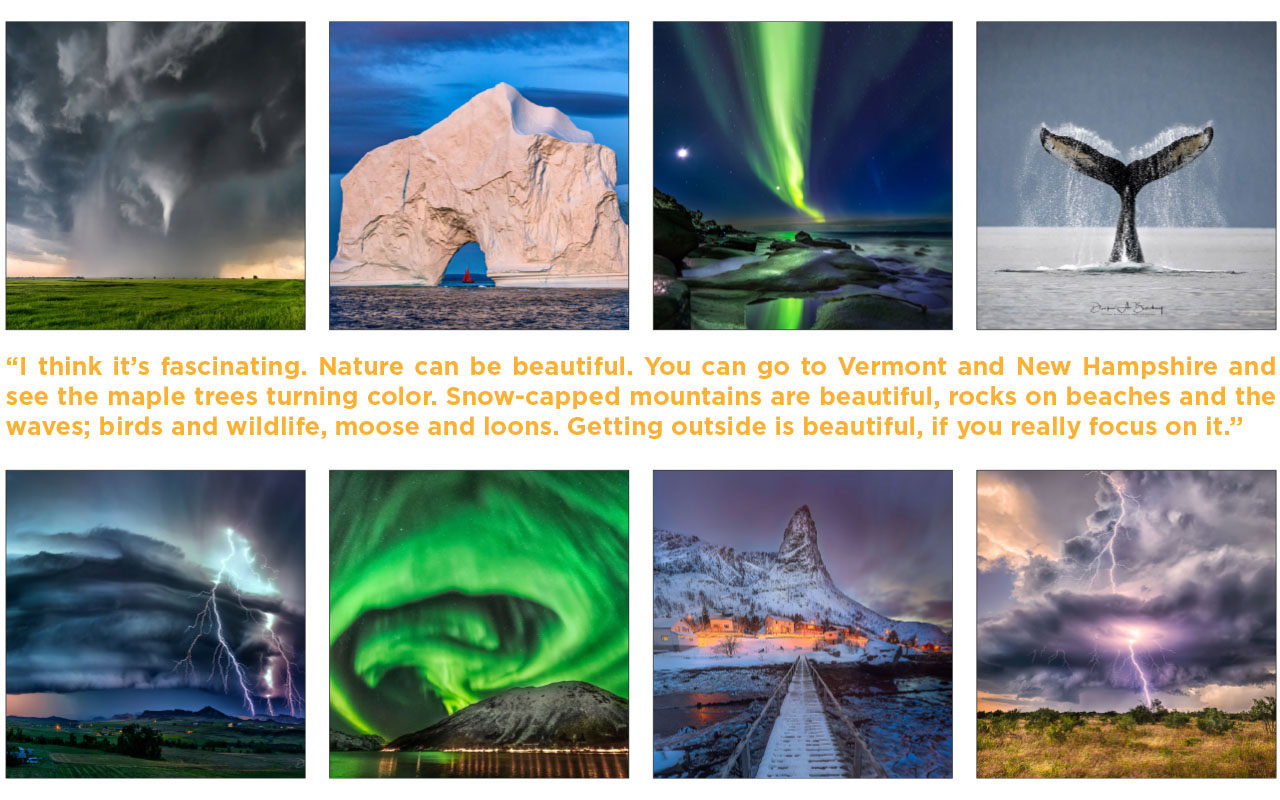
All Burdeny’s favorite subjects are found in the natural world. Photography and travel go hand-in-hand, and Burdeny has already amassed a gallery replete with studies of landscapes, wildlife, and weather phenomena, from eclipses and auroras to supercell storms and tornados.
“I think it’s fascinating,” he said. “Nature can be beautiful. You can go to Vermont and New Hampshire and see the maple trees turning color. Snow-capped mountains are beautiful, rocks on beaches and the waves; birds and wildlife, moose and loons. Getting outside is beautiful, if you really focus on it.”
“I’ve been to Arizona in the desert trying to shoot lighting,” Burdeny said. “I’ve been through the slot canyons in Utah. I’ve been to Africa eight times and always taken cameras with me. I’ve got some great iceberg pictures from Greenland. I’m heading to Newfoundland this summer, and going to Antarctica in November.”
In North America, it’s nothing for Burdeny to put in 25,000 miles in a month and a half of driving to chase a storm. The farther off he’s traveling – say, from Omaha to southwest Texas – the more he’ll want to follow a system that will remain in an area for a few days, as disappointment is part of the process.
“When you go out, you don’t know if it’s going to be a successful day or not,” Burdeny said. “If it is, it’s a bonus. You’ll go someplace and figure it’s going to be a great day, and it doesn’t turn out, or you see the storm, and someone else gets the tornado.”
Storm chasing is also difficult to do alone. Burdeny brings a friend, Rick, who drives while he previews road networks, Internet maps, and satellite programs to see how the storm is shaping up. Catching up with a storm enough to photograph it inevitably requires finding a way to avoid its path as well as an awareness of how to flee in any scenario. His advice: keep your distance if the local road network is unreliable or hard to identify.
“Tornados usually move from west to east, so if you’re approaching from the east, that means you’ve got a chance that the storm’s coming at you,” Burdeny said. “You’ve got to make sure that you’ve got a safety escape route. You don’t want to cross a tornado’s path. If you’ve got a tornado coming towards you and a road ends, or you’ve got a bridge to cross, you can be in trouble. Going down gravel roads can be a little dangerous unless you’ve been on them.”
Of course, the drive out in pursuit of a storm invites observation of its own sort of beauty. Burdeny enjoys experiencing new and unfamiliar countryside, like the Oklahoma farm hills that move like waves in a green ocean when the wind hits, or the creek bed that cuts through them in orange slices.
“If we get a big, good picture, you feel good; it’s a success, especially if it’s a severe storm in the middle of nowhere,” Burdeny said. “It’s nice to see these things, but then you’ve got to realize that what’s happening is someone else’s worst nightmare, destroying their buildings and hurting people.”
“I don’t like going out to Eastern Texas, Oklahoma, Arkansas, Louisiana, Kentucky,” he said; “there’s a lot of trees, people, more chance of damage, and people getting hurt. I just want to see these things when they’re beautiful and not any chance of hurting anybody.”
To see more of Derek’s work, visit derekburdenyphotography.com.