For much of his youth, Ramin Abrahim was an only child, and his father encouraged him to occupy those hours making art. From making charcoal drawings in a sketchbook, the boy was given a miniature camera at age 10, which sparked an interest in photography.
Abrahim was also a gifted student, skipping a grade in middle school, finishing high school at 17, and completing his undergraduate education at the University of California-Irvine by age 20. At 25, he became the second-youngest in his 150-student graduating class at the Tufts University School of Medicine, and by 32, Abrahim was completing his radiology residency at New York Medical College, a married father to twin boys.
Throughout that intensive academic career, his pursuit of painting and photography was burgeoning silently in the background.
“While I was in Southern California, my dad bought me a Pentax SLR manual film camera; I played around with that without any training,” Abrahim said. “In my first year of medical school, I met my future wife. She gifted to me a box of oil paint and a bunch of canvases she had used for some class. I was living in a little apartment then, playing with some oil paint, and it just fired up a bunch of emotions and I was really enjoying paint in general.”
As Abrahim switched from oil to acrylics, he also expanded his approach to the canvas from realism to abstract interpretation, exploring techniques and styles “at a very low volume, as time allowed,” he said.
“During my internship in Sacramento, I was painting, but I was working 36-hour shifts every other day; I barely had time to sleep,” he said. “The photography took a back seat, although by 2000-01, when the tiny digital cameras came around, I started picking it up. It was more like snapshots, and I kept on with that for maybe a decade-plus, but the painting kept going.”
By the end of 1998, Abrahim had landed work with a private practice, Washington Radiology, in Washington, D.C., with which he would spend the bulk of his career. In his basement home office, an easel was set up next to the PC, and as Abrahim’s personal interest in computing flourished, he realized it could be even more useful in the workplace.
By the early 2000s, he had become the physician head of PACS for Washington Radiology, and a leading-edge expert in imaging informatics. All that work intensified the demands of his career by the day, and art remained his personal refuge.
“Art for me was the grounding part of life,” Abrahim said. “If I was doing painting or photography, it was a space where mistakes didn’t matter. Nobody was going to sue me. I could be me, and be relaxed, and do what I wanted to, and not be worried.”
“It became my sanctuary and remains my sanctuary throughout my career.”
The family was struck by tragedy in 2008, when Abrahim’s wife died, unexpectedly, at 43. In his grief, he was plunged into a search for meaning. Abrahim moved from the Washington, D.C. suburbs into the Georgetown neighborhood, his sons went off to college, and he began painting again.
Abrahim describes this period of his life as “like a renaissance of sorts.”
“I felt a lot of light coming through,” he said. “[My painting] became more emotion-based, and it just changed how I practiced. It really impacted how I valued time. I became very focused on capitalizing on my time in the best way possible, whether it’s in relationships, family, friends, travel, or art. I felt compelled to pay more attention to it.”
As his work expanded to contain these new insights, Abrahim took his first commission from an art collector. By 2015, he had launched a website for his artwork. His work was featured in exhibitions, and he began selling paintings from California to London. Moreover, Abrahim also began to find greater personal and emotional expression through his art.
“Up to 2014, I was painting for myself; I didn’t have any understanding of where it fit,” he said. “I never aspired to be in the business side of things, so whatever happened was coincidental.”
“I did a lot of paintings that are emotion-based,” Abrahim said. “Some of them are around enlightenment; some of them are around your feelings. Some of them are around practicing ideas of control and being outside of my comfort zone.”
One of these works, “Ascension,” Abrahim describes as his “turning point painting.” At its center is a burning orb, casting flames upwards against a background of narrow, dark spires. He sees it as the depiction of “the first spark to arise from the darkness” on a path to enlightenment.
“Pain,” which shows a smoky kanji character set against a crackling red and beige backdrop, was inspired by a back injury sustained during a ski trip. Abrahim said it seeks to understand the power of physical discomfort as a pivotal motivational force.
“You come to a fork where you decide, ‘Am I going to change my circumstances or stay in pain?’” he said.
Like his painting, Abrahim’s photography shows a similar patience in its composition, and interest in a variety of subjects, from architecture to the natural world.

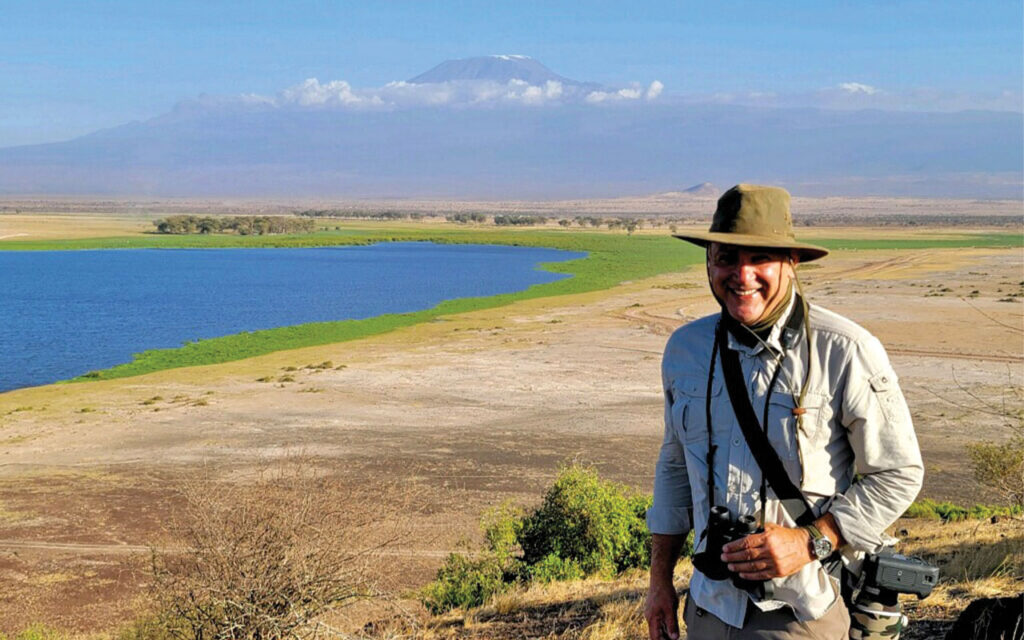
“I started with landscape [photography] because my father was a mountaineer,” he said. “Since I was traveling, I started mixing in travel photos. Wildlife is what I got into during the [novel coronavirus] pandemic because our practice was shut down to 5-percent capacity.”
After shooting monuments, flowers, and reflections of sites around Washington, D.C., Abrahim began seeking “opportunistic shots” in places as far-flung as Havana, Cuba; Pantanal, Brazil; London, England; and Banff, Alberta.
He credits an innately strong visual cortex with establishing his appreciation for the beauty of the natural world, and the ability to recognize and recreate patterns of artistry, felt or observed, within it.
“Sometimes I pause as I’m reading an MRI, and I zoom in and look at it, and it looks kind of abstract,” Abrahim said. “I have something of a photographic memory, so visual art, imaging, radiology, and photography, it’s all connected.”
Moreover, Abrahim said, it’s the interconnectedness of visual metaphor and the underlying discipline of creating and appreciating art that has offered him the catharsis to endure through both personal tragedy and the weight of high-level medical practice.
“I think it’s very important for one to put enough priority for things outside of work to make life even more enjoyable and balanced,” he said. “Joy and balancing different degrees of intensity helps for longevity of careers.”
“There’s a lot of pressure at work, and it’s good nutrition for the soul to have something that grounds you.”