
 By Matt Skoufalos
At Industrial Inspection and Consulting (IIC) of Norton Shores, Michigan, general manager Keith Irwin and a team of imaging professionals use industrial radiography to provide an array of services, mostly for clients in production and manufacturing businesses.
Imaging studies at IIC are conducted with cabinet-and-vault-style Nikon industrial X-ray and CT scanners that can resolve an image down to three microns. The technology is used to examine inconsistencies in structural castings and component-level, manufactured elements, as well as to certify that products are constructed within established tolerances. The IIC laboratory is ISO17025-accredited, and its personnel are certified by the American Society for Non-Destructive Testing and National Aerospace Standards for certification and inspection.
“We love and are good at what we do,” Irwin said. “We have a lot of companies that depend upon our services.”
For all the work IIC is contracted to perform – like studies on structural castings for brake pads, or imaging leaky condiment bottles to shore them up before mass production – the company has also evolved a bespoke service for the collectibles industry. IIC can perform imaging studies to help verify the authenticity of high-ticket items before they’re sold at auction, or to certify that a purchase that’s already been made is legitimate. It’s believed to be the first laboratory of its type to offer the service.
“There had been chatter online for almost 20 years, when we tried to look back in time on the Internet, about whether it’s possible to X-ray or even CT scan collectibles,” Irwin said. “The general consensus was, ‘no.’ There’s even evidence of other labs that were trying.”
“As a contract inspection lab, our specialty is being able to say ‘yes’ to pretty much any inquiry that we get,” he said. “We deal with a lot of the very difficult tasks that people don’t think are possible.”
For a company that prides itself on establishing linear defects in contact lens cases, or measure the thickness of polymer coating on manufactured materials within 10 microns or less, IIC took up the challenge to demonstrate just how fine of a detailed distinction its equipment could deliver.
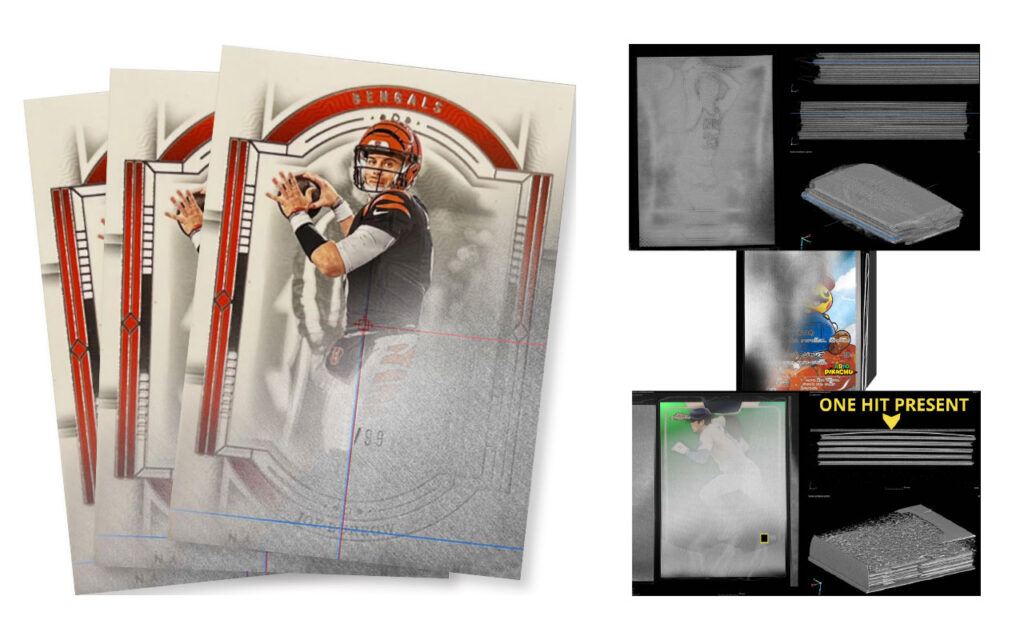
“That’s how the idea of a Pokémon card came up,” Irwin said. “It’s just a layer of ink on a cardstock. We tested it, and it worked very well. We put it online as a case study, and it went viral. That virality led to hundreds of thousands of hits to our website, with many requests.”
IIC staff spent “several weeks not sleeping” to determine how to image trading cards as a service, Irwin said. It was a novel application for their imaging equipment, and the team was eager to meet the challenge.
“It took us a while to perfect the technique and a while to monetize it,” he said. “It was a lot of experimentation. Anybody who goes and buys this equipment and the software can figure it out; we were just the first to try, and we tried hard.”
Beyond sweat equity, any laboratory studying the collectible market must not only be able to capture usable data with its imaging equipment, but also to read the subtle differences in that data, “looking inside those gray values and figuring out what it is,” Irwin said.
“Every card is a little different, even if it is the same product line,” he said. “After a lot of practice and experience and time reviewing that we can do it, [we realized] ‘Wow, this works.’
“I remember the first time we found a high-value card, a six-figure card, and it was like a bomb dropping in here,” Irwin said. “It was a lot of excitement.”
Irwin said his staff are completely disconnected from the collectability of the materials they study, and in the time since the service took off, all of them have made formal attestations to not collect or resell the products with which they are tasked to image.
“We’re an unbiased, accredited laboratory,” Irwin said. “To us, the work is all the same; scanning aerospace castings or providing authentications for auction houses.”
“We didn’t know anything about cards; we know there’s a lot of value there,” he said. “We are not going out and buying a bunch of collectibles, scanning them, and using our equipment for that purpose, because there could be a perceived bias or interest.”
“There was a lot of concern and criticism about that tampering with high-value products, but there are also many things people can do to secure their items: they can weigh their packs or photograph the seals, which act as unique product fingerprints,” Irwin said.
IIC has reviewed “the full variety” of collectibles, from packs, boxes, and cases of cards, to cases of vintage toys, Irwin said. Sometimes X-rays can be used simply to verify that the original product is in the box, and that it hasn’t been resealed with its contents removed.
Famously, Internet celebrity Logan Paul was an alleged victim of such a scam. After having spent $3.5 million on what he’d believed was an authenticated, sealed case of Pokémon cards, he opened them to discover GI Joe trading cards instead.
“We’ve found a lot of fake and fraudulent boxes, and helped people in their disputes,” Irwin said. “There are several metrics that we can grade against. Is the right number of packs in there? The right number of cards in packs? Inconsistencies? Are the seals appropriate?”
“We provide a report to that customer or auction house,” he continued. “We place a coded sticker on that, a matching sticker on the product, and then it’s traceable. Some of these boxes that we get are worth $50,000 to $100,000. All of that is shown on our online registry.”
Another time, an IIC client purchased three, antique Gameboy cartridges at auction, and, when the company imaged them, found the contents had been replaced with other materials that would simulate the weight of the cartridges.
“There is a value-added approach for people who have their collectibles but don’t want to devalue them,” Irwin said. “A lot of our customers are people who have a random collectible sitting on their shelf that’s old, and they don’t want to open it, because then it’s worth nothing, but the contents themselves could be life-changing. If you pull a Charizard out of a 1999 Pokémon pack, that card could be worth $400,000.”
IIC product scans are priced upon the hourly work rate at the business, and not upon the perceived value of the collectible. The service charges $75 to scan a pack, whether it would sell for $20,000 or $500, and bulk rates are available. Boxes of cards are more time-consuming because they must be exposed to hours of radiation to get a reading, Irwin said, but they’re not going to be damaged in the process.
“There are times when we’re trying to expose [an item for] as long as possible to get very good averaged data,” he said. “We have correction measures and reconstruction parameters that we apply, but we are trying to get the best raw data as possible.”
Although IIC has received a great deal of press attention for its involvement in the collectibles market, its core line of business remains in the industrial and manufacturing sectors. Irwin hopes to add larger, higher-exposure equipment to the lab, the better to test items at the forefront of technological change. If a few more trading card studies help the business get there, they’ll take the work.